





Listen to the Audio Version
Why Styrax Resinoid Physical Handling Properties Matter
Styrax resinoid is one of the most characterful and useful base materials available to the natural perfumer, the cosmetic formulator, and the artisan blender. Its warm, balsamic, sweet-smoky character, combined with its excellent fixative properties and long wear on skin, makes it a sought-after ingredient across fine fragrance, personal care, and aromatherapy applications. Yet it is also, without question, one of the most physically challenging materials to work with in the studio or on the manufacturing floor.
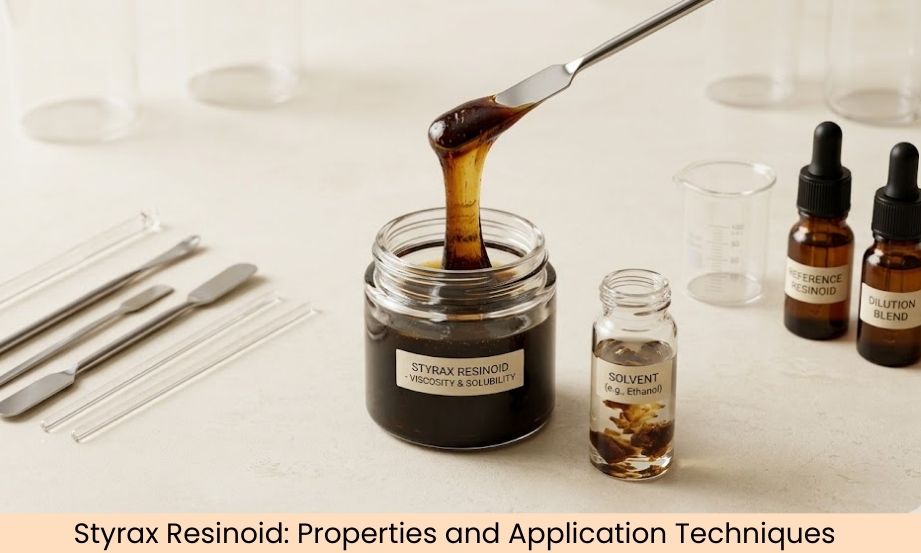
The problems begin at the container. Styrax resinoid arrives as a thick, dark, often barely pourable semi-solid that clings tenaciously to every surface it contacts. Pouring it accurately, measuring it precisely, dissolving it in carrier solvents, and incorporating it evenly into formulations all require knowledge and technique that are rarely explained in product listings, supplier descriptions, or fragrance ingredient references. The result is that first-time users frequently lose significant amounts of material through spillage and inadequate transfer, produce blends with undissolved or unevenly distributed resinoid, and sometimes conclude that the material is unusable when in fact it simply requires a different approach.
This guide fills that gap. It covers the physical and chemical properties of styrax resinoid that determine its handling behaviour, provides practical techniques for warming, pouring, measuring, dissolving, and incorporating the material, addresses compatibility with common carrier systems, and gives formulators the knowledge to work with styrax resinoid efficiently and without waste. Every piece of guidance reflects the properties of genuine, quality styrax resinoid as supplied by BMV Fragrances.
First-Time User Note
If this is your first time working with styrax resinoid, read Sections 1 through 4 before opening your container. The physical handling challenges are real but entirely manageable with the right preparation. Attempting to work with styrax resinoid at room temperature without preparation is the single most common cause of the frustration that first-time users report.
Physical Properties of Styrax Resinoid
What Styrax Resinoid Actually Is
Styrax resinoid is an aromatic extract produced from the pathological resin of Liquidambar trees, principally Liquidambar orientalis (Levant styrax, from Turkey) and Liquidambar styraciflua (American styrax). The resin, which the tree produces in response to bark wounding, is extracted using organic solvents — typically alcohol or hydrocarbon solvents — to yield a highly concentrated aromatic extract that retains the full character of the raw resin while removing non-aromatic plant material.
The chemical composition of styrax resinoid is complex and varied, but its characteristic thick, sticky physical nature derives primarily from its high content of cinnamic acid esters (particularly cinnamyl cinnamate and cinnamyl alcohol), styrene polymers, and various triterpene and phenylpropanoid compounds. These large, heavy molecules have high boiling points, low vapour pressures, and strong intermolecular attractions — all of which contribute to the resinoid’s resistance to flow and its tenacious adhesion to surfaces.
Appearance and Colour
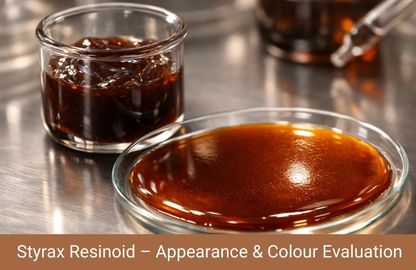
Fresh, quality styrax resinoid from BMV Fragrances presents as a dark brown to reddish-brown semi-solid or very thick liquid at ambient temperature. The colour ranges from deep amber-brown to almost black depending on the extraction batch, solvent system, and concentration. Colour alone is not a quality indicator — darker material is not inferior — but significant colour variation between batches from the same supplier may reflect batch-to-batch variation in raw material or processing conditions.
In thin films — for example, when spread on a blotter or glass plate — styrax resinoid appears as a translucent to semi-opaque warm brown, with a characteristic resinous gloss. This film character is useful for evaluating the material: a clean, even, non-granular film indicates well-processed resinoid free from undissolved particulate or wax crystallisation.
| Property | Typical Value / Description |
|---|---|
| Appearance | Dark brown to reddish-brown semi-solid or thick viscous liquid |
| Colour (visual) | Deep amber-brown to near-black in bulk; translucent warm brown in thin film |
| Consistency at 20°C | Soft semi-solid to very thick paste; minimal to no flow under gravity |
| Consistency at 40°C | Viscous liquid; slow but sustained flow under gravity |
| Consistency at 60°C | Freely pourable viscous liquid; suitable for transfer operations |
| Specific gravity (20°C) | 1.080 – 1.120 g/cm³ (denser than water) |
| Refractive index (20°C) | 1.580 – 1.610 |
| Flash point | Typically >100°C (varies by extraction solvent system) |
| Solubility in ethanol (95%) | Soluble with warming; may show slight turbidity at high concentrations |
| Solubility in IPM/IPP | Partially soluble; requires warming and mixing; may require co-solvent |
| Solubility in water | Insoluble (water-based systems require emulsification) |
| Acid value | Typically 40 – 90 mg KOH/g (reflects cinnamic acid content) |
| Odour character | Warm, balsamic, sweet-smoky, vanilla-like, slightly spicy; tenacious base note |
Viscosity Behaviour: The Core Challenge
Viscosity is the defining handling challenge of styrax resinoid, and understanding it is the key to working with the material efficiently. Styrax resinoid is a non-Newtonian fluid — specifically, it exhibits pseudoplastic (shear-thinning) behaviour, meaning its viscosity decreases under shear stress (stirring, mixing, pumping) and increases when at rest. This is the same behaviour exhibited by honey, certain paints, and other thick natural materials.
The practical consequence is that styrax resinoid that appears to be a solid or near-solid at rest can be made to flow by applying mechanical force (stirring or scraping), particularly when the material has been warmed. Equally, material that has been liquefied by warming will thicken rapidly as it cools, which means transfer and weighing operations must be completed while the material is still warm.
| Temperature | Approximate Behaviour | Practical Implication |
|---|---|---|
| Below 15°C | Firm to hard semi-solid; negligible flow | Do not attempt to pour or measure. Material may fracture under mechanical stress. |
| 15–25°C (ambient) | Thick paste to very viscous liquid; no gravity flow | Spoonable or scrapeable; weighing requires spatula. Not pourable from container. |
| 30–40°C | Viscous liquid; very slow gravity flow; flows under stirring | Begin warm-water bath treatment. Pourable with effort; still clings to surfaces. |
| 45–60°C | Moderately viscous liquid; sustained gravity flow | Optimal working temperature for most handling operations. Transfer and weighing practical. |
| 65–80°C | Freely pourable; significantly reduced viscosity | Efficient for bulk transfer. Do not exceed 80°C to avoid degradation and odour change. |
| Above 100°C | Risk of degradation, polymerisation, flash point approach | Never use direct heat above 80°C. Risk of oxidation, charring, and safety hazard. |
Heat Safety
Never apply direct heat (naked flame, direct contact heating element) to styrax resinoid. Always use an indirect water bath, oven, or controlled heating cabinet. The material’s flash point is typically above 100°C, but thermal degradation can begin at lower temperatures and produces unpleasant off-notes in the resinoid. The target working temperature is 50–60°C, achieved gradually.
Our Other Product
Carthamus OilWarming and Preparing Styrax Resinoid for Use
The Water Bath Method: Standard Approach
The warm water bath is the safest, most reliable, and most widely used method for liquefying styrax resinoid for transfer and weighing. It provides controlled, even heating without risk of local overheating, and allows the formulator to monitor and maintain a consistent working temperature.
Equipment Required
- Large container (pot or bowl) capable of holding several litres of water
- Heat source with temperature control: electric hot plate, water bath heater, or controlled heating plate
- Thermometer (probe or infrared)
- Spatula or stiff metal spoon for scraping and stirring the resinoid
- Tared weighing container pre-warmed to approximately 40°C
- Protective gloves (heat-resistant) and eye protection
Procedure
- Fill the water bath to a level that will surround the lower two-thirds of the styrax resinoid container. Set the water temperature to 55–60°C and allow it to stabilise before placing the resinoid container in the bath.
- Place the sealed or loosely covered styrax resinoid container in the water bath. Ensure no water can enter the container — water contamination will cause cloudiness and may affect stability.
- Allow the resinoid to warm for 15–30 minutes (depending on container size) before attempting to assess its consistency. Do not attempt to force the material during this period.
- Once the resinoid shows visible softening (begins to flow from the sides of the container when tilted), use a pre-warmed metal spatula to gently fold and stir the material to equalise temperature throughout. Surface and centre temperatures can differ significantly in a cold container.
- Allow warming to continue until the resinoid is uniformly fluid throughout — typically 30–45 minutes for a 100 g container, up to 90 minutes for containers of 500 g or larger.
- Transfer to a pre-tared, pre-warmed weighing vessel immediately. Work quickly, as the resinoid will begin to thicken as soon as it is away from the heat source.
 Call Us Now!
Efficiency Tip
Pre-warm your weighing vessel and any tools (spatulas, stirring rods, transfer pipettes) in the same water bath before use. Cold equipment causes the styrax resinoid to solidify on contact, dramatically reducing transfer efficiency and increasing waste. A 30-second pre-warming of your spatula makes a significant practical difference.
Oven Warming Method: For Larger Volumes
For containers larger than approximately 500 g, the water bath method becomes unwieldy. An oven or controlled heating cabinet set to 55–65°C provides an effective alternative for warming larger quantities of styrax resinoid.
- Set oven or heating cabinet to 60°C maximum. Verify temperature with an independent thermometer, as oven thermostats are frequently inaccurate.
- Place the resinoid container (with lid removed or loosely placed) on a clean tray lined with aluminium foil to catch any overflow.
- Allow 45–60 minutes warming time for containers of 500 g–1 kg; 90–120 minutes for larger containers.
- Stir periodically using a pre-warmed spatula to equalise temperature and assess consistency.
- Remove from oven and transfer immediately while the material is fully fluid.
Container Integrity
Check that your container is heat-safe before oven warming. Plastic containers (HDPE, LDPE) are generally not suitable for oven warming above 50°C and may deform, release plasticisers, or fail. Aluminium, glass, and stainless steel containers are appropriate for oven warming. If your resinoid was supplied in plastic, transfer to a suitable container before oven warming.
Warming in Situ: Whole-Container Methods
For formulators who regularly work with styrax resinoid and require it to be consistently workable, a practical approach is to maintain the working container at a slightly elevated temperature using a purpose-built resin heater, drum heater, or heated laboratory cabinet. This eliminates repeated warm-up time and reduces the thermal stress on the material from repeated heating and cooling cycles.
Recommended approach: maintain a working container of styrax resinoid at a steady 40–45°C in a dedicated warming cabinet or low-temperature oven. At this temperature the material is consistently soft and workable (though not freely pourable) without being excessively fluid. Draw quantities for immediate use as needed. The remainder stays warm and accessible without degradation risk at this temperature range.
Workshop Workflow Tip
Many professional perfumers and cosmetic manufacturers who use styrax resinoid regularly keep a dedicated working container in a warming cabinet at 45°C year-round. The material can be safely maintained at this temperature for weeks without significant odour or quality change. This approach eliminates the daily warm-up delay and the frustration of working with a cold, stiff container.
Measuring and Transferring Styrax Resinoid Accurately
Weighing vs. Volume Measurement
Always weigh styrax resinoid by mass, not volume. The material’s high viscosity makes volumetric measurement highly inaccurate: surface tension, adherence to container walls, and the variable flow behaviour of a warmed viscous liquid all introduce significant errors. A dropper, pipette, or graduated measuring cylinder will give unreliable results. A calibrated laboratory balance or a good digital kitchen scale (0.1 g resolution for small quantities; 1 g resolution for larger batches) is the correct tool.
Given styrax resinoid’s specific gravity of approximately 1.09–1.12 g/cm³, volume-to-mass conversions are not straightforward for a material that is rarely uniform in density within a container (denser material may settle; surface layers may be more aerated after stirring). Mass measurement eliminates all of these variables.
Transferring by Spatula
For quantities up to approximately 20–30 g, spatula transfer to a pre-tared weighing container is the most practical method for warmed styrax resinoid. Key technique points:
- Use a stiff-bladed metal spatula with a broad working surface. Flexible or narrow spatulas are inefficient and lead to material loss.
- Pre-warm the spatula in hot water or the warming bath before use. Shake or wipe off water before contact with the resinoid.
- Work in short, deliberate movements. Scoop a quantity onto the spatula, guide it over the weighing container, and allow the material to flow off under gravity assisted by tilting the spatula.
- For the final trim to exact weight, use the spatula to add or remove small amounts while monitoring the balance readout.
- Accept some material remaining on the spatula — attempting to scrape it 100% clean leads to contamination of the work surface. Dissolve the spatula residue in your working solvent between uses.
Transferring by Pour
At temperatures above 55–60°C, styrax resinoid is sufficiently fluid to pour from a container into a weighing vessel. This is the preferred method for quantities above approximately 20 g. Key technique:
- Work with the container at a consistent temperature throughout the pour. Set it back in the water bath between weighing additions if the material begins to thicken mid-transfer.
- Pour slowly, in a thin stream, over a pre-tared warm receiving vessel. Allow the material to flow completely from the lip of the container before withdrawing it.
- Expect some material to trail on the outside of the container lip — catch this with a pre-warmed spatula and add it to the weighed quantity.
- The material will continue to flow for several seconds after pouring stops. Account for this when approaching your target weight by stopping the pour slightly under target and allowing the trail to complete.
Tare and Pour Sequence
Place your receiving vessel on the balance, tare to zero, then bring your warm styrax resinoid container to the balance and pour directly onto the scale. This eliminates a separate transfer step and allows real-time weight monitoring. Pre-warm the receiving vessel first — a cold glass beaker touching the warm resinoid will cause it to solidify on the vessel wall before it reaches the bottom.
Residue Management and Material Recovery
Container residue is a significant practical and economic issue with styrax resinoid. Even after careful warm pouring, a coating of material remains on the container walls, spatula, and any tools used. For formulators working with expensive ingredients in small quantities, this residue represents real cost. Several practical approaches minimise waste:
- Solvent rinse recovery: after use, add a small quantity of your working solvent (typically ethanol or IPM) to the tool or container, cap or cover, and leave for 30–60 minutes at 40°C. The residue dissolves into the solvent, which can then be added directly to your blend if appropriate, or retained for future use.
- Heat recovery: return the container with residue to the water bath; the material will consolidate at the bottom of the container and can be scraped out with a spatula for incorporation into subsequent batches.
- Wipe recovery: for spatulas and rods, wipe while still warm using a clean paper towel or lint-free cloth. The collected material can be re-incorporated into the warm working stock.
- Residue accumulation container: maintain a dedicated 'rinse container' where solvent rinses from multiple tool cleanings accumulate. Over time this builds a usable dilute solution of styrax resinoid in your working solvent that can be incorporated into appropriate batches.
Our Other Products
Ylang YlangSolubility of Styrax Resinoid: Carrier Compatibility
Solubility Overview
Styrax resinoid is a complex mixture of polar and non-polar compounds. Its solubility in common formulation carriers is correspondingly variable — it dissolves readily in some solvents, partially in others, and not at all in water-based systems without emulsification. Understanding solubility behaviour prevents the most common formulation failures, which arise from using styrax resinoid in incompatible carrier systems without appropriate pre-treatment.
| Solvent / Carrier | Solubility | Conditions Required | Practical Notes |
|---|---|---|---|
| Ethanol 95–96% | Good to excellent | Warm both components; stir well | Best general solvent for resinoid incorporation; standard for perfume alcohol bases |
| Ethanol 70–80% | Moderate | Warm; extended mixing | Slightly cloudy at high resinoid concentrations; acceptable for most alcohol-based applications |
| Isopropyl myristate (IPM) | Partial | Warm to 60°C; prolonged mixing; may require co-solvent | Cloudiness possible, especially on cooling; test at intended use rate before formulating |
| Isopropyl palmitate (IPP) | Partial | Warm to 60°C; prolonged mixing | Similar to IPM; better at lower resinoid concentrations |
| Dipropylene glycol (DPG) | Good | Warm to 50°C; stir well | Excellent carrier for perfumery; good clarity at moderate concentrations |
| Benzyl benzoate | Very good | Warm; brief mixing | Classic resin solvent; improves miscibility of resinoid in blends; useful as co-solvent |
| Diethyl phthalate (DEP) | Very good | Warm; brief mixing | Common perfumery solvent; note regulatory status in target markets |
| Fractionated coconut oil (MCFA) | Poor to partial | Warm; vigorous mixing; co-solvent needed | Not recommended as primary carrier; use benzyl benzoate or DPG as co-solvent |
| Jojoba oil | Poor | Warm; vigorous mixing | Incompatible at useful concentrations; use for skin feel only with pre-dissolved resinoid |
| Fixed oils (sweet almond, sunflower) | Poor | Warm; vigorous mixing; co-solvent required | Pre-dissolve in ethanol or DPG before incorporation into oil-based products |
| Polysorbate 20 / 80 | Moderate (with emulsification) | Warm; emulsification technique required | Required for water-based systems; achieves dispersion rather than true solution |
| Water | Insoluble | Not applicable | Do not attempt direct dissolution; use emulsification with appropriate emulsifier |
| Propylene glycol (PG) | Moderate | Warm to 50°C; mixing | Functional in small concentrations; haze possible at higher loads |
The Pre-Dissolution Technique
For incorporating styrax resinoid into carrier systems where direct solubility is limited (fixed oils, water-based emulsions, certain low-polarity wax systems), the most reliable approach is pre-dissolution: fully dissolving the resinoid in a compatible primary solvent before blending the resulting solution into the carrier system.
Pre-Dissolution in Ethanol
The most universal pre-dissolution technique. Warm your styrax resinoid to 55–60°C and add warm ethanol (95%) in a ratio of approximately 1 part resinoid to 4–8 parts ethanol by weight. Stir vigorously until the resinoid is fully dissolved and the solution is visually clear and uniform. This solution can then be blended into almost any carrier system, accepting that the ethanol co-solvent will be present in the final blend. For anhydrous products, the ethanol can be allowed to evaporate after blending by leaving the product uncovered at room temperature until the desired ethanol level is reached.
Pre-Dissolution in Benzyl Benzoate
Benzyl benzoate is an outstanding co-solvent for styrax resinoid and is widely used in perfumery for exactly this purpose. A 1:2 or 1:3 ratio of resinoid to benzyl benzoate (by weight), warmed to 55°C and stirred, produces a clear, stable solution that is compatible with fragrance concentrates, carrier oils, and wax systems. Benzyl benzoate contributes almost no odour of its own at normal use rates and is an accepted fragrance ingredient under IFRA guidelines.
Pre-Dissolution in DPG
Dipropylene glycol produces clear, stable styrax resinoid solutions and is compatible with both anhydrous and water-containing systems. A 1:5 or 1:6 ratio (resinoid to DPG) works well at 50°C with stirring. DPG solutions can be incorporated into lotion bases, water-continuous emulsions, and body care products where ethanol would be undesirable.
Pre-Dissolution Ratios Quick Reference
Ethanol 95%: 1 part resinoid to 5–8 parts solvent. Benzyl benzoate: 1:2 to 1:3. DPG: 1:4 to 1:6. IPM (with warming): 1:6 to 1:10. All ratios are approximate weight-for-weight; adjust for your specific application requirements and test for clarity at intended use temperature.
Solubility Issues and How to Diagnose Them
Several common solubility problems arise when working with styrax resinoid. Recognising their appearance and cause allows rapid diagnosis and correction:
| Problem | Appearance | Likely Cause | Correction |
|---|---|---|---|
| Cloudiness / haze | White or amber haze in solution | Resinoid not fully dissolved; temperature too low during mixing; incompatible carrier | Rewarm solution to 55–60°C and stir; add small amount of benzyl benzoate or ethanol as co-solvent |
| Separation | Resinoid layer sinks or floats; two visible phases | Incomplete emulsification in aqueous system; density mismatch in oil system without sufficient mixing | Re-warm and re-homogenise; consider pre-dissolution approach; evaluate emulsifier system |
| Gelling / solidification | Solution thickens and sets to semi-solid | Resinoid concentration too high for carrier at ambient temperature; excess wax crystallisation on cooling | Reduce resinoid load; rewarm and dilute with compatible co-solvent before re-cooling |
| Graininess / particles | Visible particles or gritty texture | Undissolved resinoid particles; wax fraction crystallisation from old or degraded resinoid | Filter warm solution through 200-micron mesh; if persistent, rewarm to 70°C and filter again |
| Colour bleed | Dark discolouration of light-coloured base | High resinoid concentration in low-viscosity carrier; incomplete mixing causing colour concentration | Pre-dissolve at lower concentration; add incrementally to base with continuous mixing |
| Alcohol cloud on dilution | Clear solution turns hazy when diluted with water | Normal ethanol/water miscibility limit with high-MW resinoid components; not a defect in fragrance context | Acceptable in perfume application; for aqueous systems use DPG or polysorbate-based approach |
Incorporating Styrax Resinoid into Formulations
Fragrance Concentrate and Perfume Bases
In perfumery applications, styrax resinoid is typically incorporated into the fragrance concentrate as a pre-dissolved solution in ethanol, DPG, or benzyl benzoate. Best practice for fragrance work:
- Prepare a 10–20% solution of styrax resinoid in your preferred carrier solvent (ethanol or benzyl benzoate recommended). Label and store this solution as a stock dilution.
- Add the stock solution to your fragrance concentrate before adding the most volatile top notes. This allows adequate mixing time before the top notes begin to evaporate.
- Stir or agitate the blend for at least 5 minutes after adding the resinoid solution, or use an ultrasonic homogeniser for blends requiring faster incorporation.
- Allow the blend to rest at room temperature for 24–48 hours before final evaluation. Styrax resinoid components continue to integrate with other fragrance materials over this period, and the initial sharp character of a freshly blended formula softens noticeably.
- For alcohol-based fine fragrance (eau de parfum, eau de toilette), the ethanol in the final formula will provide adequate solvent; cloudiness on initial mixing with the diluted alcohol base is normal and will resolve on standing.
Skin Care and Body Care Products
In cosmetic formulations, styrax resinoid is used for its fixative, balsamic-aromatic, and purported skin-conditioning properties. Incorporation into anhydrous and water-containing bases requires different approaches:
Anhydrous Products (balms, salves, body oils, hair oils)
Pre-dissolve styrax resinoid in a portion of the carrier oil system (fractionated coconut, jojoba, or sweet almond) using benzyl benzoate or DPG as a co-solvent (5–10% of the oil phase). Add this pre-mix to the warm oil phase (50–60°C) before incorporating waxes or butters. Stir thoroughly before cooling.
Emulsion Products (lotions, creams)
Incorporate styrax resinoid into the oil phase as a pre-dissolved DPG solution. Add to the oil phase before emulsification, at a temperature consistent with the rest of the oil phase (typically 65–75°C for hot-process emulsions). The emulsification process will help to disperse the resinoid throughout the emulsion.
Solid Products (wax melts, candles, solid perfumes)
For wax-based products, warm the wax to 10–15°C above its melting point, then add pre-dissolved styrax resinoid (in benzyl benzoate or minimal ethanol) with continuous stirring. Maintain the wax at temperature and stir for 3–5 minutes to ensure homogeneous distribution. Pour immediately, as the resinoid will begin to separate if the wax is allowed to cool significantly before pouring.
BMV Fragrances
BMV Fragrances supplies Styrax Resinoid in formulations-ready quality — consistent viscosity, clean dissolution profile, and reliable odour character batch to batch. Our technical team is available to advise on specific incorporation challenges for your formulation system. Contact us with your application details for tailored handling guidance.
Candle and Home Fragrance Applications
Styrax resinoid performs well in candle and home fragrance applications, contributing warm, balsamic depth and excellent cold and hot throw. Key handling considerations specific to this application:
- Use rate: 2–10% of fragrance load; the resinoid is potent and a small amount contributes significant character.
- Soy wax: pre-dissolve in benzyl benzoate before adding to the fragrance blend; soy wax has moderate fragrance retention and styrax performs best in coconut or paraffin blends in this context.
- Paraffin wax: excellent solubility with warming; can be added directly as a warm liquid at 2–5% of fragrance oil with stirring at 70°C.
- Flash point consideration: confirm that the styrax resinoid’s flash point (typically >100°C) is compatible with your wax’s pour temperature and your finished candle’s IFRA/safety requirements.
- Cold throw vs. hot throw: styrax resinoid contributes more to hot throw than cold throw in most wax systems due to its low volatility; position it as a warm base anchor rather than the primary cold throw driver.
Our Other Products
Perfume FixativesStorage, Shelf Life, and Quality Maintenance
Storage Conditions
Styrax resinoid is relatively stable compared to many essential oils, but improper storage accelerates polymerisation, oxidation, and odour drift over time. The material’s high cinnamate ester content makes it moderately susceptible to hydrolysis in the presence of moisture, and its aromatic polymers can undergo slow further polymerisation at elevated temperatures.
| Factor | Recommended Condition | Consequence of Poor Storage |
|---|---|---|
| Temperature | Below 20°C; ideally 10–15°C for long-term storage | Accelerated polymerisation; progressive viscosity increase; irreversible thickening |
| Light | Dark storage (opaque container or dark room) | Photo-oxidation; colour darkening; odour drift toward medicinal or tarry character |
| Oxygen | Sealed containers; nitrogen purge on opened containers | Oxidation of cinnamyl alcohol and cinnamic acid derivatives; rancidity development |
| Moisture | Completely dry containers; no condensation | Hydrolysis of cinnamate esters; altered chemical profile; potential mould growth in extreme cases |
| Container material | Glass (preferred) or aluminium; avoid PVC, rubber seals | Plasticiser leaching; rubber degradation products contaminating the resinoid |
| Shelf life (sealed) | Minimum 24 months from manufacture date under ideal conditions | Gradual viscosity increase; odour drift; reduced solubility in some carriers |
| Shelf life (opened) | Use within 12 months; reseal immediately after each use | Faster oxidation; surface hardening; incremental odour character change |
Dealing with Over-Thickened or Aged Resinoid
Styrax resinoid that has been stored improperly or is approaching the end of its shelf life may show significant viscosity increase, surface hardening, and in advanced cases, a grainy or crystalline texture from wax fraction crystallisation or cinnamate ester precipitation. While severely degraded material should not be used in quality formulations, mildly over-thickened resinoid can often be restored to useability:
- Gentle warming to 70–75°C followed by thorough stirring will often re-homogenise material that has phase-separated or developed a crusty surface layer.
- Adding 5–10% benzyl benzoate by weight and warming with stirring can restore fluidity to mildly thickened material and improve dissolution behaviour.
- Filtering warm (65°C) over-thickened material through a 200-micron stainless steel mesh removes crystalline particles while retaining the aromatic liquid fraction.
- Perform an odour evaluation on restored material before use in quality formulations. If the character has drifted toward medicinal, tarry, or harsh, the material should not be used in fine fragrance applications even if it flows acceptably.
Safety and Handling Precautions
Skin Sensitisation
Styrax resinoid is a significant skin sensitiser and is subject to IFRA restriction under the current (49th) amendment. The responsible components are primarily cinnamyl alcohol, cinnamyl cinnamate, benzyl cinnamate, and related cinnamic derivatives. The IFRA maximum use levels vary by product category and should be verified against current IFRA guidelines for every product in which styrax resinoid is used.
IFRA Compliance Requirement
Styrax resinoid is NOT an unrestricted fragrance ingredient. It is subject to IFRA concentration limits that differ by product category (leave-on skin products, rinse-off products, fine fragrance, etc.). Always verify current IFRA limits and ensure your finished product complies. BMV Fragrances provides an IFRA compliance letter for our styrax resinoid with every shipment. Do not formulate with styrax resinoid without confirming compliance with current IFRA guidelines for your specific application category.
EU Cosmetics Regulation and Mandatory Allergen Declaration
Under EU Cosmetics Regulation 1223/2009, certain compounds present in styrax resinoid — including benzyl cinnamate and cinnamyl alcohol — appear on the list of 26 declarable contact allergens that must be listed on the finished product label when present above threshold concentrations (0.001% in leave-on products; 0.01% in rinse-off products). Formulators selling cosmetic products in the EU must assess their finished formula for these compounds and comply with declaration requirements.
Physical Handling Safety
In addition to regulatory compliance concerns, day-to-day physical handling of styrax resinoid carries some practical safety considerations:
- Skin contact: avoid prolonged or repeated skin contact during handling. While small amounts of incidental contact during formulation are unlikely to cause acute issues, chronic sensitisation is a documented risk from repeated occupational exposure. Wear nitrile or vinyl gloves during regular handling.
- Eye protection: wear safety glasses or goggles when warming or pouring. Heated resinoid can splatter if subjected to sudden agitation.
- Surface protection: styrax resinoid is extremely difficult to remove from porous surfaces (wood, uncoated stone, fabric) once cooled. Work on non-porous, cleanable surfaces. Disposable bench covers or aluminium foil are practical preventive measures.
- Cleaning spills: clean spills while warm using disposable paper towels, then clean residue with ethanol. Cooled spills are very difficult to remove without solvent. Acetone is effective on hard surfaces but check surface compatibility before use.
- Labelling: label all pre-dissolved solutions of styrax resinoid clearly with concentration, date, and solvent identity. Styrax resinoid solutions can look similar to plain carrier oil or DPG and accidental mis-labelling creates formulation errors.
Why Source Styrax Resinoid from BMV Fragrances?
BMV Fragrances is a leading manufacturer, exporter, and wholesale supplier of Styrax Resinoid in India, supplying perfumers, cosmetic formulators, fragrance blenders, and ingredient distributors across the globe. Everything described in this guide — from viscosity behaviour and dissolution technique to storage requirements and IFRA compliance documentation — reflects the quality and handling profile of the styrax resinoid we produce and supply.
| What Formulators Need | What BMV Fragrances Provides |
|---|---|
| Consistent viscosity batch to batch | Controlled manufacturing process; viscosity within specification range; no over-thickened or pre-degraded material |
| Full documentation per batch | CoA, IFRA compliance letter (current amendment), SDS (GHS/CLP), origin declaration — every shipment |
| Known chemical profile | Characteristic cinnamic ester composition; clean dissolution profile in ethanol and DPG |
| Appropriate packaging | Sealed, correctly labelled containers; nitrogen-purged headspace; manufacturer and use-by dates clearly marked |
| Flexible order sizes | From 100 g / 500 g trial quantities to bulk kg orders for manufacturing customers |
| Technical support | Handling and formulation guidance from our team; willing to advise on specific application challenges |
| Reliable supply | Experienced exporter with consistent availability; global shipping capability |
| Competitive pricing | Manufacturer-direct pricing for wholesale and bulk orders |
BMV Fragrances
Whether you are a hobbyist perfumer working with styrax resinoid for the first time or a cosmetic manufacturer incorporating it into a volume production formula, BMV Fragrances supplies the material, the documentation, and the support to make your work successful. Contact us to obtain a quotation, or discuss your specific formulation requirements.
Frequently Asked Questions
Short answers to the handling, solubility, and formulation questions asked most often by first-time and experienced styrax resinoid users.
Yes, completely normal. Styrax resinoid is a semi-solid to very thick liquid at typical ambient temperatures (15–25°C). Material that barely flows or appears solid at room temperature has not been damaged in transit. A warm water bath at 55–60°C will liquefy it to a workable consistency within 30–45 minutes.
Not recommended. Microwave heating is uneven and difficult to control, creating hot spots that can locally degrade the resinoid and produce off-notes. It also poses a risk of overheating and potential fire risk at sustained high temperatures. Use a water bath at 55–60°C for safe, controlled liquefaction.
For perfumery, 95% ethanol and dipropylene glycol (DPG) are the most practical solvents. Benzyl benzoate is an excellent co-solvent that aids dissolution in oil-based systems. Use a 1:5 to 1:8 ratio (resinoid to solvent, by weight) warmed to 50–60°C with stirring for best results.
Cloudiness usually means incomplete dissolution. Rewarm the solution to 55–60°C and stir for 5–10 minutes. If cloudiness persists, add a small amount of benzyl benzoate (5–10% by weight of the total solution) as a co-solvent and stir again. Cloudiness that appears only on cooling and clears on warming is generally harmless in most applications.
Styrax resinoid is potent. In fine fragrance, 1–5% of the concentrate is a typical range for a supporting base note; 5–10% for a prominent balsamic character. Always observe current IFRA limits for your application category — styrax resinoid is a restricted ingredient and cannot be used without limit. BMV Fragrances provides IFRA compliance documentation with every shipment.
Warm ethanol (95%) is the most effective cleaner. Fill the tool or container with warm ethanol, allow to soak for 15–30 minutes, then rinse. For stubborn residue, repeat the soak at 50°C. Cold resinoid residue is extremely difficult to remove without solvent. Prevent the problem by cleaning tools while still warm, immediately after use.
Not directly — styrax resinoid is insoluble in water. For water-containing formulations, pre-dissolve the resinoid in DPG or a polysorbate emulsifier before incorporation into the aqueous phase. Alternatively, incorporate into the oil phase as a DPG solution before hot-process emulsification. Test for stability in your specific emulsion system before full-scale production.
Sealed and stored below 20°C in a dark location, styrax resinoid from BMV Fragrances has a minimum 24-month shelf life. Once opened, reseal immediately after use and aim to use within 12 months. Avoid repeated warming and cooling cycles if possible — a dedicated warm-cabinet working container is preferable to daily re-warming of your main storage container.
In the EU, certain compounds present in styrax resinoid — including benzyl cinnamate and cinnamyl alcohol — are mandatory declarable allergens under EU Cosmetics Regulation when present above threshold concentrations in the finished product. Always check the allergen content of your finished formulation and comply with current EU declaration requirements. BMV Fragrances can provide allergen content information for our styrax resinoid on request.
BMV Fragrances is a manufacturer, exporter, and wholesale supplier of Styrax Resinoid in India, supplying customers across the globe. We provide batch-specific documentation (CoA, IFRA letter, SDS) as standard, consistent quality and viscosity across batches, flexible order sizes from trials to bulk, and manufacturer-direct pricing. Our material is properly packaged for international shipping with nitrogen-purged headspace and clear labelling. Contact us to request a sample and see the quality for yourself.
Contact BMV Fragrances
BMV Fragrances is a leading manufacturer, exporter, and wholesale supplier of Styrax Resinoid in India. We supply perfumers, cosmetic formulators, fragrance blenders, aromatherapy producers, and ingredient distributors worldwide.
We supply: sample quantities for evaluation and trials; commercial quantities for production use; bulk wholesale orders for distributors and manufacturers; full documentation packages for regulated markets; and practical technical guidance for formulation and handling questions.
Recent Posts
- Balsamic Depth and Woody Elegance of Resinoid Guggul
- Resinoid Tolu Pourable: Composition, Aroma, Uses and Stability
- Olibanum Crystals: A Timeless Essence in Components, Fragrance and Emerging Trends
- Resinoid Styrax: A Comprehensive Guide to Its Origins, Composition, Safety and Market Trends
- Resinoid Olibanum Super: Aroma, Composition, Applications and Global Impact
- Agarbatti Perfume: The Cultural Significance in Religious and Spiritual Practices
- Indian Oud Reconstitution vs. Natural Oud: Cost Effectiveness, Performance, and Quality Comparison for Bulk Buyers
Copyright @ 2026 | BMV Fragrances Private Limited | All Rights Reserved
Website Design & Digital Marketing by webmasterindia.
Website Updated On: