





Listen to the Audio Version
Objective
Explain clearly and technically how Resinoid Cistus functions as a natural fixative in incense. Describe how it stabilizes volatile aromatics, smooths combustion in sticks and cones, preserves scent character over time and improves perceived longevity - while showing when to use Cistus Essential Oil within a practical formulation context.

Introduction
Longevity in incense is not just about adding more fragrance. It depends on how aromatics evaporate, how the matrix smolders and how the composition releases scent in a controlled arc from ignition to ash. Resinoid Cistus - derived from the sticky exudate of Cistus (rockrose) - acts as a natural fixative that anchors volatile notes, moderates burn behavior and prolongs the aromatic presence during and after the burn. Its ambery, leathery-balsamic profile integrates easily with woods, balsams, florals and spices, making it a favored base in high-quality incense.
This article examines the chemistry and mechanics that make Resinoid Cistus effective, compares it to cistus absolute and provides practical guidance for using Natural Cistus in sticks, cones and loose-resin blends to achieve longer-lasting, more stable results.
What is Resinoid Cistus?
Resinoid Cistus is produced by solvent extracting the gummy exudate of Cistus ladanifer (and related Cistus species), then refining it into a soft, resinous mass. It presents a warm amber-leather-balsam profile with faint smoky and honeyed facets. Unlike lighter essential oils, the resinoid contains higher–molecular weight fractions - resin acids, labdane-type diterpenoids and other heavy constituents - which evaporate more slowly and provide effective fixation.
By contrast:
- Cistus Essential Oil (steam distilled) is brighter, more terpenic and notably more volatile.
- cistus absolute (solvent extracted) captures a fuller spectrum than the essential oil and blends easily, offering depth and warmth.
- Cistus Oil is often used informally to denote either the essential oil or blends derived from Cistus materials - clarify your source to ensure consistent behavior.
For incense longevity, the heavier resin phase of the resinoid is particularly valuable.
Why Fixatives Matter for Cistus Resins Incense Longevity?
Incense often starts with a burst of top notes (herbs, citrus, light florals) that can fade rapidly if not anchored. A fixative slows this loss through three practical mechanisms:
- Partitioning and Retardation of Evaporation
Volatile molecules can dissolve or adsorb into the resinous phase of Resinoid Cistus. Heat mobilizes these trapped volatiles and re-releases them steadily, reducing early “flash-off.” - Combustion Smoothing
During smolder, resins soften and form a molten layer that tempers combustion peaks, so delicate aromatics are less likely to scorch and disappear prematurely. - Sillage and Residual Presence
Heavy resins contribute to a lingering room scent after the ember dies. This residual halo supports the perception of a longer burn even at identical durations.
The result is a more balanced aromatic curve: less front-loaded intensity, more sustained mid-to-late burn character and a more coherent overall profile.
Resinoid Cistus & its Other Cistus Forms
Cistus Essential Oil
- Profile: Fresh resinous, terpenic sparkle.
- Volatility: High; contributes early lift.
- Function: Modifier for brightness; minimal fixation.
cistus absolute
- Profile: Amber-balsamic with soft leather/honey; rich and smooth.
- Volatility: Medium; useful as a bridge from top to base.
- Function: Depth and diffusion; moderate fixation; easy blending.
Resinoid Cistus
- Profile: Deep amber/leather/balsam with slight smoke.
- Volatility: Low; strong fixative effect.
- Function: Burn-phase anchoring; smoothing combustion; extending presence.
For incense that needs superior longevity and a stable base, Resinoid Cistus is the workhorse.
Our Other Product
Olibanum OilResinoid Cistus Modulates Burn in Sticks and Cones
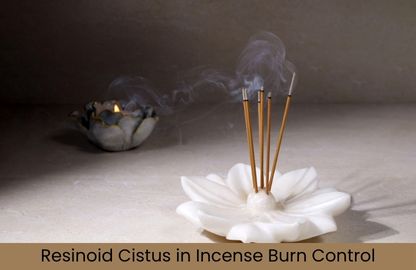
When a stick or cone burns, a heat front travels through the matrix (fuels, binder, aromatics). Resinoid Cistus:
- Melts before it combusts, forming a mobile phase that carries and slowly releases co-dissolved aromatics.
- Improves ember uniformity, reducing local hot spots and preventing harsh fumes from scorched volatiles.
- Extends the aromatic plateau, keeping heart and base notes consistent across the mid-burn and tail.
These physical effects translate into perceivable longevity and a cleaner, more even olfactory evolution.
Formulation Guidelines for Styrax’s Incense Longevity
Agarbatti Sticks (Powder + Paste)
- Method: Pre-dissolve the resinoid in a compatible diluent (e.g., high-proof ethanol) for even distribution. Blend into the paste with wood powders, spices and other aromatics.
- Note: Excess resin can over-dampen the paste; balance with lightweight wood powders for proper drying and ignition.
Dhoop/Cones (Self-Burning)
- Matrix: Charcoal/wood powder + natural binder (e.g., water-soluble gums).
- Caution: Too much resin may choke airflow and cause snuffing; adjust particle size and binder to keep the ember alive.
Loose Resin on Charcoal
- Approach: Place a small dab of cistus resin on the hot charcoal and layer supporting materials around it.
- Control: Add incrementally to avoid overpowering lighter companions.
Building a Stable Scent Architecture
A robust incense typically benefits from a base-forward architecture:
- Base(longevity, cohesion): resinoid cistus, heavier balsams, deep woods.
- Heart(character): Florals, spices, sweet woods.
- Top(lift): Herbs, citrus, light resins or a trace of Cistus Essential Oil for resinous sparkle.
With Cistus Oil anchoring the base, you may keep tops restrained so they do not spike early and vanish.
Pairing Considerations
Resinoid Cistus pairs effectively with:
- Woods(cedar, guaiac): Adds structure and warmth.
- Balsams(amber-style accords): Reinforces longevity and roundness.
- Leather nuances: Accentuates resinous depth.
- Floral hearts(rose/jasmine types): Adds body without masking petals when dosed carefully.
It can mute extremely fresh citrus if overdosed; keep bright materials in modest proportion for lift without conflict.
Read Our Article
Essential Oil Blends Featuring Rosemary Oil: Enhancing Its EffectsTesting and Quality Control of Cistus
Micro-Burn Protocol
- Prepare mini-sticks or 0.3–0.5 g cones.
- Burn in a still, ventilated room.
- Log ignition behavior, ember stability, smoke character and note evolution at early/mid/late phases.
- Evaluate residual room scent 30–60 minutes post-burn.
Adjustment Logic
- Collapsing mid-burn→ Increase Cistus slightly or add a compatible balsam; reduce highly volatile tops.
- Overly dense smoke→ Reduce resinoid a touch; increase porous wood powders; ensure proper drying.
- Snuffing→ Improve airflow (coarser particles, less binder, reduce resin fraction).
Cistus Resin: Handling, Processing and Storage
- Pre-dissolution: Soften or dissolve cistus concrete in a small amount of ethanol or a suitable diluent for uniform blending.
- Gentle warming: 40–45 °C can reduce viscosity; avoid high heat that may darken or skew scent.
- Curing: Allow sticks and cones 7–14 days to dry and equilibrate; longevity and smoothness often improve with curing.
- Storage: Keep cistus absolute airtight, cool and away from light.

Choosing Among Cistus Materials
- Resinoid Cistus: Best for burn-phase fixation and endurance in incense.
- cistus absolute: Rich, blendable and diffusion-friendly; bridges heart to base.
- Cistus Essential Oil: Adds a clean resinous lift to the top; limited fixation.
- cistus resin(raw): Useful in loose blends on charcoal; may be harder to homogenize in pastes without pre-processing.
Selecting the right form depends on whether you need lift (top), body (heart) or anchoring longevity (base).
Our Other Product
Amyris OilConclusion:
As a natural fixative with a warm amber-balsamic profile, Resinoid Cistus plays a central technical role in crafting high-quality, long-lasting incense. Its heavy constituents slow the escape of volatile notes, smooth the burn and maintain a coherent scent profile from the first glow to the final curl of smoke. By choosing the appropriate form - cistus resin - and applying sound formulation practices, makers can design sticks, cones and loose blends that deliver consistent, enduring aroma and refined burn behavior.
FAQ About Resinoid Cistus
Its heavy resinous fractions evaporate slowly, absorb lighter aromatics and form a molten phase during smolder, which moderates release and extends perceived longevity.
Start with small amount of the aromatic phase for sticks and for cones, then refine after micro-burn tests based on stability and intensity.
Use the essential oil for resinous lift and brightness; choose the absolute for richer amber depth and easier blending; select the resinoid for burn-phase fixation.
It may slightly slow and smooth the burn by stabilizing the ember and moderating aromatic release, which helps maintain an even scent arc.
Keep materials airtight, cool and away from light. Allow finished incense to cure 7–14 days before use to let the matrix equilibrate and the aroma settle.
Recent Posts
- Natural Vetiver Oil vs Vetiver Reconstitution vs Perfumery Base: Which Option Should Formulators Choose?
- Geranium Oil Quality Control: How Bulk Buyers Evaluate Purity and Batch Consistency
- Labdanum Resinoid Solubility and Handling: A Practical Guide for Fragrance Manufacturers
- Oudh Oil for Attar and Mukhallat: Building Balanced Traditional Fragrance Blends
- Frankincense Serrata in Fine Fragrance: Building Woody, Citrus and Balsamic Accords
- How to Choose Perfume Oil Manufacturers & Suppliers: A Buyer's Quality Checklist
- Fragrance Oil Stability Testing for Cosmetics, Soaps, Candles and Home-Care Products
Copyright @ 2026 | BMV Fragrances Private Limited | All Rights Reserved
Website Design & Digital Marketing by webmasterindia.
Website Updated On: