





Listen to the Audio Version
Amyris Oil: Bakhoor Traditions in Middle Eastern Fragrances
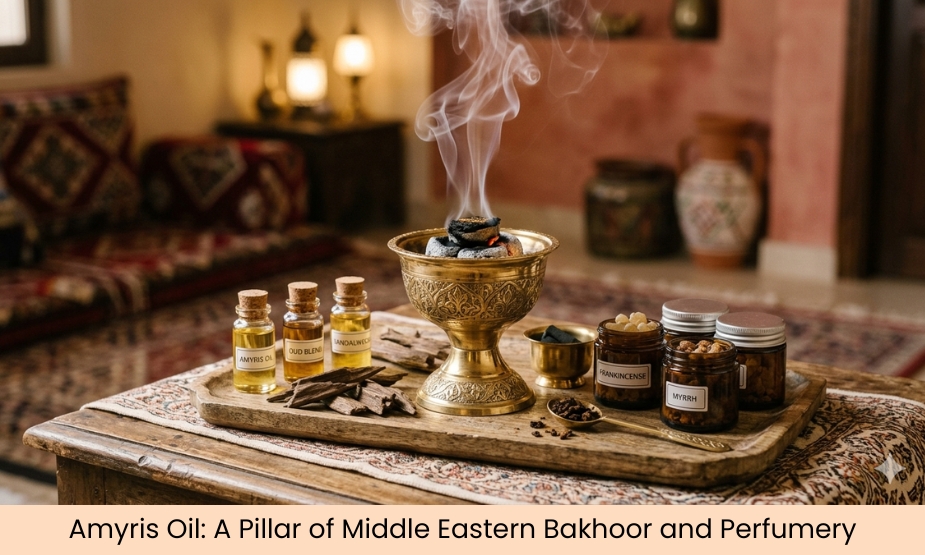
Bakhoor, the aromatic incense burned across Gulf households, mosques, and majlis gatherings, carries centuries of olfactory tradition within its smoke. At the heart of this tradition lies a careful selection of base materials - and amyris oil has steadily earned its place among them. While oud remains the crown jewel of Middle Eastern perfumery, formulators across the Gulf, Levant, and broader Arab world increasingly rely on amyris as a foundational building block that shapes texture, diffusion, and lasting depth in both incense and fine fragrance.
Amyris Oil's Role in Bakhoor Formulations and Incense Blending
Amyris oil functions as a fixative and carrier in bakhoor sticks, chips, and pressed incense cakes. Sourced from the Amyris balsamifera tree - a species native to Haiti and the Caribbean - its woody, creamy, and slightly sweet profile integrates seamlessly with the resinous and smoky character that Gulf consumers expect. When incense manufacturers in cities like Riyadh, Dubai, and Muscat develop bakhoor blends, amyris provides the slow-release base that sustains fragrance diffusion over extended burn times. It binds volatile aromatic compounds, preventing top-note flash-off and extending the overall scent trail - a quality that is especially valued in traditional burning rituals that last through social gatherings and prayer hours.
Amyris Reconstitution and Its Strategic Use in Oud-Based Blends
Oud is scarce, variable in quality, and increasingly expensive. Amyris reconstitution - the process of rebuilding oud's olfactory character using a blend of isolates, base oils, and amyris as a structural backbone - has become a cornerstone technique in Gulf-market perfumery. Perfumers working with mukhallats, the concentrated layered blends that define the regional scent identity, use amyris reconstitution not as a substitute but as a scaffold. It contributes the dry woody undertone that allows more expensive oud accords, rose absolutes, and musks to project without volatilizing too quickly. The result is a blend with coherence - one that reads as luxurious without requiring cost-prohibitive ingredient quantities in every batch.
Amyris Oil Producers and the India-Gulf Supply Chain
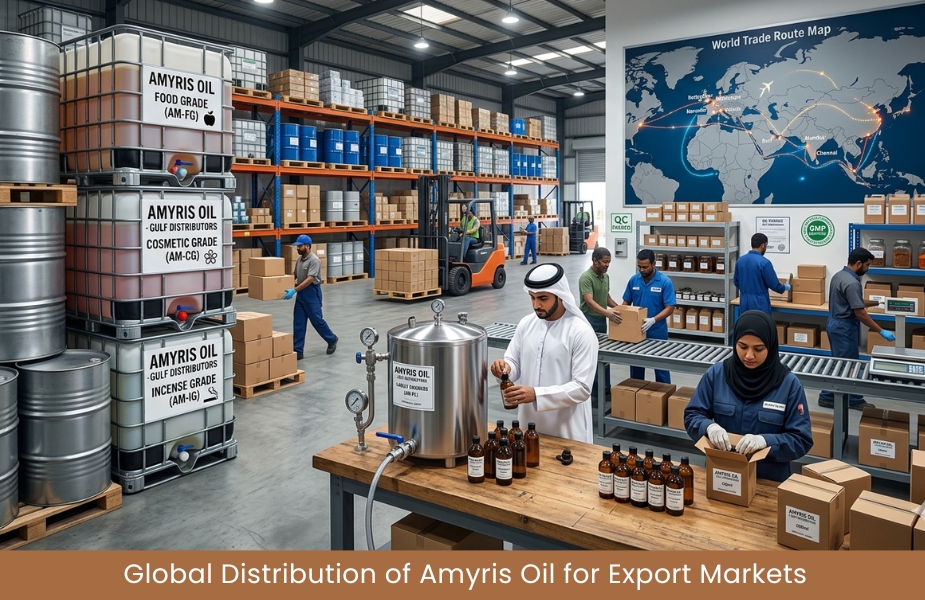
The supply of amyris essential oil into Middle Eastern markets moves significantly through India. Established amyris oil producers in cities such as Kannauj, Mumbai, and Ahmedabad refine and process the raw material into forms suitable for industrial fragrance use. These producers supply to bakhoor manufacturers, attar blenders, and incense stick factories across the Gulf. The amyris essential oil market within India has grown considerably as Gulf demand for affordable woody base materials has expanded. Indian producers offer standardized profiles - controlled refractive index, flash point, and odor character - that allow Gulf formulators to build consistent products across production batches.
BMV Fragrances Private Limited, a recognized name among amyris oil manufacturers in India, supplies this material to fragrance houses and incense producers across export markets. Their product serves both the mukhallat segment and industrial bakhoor manufacturing, reflecting the dual demand structure of the Gulf fragrance trade.
Amyris Oil Suppliers and Distribution across Export Markets
Amyris Oil in India and Its Growing Export Role
Amyris oil in India is produced and traded through a network concentrated in Uttar Pradesh, Maharashtra, and Gujarat. The Kannauj belt, historically tied to the global attar and essential oil trade, supplies a significant portion of the amyris processed for export. As demand from Gulf-based bakhoor manufacturers and mukhallat perfumer’s increases, Indian producers have scaled refining infrastructure to meet tighter quality specifications. Cold-blending compatibility, batch-to-batch consistency, and documentation for regulatory compliance have become standard requirements - all of which Indian suppliers have progressively built into their operational capabilities.
Our Other Product
Essential Oil FixativesMukhallat Perfumery and the Textural Function of Amyris
Mukhallats are built in layers. A well-constructed Gulf mukhallat might open with rose or saffron, develop through an oud accord, and settle into a base constructed around sandalwood, musk, and amyris. The material's utility in the base layer stems from its ability to slow diffusion without muddying transparency. Unlike heavier resins such as benzoin or labdanum, amyris maintains clarity in the dry-down - a characteristic that perfumers in cities like Jeddah and Abu Dhabi specifically seek when building lighter mukhallat variants intended for daytime wear or gifting markets.
Incense Sticks Targeting the Gulf Market and the Role of Amyris
The incense stick market targeting Gulf consumers differs from South Asian or East Asian categories in key respects: burn behavior, smoke character, and base material identity all carry cultural expectations. Amyris oil producers supplying to this segment understand that Gulf consumers associate quality incense with a sustained, smooth, resinous burn. Amyris delivers this because of its naturally low volatility and high boiling point relative to many other woody essential oils. Incense compounders use it both as a standalone base note and in combination with white oud reconstitutions, frankincense, and halmaddi-free binders developed specifically for Gulf distribution channels.
Amyris Essential Oil Market Trends and Regional Demand
The amyris essential oil market is being reshaped by two parallel forces: the growth of the Gulf fragrance retail segment and the rising global interest in natural and semi-natural incense products. Buyers in Saudi Arabia, the UAE, and Oman are purchasing bakhoor and mukhallats in record volumes - driven by gifting culture, social media fragrance communities, and an expanding middle-class consumer base with elevated scent literacy. This demand filters upstream to amyris oil distributors and manufacturers, creating sustained procurement activity across the India-to-Gulf supply corridor. Reformulation pressure in the cosmetic and fine fragrance industry - driven by IFRA compliance requirements around certain synthetic woody materials - has further positioned amyris as a preferred natural alternative with a favorable regulatory profile.
Sourcing Quality and What Gulf Buyers Look For
When Gulf fragrance manufacturers evaluate amyris oil suppliers, they prioritize olfactory stability under heat, compatibility with other base materials in bakhoor recipes, and availability of consistent large-volume supply. Producers who can demonstrate low batch variation and reliable lead times - supported by proper export documentation - maintain preferred supplier status in this competitive market. As the amyris essential oil market matures, the distinction between commodity-grade and premium-grade material is becoming more pronounced, with higher-specification product commanding pricing premiums among mukhallat-focused buyers.
 Call Us Now!
Conclusion
Amyris oil has carved a well-defined role within Middle Eastern fragrance traditions - not as a novelty ingredient, but as a functional base material that supports oud reconstitution, bakhoor diffusion, and mukhallat construction at both artisanal and industrial scales. As Gulf consumer demand for layered, long-lasting incense and attar-style perfumery continues to grow, the sourcing relationship between Indian amyris oil producers - including established manufacturers like BMV Fragrances Private Limited - and Gulf-based formulators will only deepen. The amyris essential oil market is no longer a secondary consideration; it is a foundational pillar of modern Middle Eastern fragrance supply chains.
FAQ on Amyris Oil
Amyris oil acts as a fixative and slow-release base in bakhoor, ensuring sustained smoke diffusion and prolonged scent throw during traditional Gulf burning rituals.
Amyris reconstitution provides a dry woody scaffold that allows expensive oud accords and rose absolutes to project evenly without volatilizing too quickly in the blend.
Major amyris oil manufacturers and suppliers in India are concentrated in Kannauj, Mumbai, and Ahmedabad, with Kannauj being the historic hub of essential oil and attar trade.
Its low volatility, heat stability, and clean woody dry-down make amyris oil compatible with oud, frankincense, and musk accords commonly used in Gulf perfumery and incense production.
Growing Gulf retail consumption of bakhoor and mukhallats, combined with IFRA compliance pressure on synthetic woody materials, is driving sustained procurement of amyris oil from Indian producers and distributors.
Recent Posts
- Balsamic Depth and Woody Elegance of Resinoid Guggul
- Resinoid Tolu Pourable: Composition, Aroma, Uses and Stability
- Olibanum Crystals: A Timeless Essence in Components, Fragrance and Emerging Trends
- Resinoid Styrax: A Comprehensive Guide to Its Origins, Composition, Safety and Market Trends
- Resinoid Olibanum Super: Aroma, Composition, Applications and Global Impact
- Agarbatti Perfume: The Cultural Significance in Religious and Spiritual Practices
- Indian Oud Reconstitution vs. Natural Oud: Cost Effectiveness, Performance, and Quality Comparison for Bulk Buyers
Copyright @ 2026 | BMV Fragrances Private Limited | All Rights Reserved
Website Design & Digital Marketing by webmasterindia.
Website Updated On: