





Listen to the Audio Version
Geranium Oil in Luxury Perfumery: From Rose Accords to Chypre Compositions
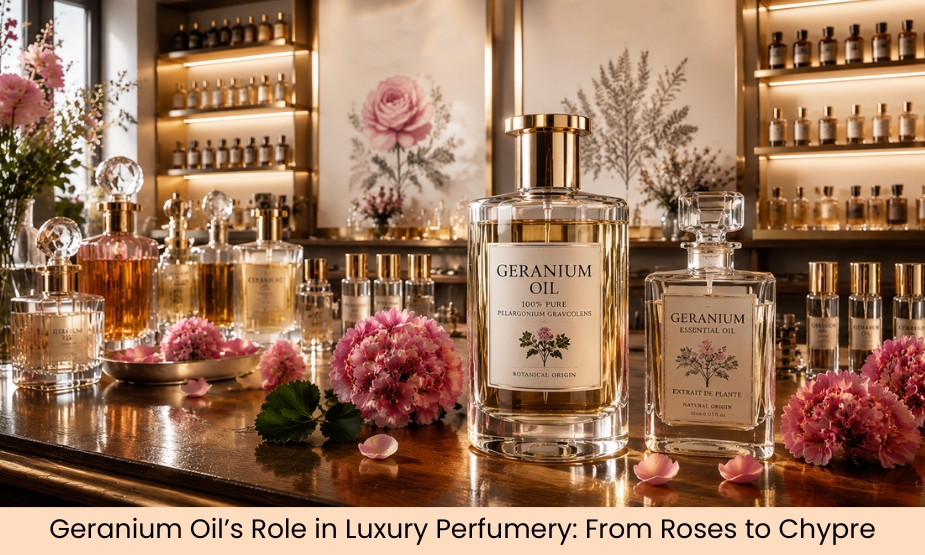
Perfumers have long considered geranium oil one of the most useful ingredients in high-end fragrance making. What makes it special is that it does not just add one smell - it plays several roles at the same time. It smooths out rough transitions between notes, strengthens floral centres, and holds complex formulas together. Whether you are looking at a century-old chypre or a modern rose perfume, geranium oil is quietly doing important work behind the scenes.
 Email Us Today!
Geranium Oil as a Technical Floralizer in Fragrance Architecture
In perfumery, a floralizer is an ingredient that makes floral notes smell fuller, brighter, and more convincing - without taking over the whole fragrance. Geranium oil is one of the best natural floralizers available, and its chemistry explains why.
Its main chemical components - citronellol, geraniol, and linalool - are almost identical to the natural compounds found in real rose petals. This is why, when a perfumer smells geranium oil, it registers as rosy, fresh, and softly green all at once. It naturally blends into floral compositions because it already speaks the same chemical language as rose.
When used at around 2–8% in a formula, geranium oil brightens the middle notes of a fragrance, adds a natural roundness to the floral heart, and tones down the harshness that some synthetic ingredients can introduce. Geraniol - one of its main components - also shows up in neroli, lemongrass, and palmarosa, which means geranium oil can connect with a wide range of other ingredients. This versatility is one of the core reasons geranium essential oil uses go far beyond simple blending - it actually reshapes how an entire formula smells and performs.
Geranium Essential Oil Benefits in Rose Accord Construction
Building a convincing rose fragrance is one of the oldest challenges in perfumery. Real rose absolute - extracted from Rosa damascena or Rosa centifolia - is one of the most expensive raw materials in the industry. Using it at full strength in every formula simply is not financially possible for most fragrance houses. At the same time, building a rose accord entirely from synthetic molecules often results in something that smells flat, one-dimensional, or artificial to trained noses.
This is where geranium essential oil benefits the perfumer most directly. It acts as a natural, cost-effective body for a rose accord - providing the fresh, slightly leafy, rosy character that synthetics struggle to replicate on their own.
A typical rose accord might combine geranium oil with phenylethyl alcohol (PEA) for sweet, honey-like softness, rose oxide for the sharp, metallic edge of a real rose, and damascenone for depth and a rich, jammy quality. Geranium supplies the structural backbone of that accord - the part that makes it smell genuinely rosy rather than chemically constructed.
The benefits of geranium essential oil in this application also come from its natural complexity. The oil contains over 200 identified chemical compounds, including various esters, terpenes, and aldehydes. No single synthetic molecule can replicate that layered quality, which is precisely what gives a geranium-built rose accord its convincing naturalness.
Geranium Oil Benefits: Bridging Rose and Green Notes
One of the most distinctive geranium oil benefits in luxury perfumery is its position at the crossroads of two very different scent territories - rose and green. Most floral ingredients sit firmly in one camp or the other, but geranium occupies both simultaneously.
Its rosy side is warm, round, and slightly sweet. Its green side is crisp, fresh, and reminiscent of crushed leaves, wet stems, and garden air after rain. Together, these qualities allow a perfumer to use geranium as a bridge - connecting a soft floral heart to a sharper, more herbal or green top note without an awkward jump between the two.
The green character in geranium comes mainly from rose oxide and certain heavier aromatic molecules called sesquiterpenes. These give the oil a freshness that feels natural rather than synthetic, which is increasingly important as consumers and perfumers move toward fragrances that smell like something genuinely found in nature.
This bridging quality also means geranium oil works across multiple fragrance families. It fits comfortably within rosy-powdery florals, herbal fougères, and even fresh green compositions - a level of flexibility that very few natural ingredients can match.
Geranium Egyptian Oil and Its Superior Role in Luxury Formulations
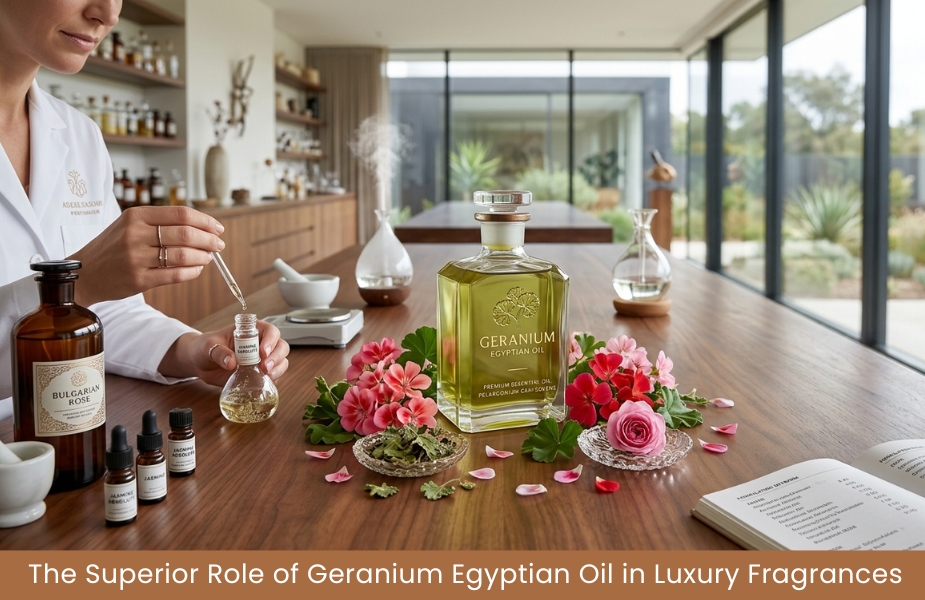
Not all geranium oil is the same. Sourcing origin has a significant impact on olfactory quality, and within the global supply of geranium, Geranium Egyptian oil consistently sits at the top tier for luxury fragrance applications.
Grown primarily in the Nile Delta region, Egyptian geranium benefits from specific soil conditions, climate, and cultivation practices that produce an oil with a higher citronellol content - often between 30 and 40%. This higher citronellol level translates directly into a cleaner, more refined rose character with less of the sharp, camphor-like edge that can appear in geranium from other regions such as China or parts of Africa.
For luxury and niche perfume houses, Geranium Egyptian oil is the preferred sourcing choice when the material will be used at high concentrations or placed alongside expensive naturals like jasmine absolute, iris, orris root, or Bulgarian rose. Its smooth, velvety quality integrates with these high-value ingredients in a way that lower-grade geranium simply cannot match.
Our Other Product
Fixatives PerfumeGeranium Synthetic Oil and Its Functional Role in Modern Perfumery
Alongside natural geranium, geranium synthetic oil has become an equally important tool in modern fragrance formulation. Synthetic versions are typically built around isolated geraniol, citronellol, or their ester derivatives - chemical building blocks that reproduce specific aspects of the geranium smell without using the whole natural oil.
Why does this matter? Several reasons. First, synthetic geranium offers consistency - every batch smells the same, which is critical for mass-market fragrance production where a bottle made today must smell identical to one made six months from now. Second, it reduces allergen risk. Some people are sensitive to citronellol at high concentrations, and using a synthetic version allows formulators to manage exactly how much is present in a formula. Third, it supports regulatory compliance, as international cosmetic and fragrance regulations continue to tighten around certain natural extract components.
Geranium synthetic oil also gives perfumers greater creative control. Want the warm, rosy aspect of geranium without the green freshness? Use a citronellol-forward synthetic. Want the crisp green facet without the floral warmth? Use a different isolate. This level of precision is not possible with the whole natural oil, making geranium synthetics genuinely valuable rather than simply a cheaper substitute.
Fragrance Families That Use Geranium Oil Most Prominently
Chypre Compositions. The chypre family is built on a classic trio of bergamot at the top, labdanum in the base, and oakmoss anchoring the whole structure. It is a sophisticated, slightly austere fragrance style that has defined luxury perfumery for over a century. Geranium oil plays an essential supporting role in chypres by providing the rosy floral heart that sits between the bright citrus opening and the deep, earthy base. Without it, many chypres would feel too stark or disconnected between their top and base notes.
Fougère Accords. The fougère family - built around lavender, coumarin, and oakmoss - uses geranium to add a floral lift that stops the composition from smelling too sharp or herbal. Geranium's rosy-green quality softens the lavender without competing with it, adding warmth and roundness to what can otherwise be a very linear aromatic structure.
Floral Aldehydics. In classic aldehydic florals - the type associated with mid-century luxury perfumery - geranium contributes to the soapy, rosy cluster at the heart, sitting comfortably alongside ylangylang, jasmine, and rose. It adds body and connection to these complex multi-floral arrangements.
Green Florals and Contemporary Aquatics. In newer fragrance styles oriented toward freshness and naturalness, geranium's crisp green facet takes centre stage. It helps perfumers build dewy, garden-fresh hearts that feel genuinely botanical rather than synthetic - a quality that resonates strongly with today's fragrance consumers.
 Call Us Now!
Geranium Oil in India: Supply Chain, Manufacturers, and Producers
India has quietly grown into a significant player in the global geranium supply chain. Cultivation has expanded across cooler hill regions including Himachal Pradesh, Uttarakhand, and parts of the northeastern states - areas where the climate supports Pelargonium graveolens crops with good yield and acceptable oil quality.
Indian-grown geranium oil tends to have a slightly more camphoraceous character compared to Egyptian origins, but it remains commercially valuable for blending applications, personal care product formulation, and aroma compound extraction. As the domestic fragrance and cosmetics industry has grown, so has the infrastructure around it.
Geranium Oil in India is now supported by a well-developed network of geranium oil producers, distilleries, and trading companies serving buyers across domestic and export markets. Among the established names in this space, BMV Fragrances Private Limited stands out as a trusted geranium oil manufacturer and supplier, offering quality-controlled geranium materials alongside a broader range of essential oils and aroma chemicals. Their experience working with both natural and aroma-grade materials, combined with their export reach, makes them a reliable partner for fragrance houses and industrial buyers looking for consistent supply.
Conclusion
Geranium oil earns its place in luxury perfumery not by smelling impressive on its own, but by making everything around it smell better. Its ability to floralise, bridge rose and green territories, and hold complex compositions together gives it a structural intelligence that few natural ingredients can match. Whether sourced as Geranium Egyptian oil for a high-end floral accord, used as geranium synthetic oil for regulatory compliance, or procured through established geranium oil suppliers like BMV Fragrances Private Limited, its contribution to chypre, fougère, and floral fragrance families remains as relevant today as it has ever been.
FAQ on Geranium Oil
Geranium oil provides the rosy floral bridge that connects citrus top notes to mossy or coumarinic bases in these fragrance families, creating the smooth, layered transitions that define their classic structure.
Egyptian geranium carries a higher citronellol content and a cleaner, less camphoraceous rose character, making it the top sourcing choice for luxury and haute parfumerie applications..
Geranium synthetic oil delivers greater batch consistency, lower allergen risk, and regulatory flexibility, while also allowing perfumers to isolate specific scent facets - the rosy warmth or the green freshness - independently of each other.
Perfumers typically use geranium oil between 2–8% concentration to achieve the best floralising effect - present enough to lift and round the floral heart, but not so dominant that the geranium character becomes the main story of the fragrance.
India has become a meaningful production hub for geranium oil, with cultivations in northern hill regions supporting an expanding network of geranium oil manufacturers and suppliers serving both domestic and global fragrance and personal care markets.
Recent Posts
- Importing Balsam Peru from India: A Guide to Documentation, Packaging and Bulk Supply
- Balsamic Depth and Woody Elegance of Resinoid Guggul
- Resinoid Tolu Pourable: Composition, Aroma, Uses and Stability
- Olibanum Crystals: A Timeless Essence in Components, Fragrance and Emerging Trends
- Resinoid Styrax: A Comprehensive Guide to Its Origins, Composition, Safety and Market Trends
- Resinoid Olibanum Super: Aroma, Composition, Applications and Global Impact
- Agarbatti Perfume: The Cultural Significance in Religious and Spiritual Practices
Copyright @ 2026 | BMV Fragrances Private Limited | All Rights Reserved
Website Design & Digital Marketing by webmasterindia.
Website Updated On: