





Listen to the Audio Version
AI Summary: Oudh Oil can play a structural or supporting role in a traditional Oudh perfume, contributing woody depth depending on the material category and formulation objective. The term covers natural agarwood oil, Oudh reconstitutions and perfumery bases, each with a distinct identity. Concentration, carrier base and surrounding materials shape the outcome, and the finished blend should be evaluated after a defined integration period before commercial approval.
What Role Does Oudh Oil Play in Traditional Perfumery?
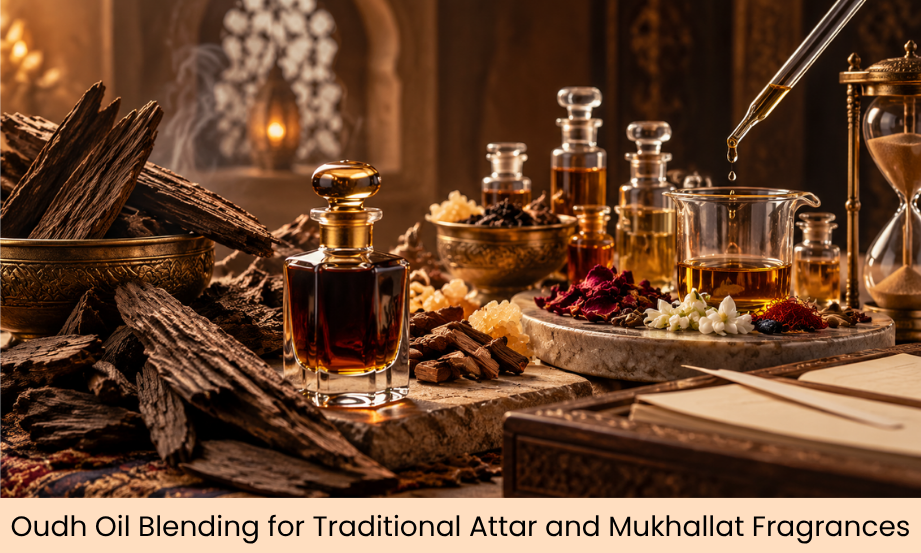
Oudh Oil is not one uniform product category. Depending on the supplier's description, the material may be natural agarwood oil, an Oudh reconstitution or a formulated perfumery base. These options can differ in origin, composition, olfactive profile, consistency and commercial positioning. Before developing an Oudh attar formulation, formulators and buyers should confirm the exact material category and specification. BMV Fragrances Private Limited, for example, presents its materials under distinct Oudh Reconstitution and Oudh Perfumery Base categories.
Attar makers developing a traditional Oudh perfume should assess Oudh Oil for attar according to the intended fragrance direction, carrier, strength and supporting ingredients. When evaluating Oud Oil for mukhallat, formulators must also consider how the material behaves within a composition containing several aromatic ingredients. Buyers searching for Oudh Oil India should compare documentation and sample consistency among Oudh suppliers. The material category is equally important when assessing Oudh base manufacturers, because a formulated base should not be expected to perform like natural distilled oil.
 Email
Email
What Does Oudh Oil for Attar Contribute to a Blend?
In an attar, the selected Oudh material can establish the main woody direction or reinforce the base beneath floral, spicy, amber or musky elements. Its specific function depends on the desired intensity, surrounding ingredients and market positioning.
How Does Oudh Function in Different Oudh Fragrance Blends?
The relationship between Oudh and its supporting materials changes according to the fragrance structure:
| Fragrance Structure | Possible Oudh Contribution | Formulation Consideration |
|---|---|---|
| Floral | May provide depth beneath delicate floral materials | Prevent dense woody facets from masking the florals |
| Amber | May add resinous warmth and structural weight | Avoid excessive density and sweetness |
| Spicy | May provide woody contrast to volatile spices | Balance dryness, warmth and sweetness |
| Musky | May introduce woody or animalic depth | Manage the combined intensity |
| Citrus | May contrast with bright top notes | Preserve clarity in the opening |
Building a Balanced Oudh Attar Formulation
A balanced Oudh attar formulation keeps the selected material and its supporting ingredients distinguishable, rather than letting one element dominate. Practical steps include:
- Define the intended dominance of Oudh.
- Select the carrier before finalising concentration.
- Prepare controlled concentration trials.
- Compare sweetness, dryness and diffusion.
- Record the formula and blending sequence.
BMV Fragrances can support this process with sample materials for concentration trials and profile comparison.
Using Oud Oil for Mukhallat
In a mukhallat, Oudh must connect several aromatic themes within one oil-based composition. Its dry, woody character can link rose or jasmine with saffron, amber, musk, sandalwood or patchouli. The formulator should evaluate whether these transitions remain clear throughout development, instead of relying only on traditional material associations.
Building Floral Oudh Fragrance Blends
In a floral Oudh accord, Oudh can lend structure while rose, jasmine, orange blossom or tuberose provide lift and diffusion. The main consideration is contrast: enough concentration to support the blend without masking delicate floral detail.
Building Amber, Balsamic and Spicy Oudh Accords
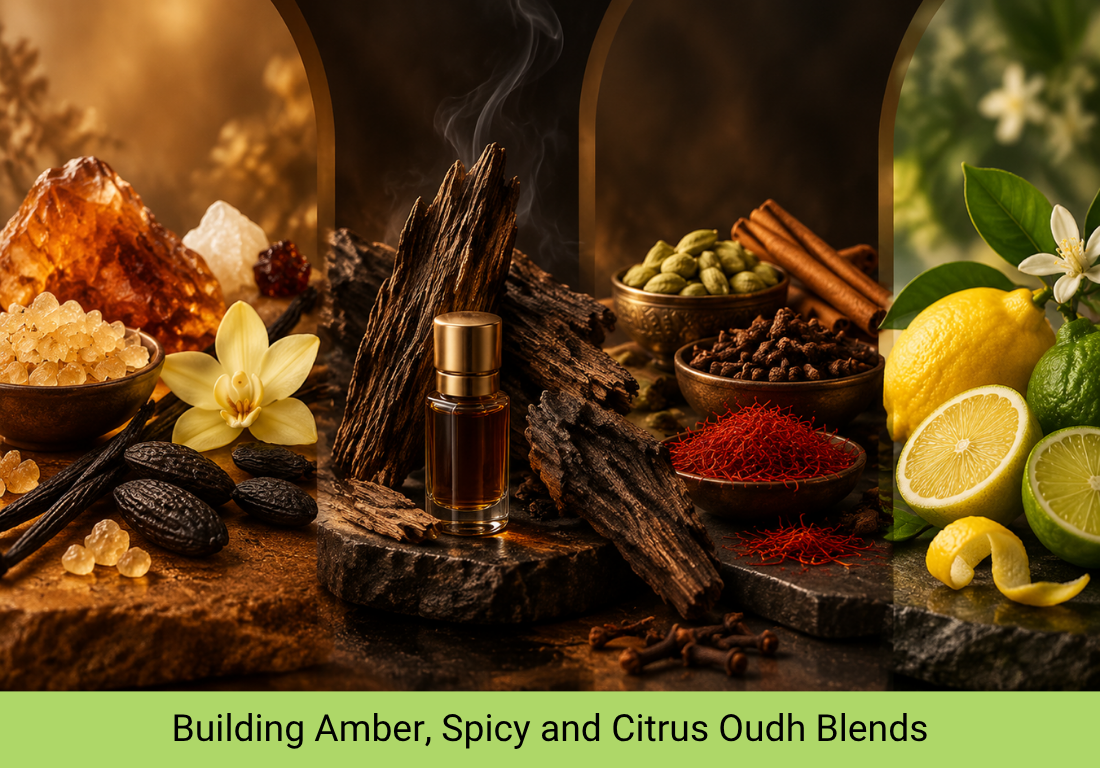
Amber materials — benzoin, labdanum, vanilla-style and tonka-style notes — can extend Oudh's resinous character, though the combination can turn dense quickly without added dryness. In a spicy Oudh accord, cardamom, cinnamon, clove-style notes and saffron need Oudh's warmth balanced against their natural dryness, so the blend reads as neither too sharp nor too heavy.
Using Oudh Oil in Citrus Oudh Fragrance Blends
Citrus and aromatic materials such as bergamot, mandarin and petitgrain introduce contrast against a dense Oudh structure, keeping the opening accessible while Oudh manages the transition into the heart and drydown. Oudh should not be assumed to extend citrus longevity without testing the specific combination.
How Do Carrier Base and Concentration Affect Oudh Fragrance Blends?
Carrier base and concentration shape intensity, diffusion, texture and how the drydown reads in the finished formulation. Suitability, safety and regulatory requirements must be assessed for the intended product and market; no single carrier or concentration works for every attar or mukhallat.
Why Are Maturation and Evaluation Important for an Oudh Attar Formulation?
An oil-based fragrance may show a different perceived balance after compounding and a defined integration period. Perfumers should evaluate it at planned intervals, tracking shifts in odour balance, any harsh or muddy facets, and changes in appearance against an approved reference sample. The appropriate interval depends on the composition, carrier and product format.
How Should Perfumers Evaluate Oudh Oil for Attar and Mukhallat?
- Define the intended fragrance direction.
- Evaluate the Oudh Oil alone at an appropriate dilution.
- Record its woody, resinous, smoky, leather-like and balsamic facets.
- Compare more than one concentration.
- Test it with the intended supporting materials.
- Evaluate it in the selected carrier base.
- Assess the complete blend after preparation.
- Reassess after a suitable interval.
- Review physical stability and packaging compatibility.
- Retain an approved reference sample for comparison.
BMV Fragrances can provide samples across its Oudh range to support this process ahead of commercial approval.
Common Mistakes When Creating Oudh Fragrance Blends
Frequent mistakes include assuming every Oudh Oil shares the same profile, using excessive concentration without checking balance, letting sweetness obscure the woody structure, masking delicate florals, overlooking the carrier's effect, evaluating only right after compounding, and confusing natural Oudh with Oudh-inspired compositions.
What Should Buyers Check When Sourcing Oudh Oil from Suppliers?
Attar and mukhallat manufacturers evaluating Oudh suppliers, comparing Oudh Oil India options, or reviewing Oudh base manufacturers should verify product identity, sample quality, technical documentation and repeat supply capability before committing. What to confirm varies by material type:
| Material Type | What Buyers Should Confirm |
|---|---|
| Natural Oudh Oil | Botanical source, production method, origin, batch profile and supporting documentation |
| Oudh Reconstitution | Product category, olfactive direction, available composition information and batch controls |
| Oudh Perfumery Base | Intended use, fragrance profile, customisation options and application suitability |
BMV Fragrances supports sample requests, material discussions, documentation and commercial supply enquiries across its Oudh range.
About BMV Fragrances: Oudh Oil and Perfumery Material Supplier
BMV Fragrances Private Limited offers formulated Oudh materials, including Oudh reconstitutions and perfumery bases, for evaluation in attar, mukhallat and other fragrance compositions. The company supports fragrance professionals with sample requests, customised development discussions and commercial supply enquiries.
 Call Now
Conclusion: Building Balanced Oudh Fragrance Blends
Oudh Oil, across its different material forms, can shape the structure of both traditional and modern fragrance blends when concentration, carrier and supporting materials are balanced and the composition is evaluated before approval. Working with an experienced perfumery material supplier can support informed material selection throughout this process.
FAQs About Oudh Oil for Attar and Mukhallat
Formulators should confirm the material category, olfactive profile, intended dominance, carrier compatibility and documentation. The selected material should be tested at different concentrations within the complete attar, since natural oil, reconstitution and perfumery base options can produce different results.
Oud Oil for mukhallat typically works alongside rose, saffron, amber and musk rather than alone. Its success depends on proportion, contrast and how the composition develops, not on traditional pairing assumptions.
Perfumers may evaluate Oudh alongside floral, citrus, spicy, amber, musky, woody and balsamic materials. Suitability depends on the required fragrance direction and proportions. Testing should focus on whether the supporting notes remain distinct and whether the composition develops coherently from application through drydown.
Perceived balance may shift after compounding and a defined integration period. Planned evaluation intervals help identify changes in odour balance, clarity and drydown before commercial approval.
Buyers should confirm material category, product identity, sample consistency, documentation and batch identification. Comparing Oudh suppliers and Oudh base manufacturers on these points helps match the material to both the fragrance and commercial requirements.
Recent Posts
- Natural Vetiver Oil vs Vetiver Reconstitution vs Perfumery Base: Which Option Should Formulators Choose?
- Geranium Oil Quality Control: How Bulk Buyers Evaluate Purity and Batch Consistency
- Labdanum Resinoid Solubility and Handling: A Practical Guide for Fragrance Manufacturers
- Oudh Oil for Attar and Mukhallat: Building Balanced Traditional Fragrance Blends
- Frankincense Serrata in Fine Fragrance: Building Woody, Citrus and Balsamic Accords
- How to Choose Perfume Oil Manufacturers & Suppliers: A Buyer's Quality Checklist
- Fragrance Oil Stability Testing for Cosmetics, Soaps, Candles and Home-Care Products
Copyright @ 2026 | BMV Fragrances Private Limited | All Rights Reserved
Website Design & Digital Marketing by webmasterindia.
Website Updated On: