





Listen to the Audio Version
AI Summary: Labdanum Resinoid can be difficult to weigh, transfer and dissolve because of its thick, sticky physical form. Labdanum Resinoid solubility depends on the solvent or carrier chosen, concentration, temperature, mixing conditions and the surrounding fragrance system, and must be verified through laboratory trials before scale up. Controlled handling protects consistency during pilot and production runs. BMV Fragrances Private Limited supports fragrance manufacturers with material selection, sampling and commercial supply of Labdanum Resinoid and related perfumery raw materials.
Why Can Labdanum Resinoid Be Difficult to Handle?
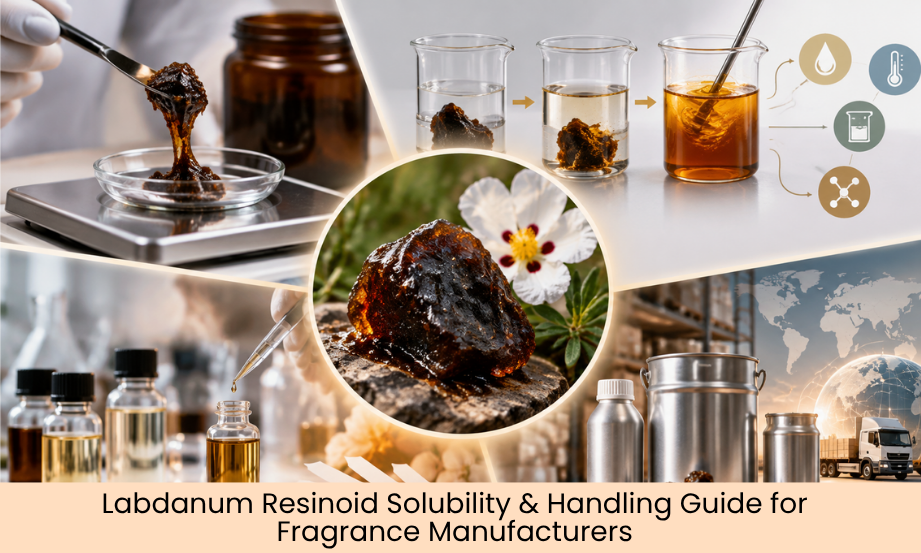
The material can be difficult to handle mainly because of its physical form. As a viscous perfumery material, it often pours slowly, clings to containers and tools, and resists accurate weighing.
Formulators working with this resinous material handling challenge commonly encounter:
- High viscosity that slows transfer
- Stickiness that leaves residue on vessel walls
- Inaccurate weighing due to slow pouring
- Uneven incorporation into the base formula
- Longer mixing times than free-flowing materials
- Flow behaviour that shifts noticeably with temperature
These characteristics can vary by supplied grade, product form, composition and storage conditions, so handling behaviour may show batch-to-batch variation within the supplier's applicable specifications. Consistent Labdanum Resinoid handling therefore requires a defined procedure for conditioning, weighing, transferring and incorporating the material.
BMV Fragrances Private Limited can confirm the supplied form of a given batch and share relevant handling information, helping formulators plan transfer and weighing steps before production begins. Buyers sourcing Natural Labdanum or Labdanum in India should confirm the exact material category, supplied form and batch documentation.
 Email
Email
What Determines Labdanum Resinoid Solubility?
No single compatibility statement applies universally to Labdanum Resinoid solubility because performance depends on the complete system the material is introduced into, not the resinoid alone.
Key influencing factors include material form and composition, the selected solvent or carrier, resinoid concentration, temperature, mixing intensity and duration, addition sequence, the presence of other fragrance materials, water content, storage temperature and time elapsed after preparation. This technical clarity is also important when comparing Labdanum Resinoid Distributors with Labdanum Resinoid Manufacturers in India, because the supplied form can affect compatibility and processing behaviour.
It is also important to distinguish complete dissolution from temporary dispersion, since a mixture that looks uniform at first may later develop haze, sediment or separation.
To determine how to dissolve Labdanum Resinoid, formulators should test the material in the intended concentrate and finished application rather than relying only on its appearance in a simple solvent trial. This is particularly important when assessing Labdanum Resinoid for perfumery, where other ingredients can affect compatibility.
The following factors should be assessed during compatibility trials:
| Influencing Factor | Possible Effect | What to Evaluate |
|---|---|---|
| Solvent or carrier choice | Influences compatibility and dissolution | Test at the intended ratio |
| Concentration | Higher levels may be more difficult to dissolve | Conduct stepwise dilution trials |
| Temperature | Changes viscosity and apparent solubility | Assess behaviour under controlled process conditions |
| Mixing intensity and duration | Affect incorporation and uniformity | Record the time required to reach visual homogeneity |
| Addition sequence | Can influence lump formation | Identify an order that avoids local overconcentration |
| Storage time and temperature | May reveal delayed instability | Recheck after cooling and equilibration |
How to Dissolve Labdanum Resinoid in a Fragrance System
There is no universal formula for how to dissolve Labdanum Resinoid, but a controlled development sequence reduces risk:
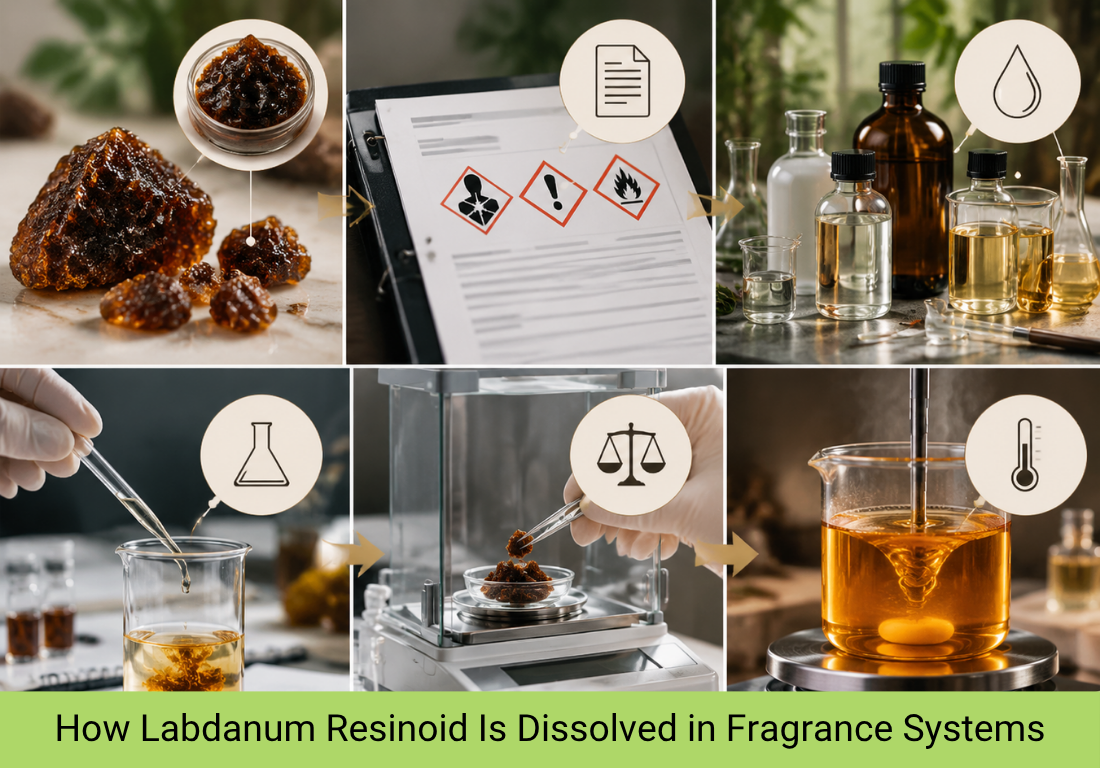
- Confirm the exact product and supplied form.
- Review the supplier's Safety Data Sheet and technical information.
- Select a solvent or carrier suited to the intended application.
- Run a small laboratory trial.
- Weigh the required quantity accurately.
- Reduce viscosity only under controlled, appropriate conditions.
- Add the material gradually to the compatible liquid phase.
- Mix until the system appears uniform.
- Allow the preparation to equilibrate.
- Check for haze, sediment, separation or viscosity change.
- Evaluate the dilution within the complete fragrance formula.
- Document the finalised method before scale up.
Specific solvents, temperatures or concentrations should only be applied where supported by verified technical information for the exact grade in use. BMV Fragrances Private Limited can provide samples and product-specific information to support these preliminary trials.
How Does Temperature Affect Labdanum Resinoid Handling?
Controlled warming may reduce viscosity and ease pouring or mixing, but excessive or uneven heat can alter the material or introduce safety and processing risks — a key part of proper Labdanum Resinoid handling.
Useful practices include conditioning containers before opening, applying controlled and even temperature exposure, avoiding direct or localised heating, monitoring the material while warming, preventing prolonged heat exposure, closing containers promptly after use, following the Safety Data Sheet and facility procedures, and recording conditions that worked well.
Exact heating temperatures should not be applied without product-specific evidence, and open flames or unsuitable sealed-container heating should be avoided. BMV Fragrances Private Limited can support product-specific storage and handling discussions where verified information is available.
How Should a Solvent or Carrier Be Selected for Labdanum Resinoid?
Solvent or carrier selection should reflect the final fragrance format, required concentration, processing method, safety needs and destination market rather than a single default choice.
Relevant factors include compatibility with the Labdanum Resinoid itself, compatibility with the full fragrance concentrate, the intended finished product, clarity requirements, odour contribution, volatility, processing conditions, packaging compatibility, safety data and regulatory acceptability for the intended use.
No single solvent is universally suitable, and solubility observed in a laboratory solvent does not automatically confirm compatibility in the finished product. BMV Fragrances Private Limited can discuss the intended perfumery application and the supplied material form directly with formulation teams.
Why Do Addition Sequence and Mixing Matter?
Adding a thick, resinous material directly into an already complex or unsuitable mixture can create lumps, local concentration differences or incomplete incorporation.
Useful practices include predilution where appropriate, gradual addition, mixing simpler phases before less compatible ones, scraping vessel walls and transfer tools thoroughly, allowing sufficient mixing time, avoiding unnecessary air incorporation, maintaining repeatable process conditions and recording the sequence that worked.
The most suitable order depends on the complete formula and the equipment in use. BMV Fragrances Private Limited supports this stage through sample evaluation and material information rather than prescribing one fixed procedure.
 Call Now
How Can Formulators Identify Incomplete Labdanum Resinoid Dissolution?
Practical warning signs include visible particles, resinous deposits, sediment, haze or cloudiness, separation, material adhering to the vessel, nonuniform colour, unexpected viscosity, changes after cooling and changes during storage.
Visual clarity alone does not prove long-term stability. Preparations should be checked immediately after mixing and again after storage or temperature exposure consistent with the manufacturer's own testing procedure.
Labdanum Resinoid for Perfumery Applications
Labdanum Resinoid for perfumerywork is valued as an amber fragrance ingredient offering possible amber character, balsamic warmth, resinous depth, leathery nuances, sweetness, tobacco-like or woody facets, and body across the heart and base that supports long drydown structures.
The exact olfactive profile varies by material and should be evaluated within the complete composition. Depending on the formula, the material may be used in amber, woody, leather, chypre-inspired and balsamic structures, or in oriental-style compositions, though not every material suits every direction. BMV Fragrances Private Limited can assist with Labdanum Resinoid sample selection for different perfumery directions.
Translating Labdanum Resinoid Handling from Laboratory to Production
A method proven in a small beaker may need adjustment at manufacturing scale. Batch size, vessel geometry, mixer type, agitation capability, heating and temperature control, addition point, transfer equipment, material retained in containers and lines, mixing time, cooling behaviour, cleaning requirements and operator safety procedures all differ from bench conditions.
Pilot-scale confirmation before routine production remains an important step in production scale mixing, and any equipment or processing capability should be confirmed with the manufacturer's own facilities rather than assumed.
How Can Manufacturers Reduce Material Loss During Handling?
Practical steps include conditioning the material appropriately before transfer, using suitable weighing and transfer tools, choosing container sizes matched to batch requirements, minimising unnecessary transfers, allowing adequate drainage time, accounting for material left on equipment, using documented transfer procedures, storing partially used containers correctly, and training operators in viscous-material handling.
Any recovery or rinsing approach must remain compatible with the formulation and the facility's approved safety and quality procedures.
Common Labdanum Resinoid Solubility and Handling Problems
Once a symptom has been observed, the next step is identifying its likely cause and an appropriate response. The table below supports this stage of fragrance formulation troubleshooting.
| Observed Problem | Area to Investigate | Practical Next Step |
|---|---|---|
| Haze or sediment after cooling | Solvent compatibility or concentration | Recheck the dilution ratio and evaluate stored trial samples |
| Resin remaining on vessel walls | High viscosity or inefficient transfer | Review conditioning and transfer procedures |
| Lumps during incorporation | Addition sequence or local overconcentration | Trial slower addition or appropriate predilution |
| Variation between preparations | Inconsistent time, temperature or mixing | Standardize and document process conditions |
| Different behaviour after scale-up | Vessel geometry, agitation or heat transfer | Conduct a controlled pilot-scale study |
About BMV Fragrances Private Limited
BMV Fragrances Private Limited supplies essential oils, resinoids, absolutes, reconstitutions and perfumery bases to businesses across fine fragrance, cosmetics, personal care and home fragrance markets. As a perfumery material supplier working with fragrance manufacturers, formulation chemists and R&D teams, the company supports sample requests, technical documentation queries and commercial supply requirements, including Labdanum Resinoid and related perfumery materials. BMV Fragrances Private Limited is positioned to discuss material availability, sample evaluation and supply logistics for perfumery raw material needs.
Conclusion
Labdanum Resinoid requires controlled handling because material form, solvent choice, temperature, concentration and mixing sequence all influence how it incorporates into a fragrance system. Laboratory trials and pilot-scale confirmation remain essential before any process moves to full production, and dissolution should always be assessed within the finished formula rather than in isolation. An experienced perfumery material supplier such as BMV Fragrances Private Limited can support material selection and sourcing throughout this process.
FAQs
Solubility is shaped by the material's form and composition, the chosen solvent or carrier, concentration, temperature, mixing conditions, addition sequence and the presence of other fragrance materials. Performance should always be assessed within the specific fragrance system rather than assumed from general expectations about resinoid dissolution.
A controlled approach works best: confirm the exact product, select a compatible solvent, run a small trial, add the material gradually with adequate mixing, and check the result after equilibration. Document the successful method before scaling to pilot or production batches.
Controlled, even warming may reduce viscosity and support pouring or mixing, but excessive or uneven heat can affect the material or raise safety concerns. Exact temperatures should follow product-specific technical guidance and the Safety Data Sheet rather than general assumptions.
Cloudiness or sediment can indicate incomplete dissolution, an unsuitable solvent, temperature sensitivity or changes occurring during storage. Visual clarity immediately after mixing does not guarantee long-term stability, so preparations should be rechecked after appropriate storage conditions.
Buyers should confirm the exact product identity, supplied form, available technical documentation and sample availability. Discussing the intended application with an experienced perfumery raw material supplier, such as BMV Fragrances Private Limited, helps align material selection with formulation goals.
Recent Posts
- Natural Vetiver Oil vs Vetiver Reconstitution vs Perfumery Base: Which Option Should Formulators Choose?
- Geranium Oil Quality Control: How Bulk Buyers Evaluate Purity and Batch Consistency
- Labdanum Resinoid Solubility and Handling: A Practical Guide for Fragrance Manufacturers
- Oudh Oil for Attar and Mukhallat: Building Balanced Traditional Fragrance Blends
- Frankincense Serrata in Fine Fragrance: Building Woody, Citrus and Balsamic Accords
- How to Choose Perfume Oil Manufacturers & Suppliers: A Buyer's Quality Checklist
- Fragrance Oil Stability Testing for Cosmetics, Soaps, Candles and Home-Care Products
Copyright @ 2026 | BMV Fragrances Private Limited | All Rights Reserved
Website Design & Digital Marketing by webmasterindia.
Website Updated On: