





Listen to the Audio Version
AI Summary: This aromatic ingredient can contribute freshness, resinous warmth, diffusion and depth to fine fragrance, connecting citrus openings with woody, spicy and balsamic elements. Its facets make it adaptable across development stages, though the effect depends on material form, concentration and surrounding materials, so evaluation within the complete formula matters. BMV Fragrances Private Limited supports fragrance houses with sampling, discussion and commercial supply.
What Is Frankincense Serrata and Why Is It Used in Perfumery?
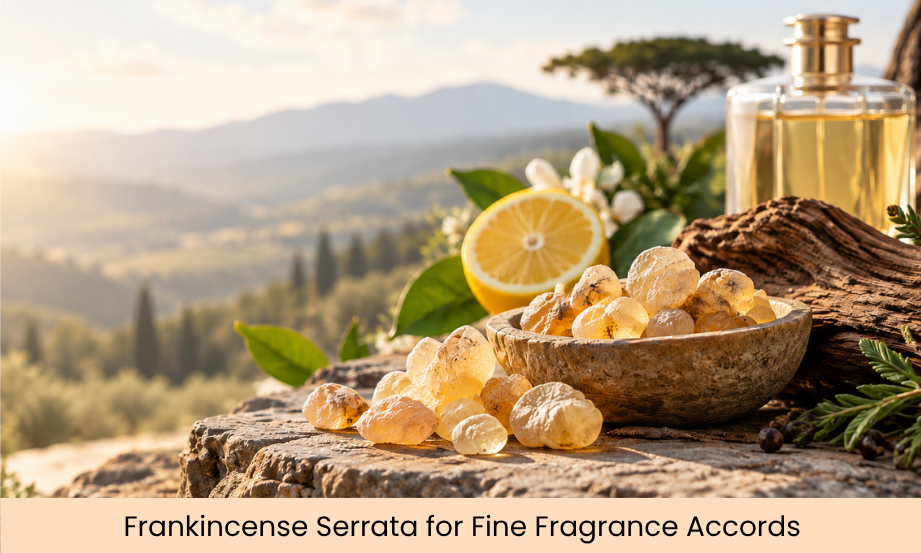
Frankincense Serrata in perfumery commonly refers to aromatic material obtained from the resin of Boswellia serrata, a tree native to the Indian subcontinent. The exact olfactory profile and formulation behaviour depend on whether the oil is supplied as a steam-distilled essential oil, resinoid or another processed form.
It is important to distinguish the raw botanical resin from frankincense serrata essential oil obtained through distillation, and from other extracts such as resinoids; these forms do not share identical composition, handling properties or olfactory behaviour.
This article focuses primarily on Indian Frankincense Oil as a Frankincense fragrance ingredient in fine-fragrance accords.
Olibanum oil is the steam-distilled essential oil obtained from hardened Boswellia resin, while olibanum resinoid is produced through solvent extraction and retains heavier components. BMV Fragrances can help perfumers confirm the available material form and discuss its intended application before sample evaluation.
 Email Us
What Does Indian Frankincense Oil Smell Like?
The odour profile can vary according to botanical source, material form, production method, batch and storage conditions, so buyers should not assume that different samples will be identical. Facets commonly discussed include:
- Fresh and lifting, sometimes citrus-like or terpenic
- Dry and woody, peppery or subtly spicy
- Resinous and incense-like, warm and balsamic
- Occasionally mineral, smoky or slightly earthy
Not every sample expresses these facets equally, which is why the olfactive profile is best judged material by material. BMV Fragrances can provide samples for evaluation against a perfumer's required direction.
How Does Frankincense Serrata Function in Fine Fragrance Formulation?
The material does not occupy one fixed position in the fragrance structure, and its contribution shifts with dosage and the surrounding formula. In some compositions it plays a lifting role near the opening, while in others it deepens the transition toward the base. The comparison below outlines how this flexibility applies across three common accord types, though the practical effect always depends on the complete formula rather than the raw material alone.
| Accord Type | Possible Contribution | Material Relationships | Formulation Consideration |
|---|---|---|---|
| Citrus | May add terpenic lift and connect the opening with the heart | Bergamot, mandarin and petitgrain | Balance resinous character against citrus clarity |
| Woody | May introduce dryness and resinous contrast | Cedarwood, vetiver and guaiac-style notes | Evaluate against the weight of surrounding woods |
| Balsamic | May provide dry lift within a dense, sweet structure | Labdanum, benzoin and tonka-style notes | Avoid unnecessary heaviness from multiple resins |
Building Citrus Fragrance Accords with Frankincense Serrata
The fresh, terpenic and resinous aspects of Frankincense Oil can support citrus-forward compositions alongside bergamot, lemon, mandarin, grapefruit, petitgrain, neroli, aromatic herbs or light woods, bridging a volatile opening toward the heart and drydown. Because citrus materials evaporate quickly, this bridging role can help the overall impression feel less abrupt as the fragrance develops. Resinous character needs balancing against freshness so the citrus fragrance accord stays clear rather than heavy, and the ratio between citrus and resinous elements often needs testing at more than one concentration. It does not automatically improve citrus longevity in every formula, and its suitability depends on the wider accord.
Building Woody Fragrance Accords with Frankincense Serrata
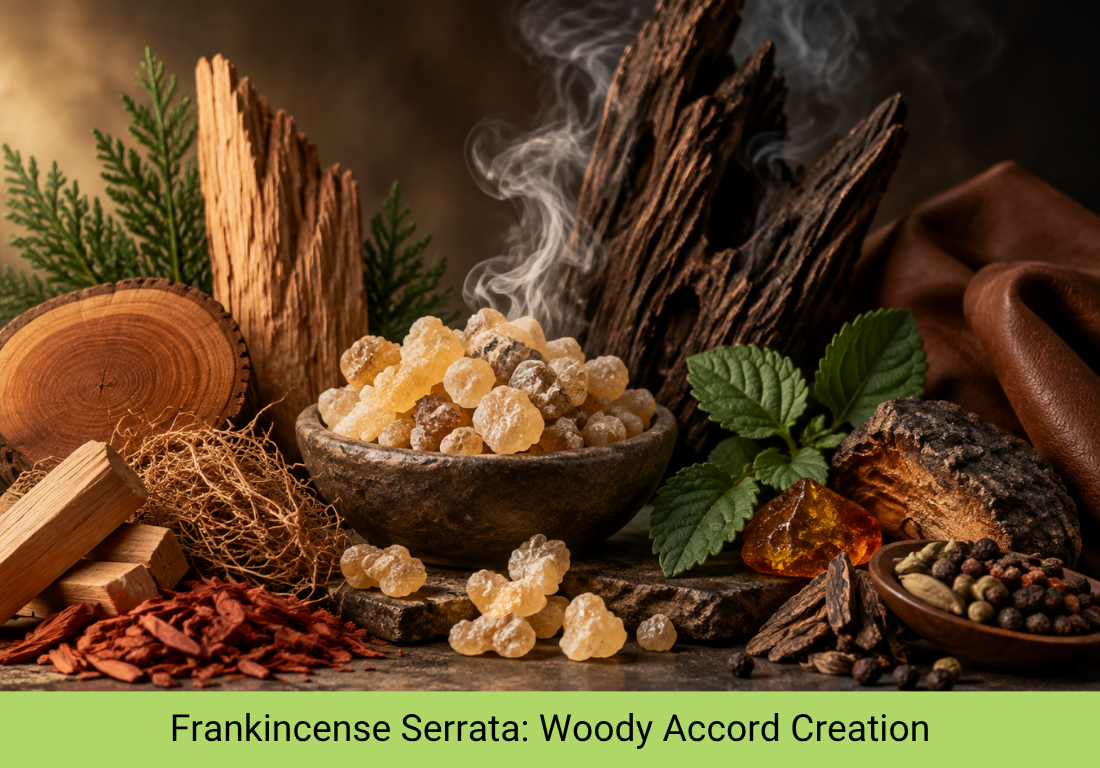
In woody fragrance accords, this ingredient can support dry, polished, mineral, smoky or resinous directions alongside cedarwood, sandalwood, vetiver, patchouli, guaiac-style notes, amber woods, dry spices or leather-inspired materials, introducing contrast and a resinous transition between heart and base. Lighter, more transparent woods may benefit from its brighter facets, while denser or smokier woods may draw out its deeper, more incense-like character. The effect changes with the weight and character of surrounding woods, so perfumers may need to test the material against more than one type of wood before settling on a final ratio.
Building Balsamic Fragrance Accords with Frankincense Serrata
The warm, incense-like dimensions of Frankincense Serrata can contribute to balsamic accords built around benzoin, labdanum, myrrh, vanilla-style notes, tonka-style notes, amber accords, spices or woods, offering dryness, lift or contrast within a dense, sweet base. Balsamic structures can become heavy or one-dimensional when too many resinous materials are combined, so its dry, slightly peppery character can be used to open space within an otherwise dense accord. Frankincense Serrata, benzoin, labdanum and myrrh are not interchangeable; each plays a distinct role, and substituting one for another without re-evaluating the full accord can shift the balance of warmth, sweetness and dryness.
Which Fragrance Families Can Use Frankincense Oil?
The suitable fragrance family depends on the balance of the selected material. A brighter, more terpenic Indian Frankincense Oil may support transparent citrus, aromatic or citrus-woody structures. A drier profile may complement woody, spicy or leather compositions, while a warmer and more resinous material may suit amber, balsamic and incense-inspired directions. These categories are creative starting points, and suitability should be confirmed through evaluation in the complete formula.
How Should Perfumers Evaluate a Frankincense Fragrance Ingredient?
- Evaluate the material alone at an appropriate dilution.
- Record its fresh, citrus, woody, spicy, resinous and balsamic facets.
- Compare its opening, development and drydown.
- Test it at more than one concentration.
- Evaluate it within the intended accord, with and without key supporting materials.
- Assess its effect in the complete fragrance concentrate.
- Test the fragrance in the intended finished product.
- Review stability where relevant and retain an approved reference sample.
Methods and concentrations vary by material, fragrance type and application.
Common Mistakes When Formulating with Frankincense Serrata
- Judging the material only from the bottle
- Treating it exclusively as a heavy base note
- Overlooking its fresh or citrus-like facets
- Assuming all frankincense materials smell identical
- Approving the concentrate without finished product testing
- Using unsupported therapeutic claims in fragrance marketing
What Should Buyers Check When Sourcing a Frankincense Fragrance Ingredient?
Sourcing a Frankincense fragrance ingredient involves olfactive suitability and supply considerations: botanical identification, material form (essential oil, resinoid or other extract), aroma profile, sample consistency, documentation, packaging, storage guidance, batch identification, and commercial or repeat supply expectations.
BMV Fragrances can share relevant technical documentation to support this evaluation.
About BMV Fragrances Private Limited: A Perfumery Material Supplier
BMV Fragrances works with essential oils, reconstitutions, perfumery bases, fragrance oils and related natural aromatic materials, including Frankincense Serrata, for fine fragrance, cosmetics, personal-care and home fragrance businesses. It supports perfumers with sample and commercial-quantity requirements, and works with international buyers across the industry.
 Call Now!
Frankincense Serrata in Perfumery: Key Takeaways
Frankincense Serrata offers perfumers an adaptable ingredient across citrus, woody and balsamic accords, with its contribution shaped by material form, concentration and the surrounding formula. Its final effect always depends on the complete composition rather than the raw material in isolation, which is why evaluation within the full fragrance remains essential before commercial approval.
Frankincense Serrata FAQs
Frankincense Serrata in perfumery refers to aromatic material obtained from Boswellia serrata resin. It may be supplied as an essential oil, resinoid or another extract, depending on the intended application.
It can show fresh, citrus-like, dry, woody, peppery, resinous and balsamic facets, with intensity varying by material and source. Some samples lean brighter and terpenic, others deeper and smokier, so evaluating individual samples is recommended.
It can add dryness, resinous contrast and diffusion alongside cedarwood, vetiver or guaiac-style notes. The effect depends on the weight of surrounding woods and the dosage used.
Yes, its fresh and terpenic facets can support citrus accords built with bergamot, mandarin or petitgrain, bridging the opening toward the heart, with freshness balanced against resinous character.
Botanical identification, material form, aroma profile, sample consistency, documentation, packaging and storage guidance, alongside commercial quantity and repeat supply needs. BMV Fragrances can support these discussions directly.
Recent Posts
- Natural Vetiver Oil vs Vetiver Reconstitution vs Perfumery Base: Which Option Should Formulators Choose?
- Geranium Oil Quality Control: How Bulk Buyers Evaluate Purity and Batch Consistency
- Labdanum Resinoid Solubility and Handling: A Practical Guide for Fragrance Manufacturers
- Oudh Oil for Attar and Mukhallat: Building Balanced Traditional Fragrance Blends
- Frankincense Serrata in Fine Fragrance: Building Woody, Citrus and Balsamic Accords
- How to Choose Perfume Oil Manufacturers & Suppliers: A Buyer's Quality Checklist
- Fragrance Oil Stability Testing for Cosmetics, Soaps, Candles and Home-Care Products
Copyright @ 2026 | BMV Fragrances Private Limited | All Rights Reserved
Website Design & Digital Marketing by webmasterindia.
Website Updated On: