





Listen to the Audio Version
AI Summary: Fragrance oils can smell pleasant on their own yet behave very differently once blended into a finished cosmetic, soap, candle or home-care base. Surfactants, waxes, alkalinity, heat, light and packaging can all affect fragrance stability. The process should define the characteristics to monitor and account for differences between applications. BMV Fragrances Private Limited supports manufacturers through application-specific fragrance selection, sample evaluation and customisation for their intended product base.
Fragrance Oil Stability Testing: Why the Original Sample Is Not Enough
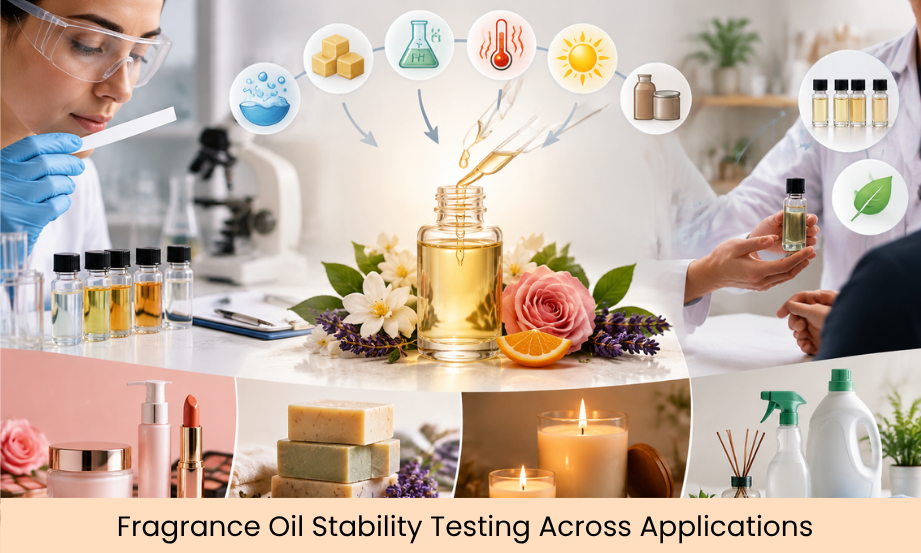
A fragrance oil that smells balanced from its original container or on a blotter strip cannot confirm how it will behave once it becomes part of a finished formulation. Fragrance stability depends heavily on what surrounds it, and that context changes the moment a fragrance meets a working product base. This is the core reason fragrance oil stability testing exists as a distinct step, separate from fragrance selection and initial evaluation.
Several factors influence how fragrance oils behave once incorporated:
- Surfactants and emulsifiers can alter odour perception and emulsion behaviour
- Oils, waxes and solvents may dissolve or interact with fragrance components
- Alkaline soap bases may alter fragrance character, while some fragrances can accelerate trace during cold-process soap manufacturing
- Preservatives and active ingredients may influence fragrance behaviour or finished-product stability, depending on the formulation
- Manufacturing temperature affects volatile components differently across product types
- Light and oxygen exposure can cause discolouration or off notes over time
- Storage conditions and packaging materials add further variables to fragrance retention
These influences differ across product categories. Fragrance testing in cosmetics should examine how a cosmetic fragrance affects emulsions, surfactant systems, viscosity, appearance and odour retention, while a fragrance oil for soap must withstand the relevant manufacturing conditions and curing or settling process. Testing fragrance oil for candles requires attention to wax compatibility, fragrance retention and burn performance. Manufacturers selecting fragrance for soaps or fragrance for agarbatti must also evaluate the material in the actual product and production process rather than relying only on its odour from the original container.
 Drop Us an Email!
Key Stability Criteria for Finished Fragranced Products
Testing should track how a fragrance and its host formulation change together over time, not just whether the scent remains pleasant. Key evaluation points include:
- Odour quality and character throughout the storage period
- Fragrance intensity and retention compared with a freshly made reference
- Development of undesirable or altered odour notes
- Colour change or discolouration in the finished product
- Cloudiness, separation or precipitation
- Changes in viscosity, texture or clarity
- Compatibility with the intended packaging
- Performance during normal, realistic product use
Keeping an unfragranced control and an initial fragranced reference helps evaluators distinguish changes in the base from changes associated with the fragranced formulation, giving a clearer picture during accelerated stability testing and real-time stability testing alike.
Fragrance Testing in Cosmetics and Personal Care Products
Cosmetic and personal care formulations such as creams, lotions, shampoos, conditioners and body washes combine surfactants, emulsifiers, preservatives and active ingredients that can each affect fragrance performance differently. Key variables to monitor include emulsion stability, product pH, viscosity and clarity, compatibility with surfactants, preservatives and active ingredients, and fragrance retention within the proposed commercial packaging. Cosmetic fragrance behaviour can shift once sealed in its final container, so packaging interaction deserves the same attention as the formulation itself.
Fragrance Oil for Soap: Stability Testing Considerations
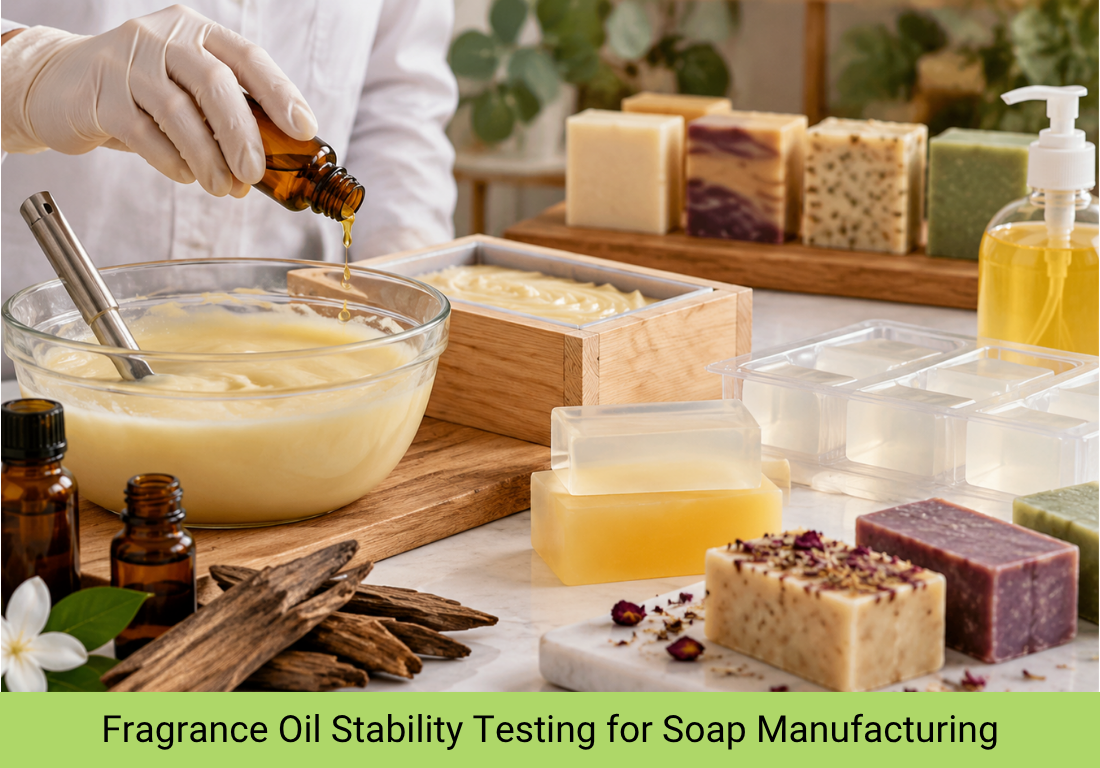
Soap manufacturing introduces alkaline conditions and processing steps that can noticeably change how a fragrance oil for soap performs. In cold-process soap, some fragrances may accelerate trace, causing the soap mixture to thicken faster than expected. Manufacturers should monitor changes in working time, setting behaviour, discolouration, scent character and fragrance retention during curing.
Cold-process, melt-and-pour and liquid soap bases each respond differently, so evaluation should continue through the complete curing or settling period rather than stopping at first impression. Successful performance in one soap base does not guarantee identical results in another, which is why soap fragrance stability testing should be repeated whenever the base changes.
Fragrance Oil for Candles: Stability Testing Considerations
Fragrance oil for candles needs evaluation using the actual wax, wick, container and fragrance concentration planned for production, since each element affects final performance. Compatibility with paraffin, soy, coconut or blended waxes and fragrance incorporation temperature are useful starting points. Depending on the candle format, evaluation may include cold throw, hot throw, oil migration or sweating, surface appearance, wick behaviour, flame stability, visible soot and container temperature.
Fragrance Stability Testing for Home-Care Products
Home-care fragrance testing covers detergents, surface cleaners, fabric care products, room sprays and other air-care formulations, each presenting different compatibility challenges.
Fragrance performance in these products should be evaluated for:
- Behaviour at acidic or alkaline pH
- Clarity in transparent cleaner formulations
- Interaction with surfactants and solvents
- Odour retention after dilution
- Performance on fabric or cleaned surfaces
- Spray compatibility for room and surface products
Testing should continue through storage and under realistic conditions of use, since these products are often opened, diluted or exposed to air repeatedly across their usage life.
Fragrance for Agarbatti: Application and Burning Evaluation
Fragrance for agarbatti and other incense products requires separate application evaluation because the aromatic material interacts with incense base materials, binders, processing conditions, drying, storage and burning. Manufacturers should assess the unburned odour, fragrance retention during storage, aroma diffusion during use, smoke character and compatibility with the selected incense composition. Testing should also determine whether the fragrance changes after incorporation or produces an unbalanced effect during burning.
Fragrance Oil Stability Testing: Building a Practical Plan
A workable plan typically follows these steps:
- Define the finished product formulation and fragrance concentration
- Prepare fragranced samples and an unfragranced control
- Follow the proposed manufacturing process and temperature conditions
- Fill samples into representative commercial packaging
- Establish suitable storage and exposure conditions
- Evaluate samples at predetermined intervals
- Record odour, appearance and relevant physical properties
- Conduct application-specific performance tests
- Investigate any unacceptable changes
- Confirm performance through pilot-scale or production-scale validation
Test conditions and duration should be set according to the product category, intended shelf life, formulation, packaging, distribution conditions and internal quality procedures. Accelerated stability testing is a useful indicator, but it should not be treated as an exact substitute for real-time stability data.
Information supplied by a fragrance manufacturer can support material selection, but it does not replace stability, safety, packaging and performance testing of the buyer's finished product. The final protocol and acceptance criteria should be established by the product manufacturer according to the formulation, application, intended shelf life and applicable requirements.
Fragrance Oil Stability Testing: Common Mistakes to Avoid
Manufacturers sometimes approve a fragrance based on the original sample alone, or test only one fragrance concentration without checking others. Failing to prepare an unfragranced control, ignoring processing temperature, and testing in laboratory packaging instead of the intended commercial pack are frequent oversights.
Other mistakes include evaluating odour while ignoring physical formulation changes, assuming performance in one product base applies automatically to another, skipping pilot-scale confirmation, and treating accelerated results as a guaranteed shelf life outcome. Avoiding these gaps early helps prevent costly reformulation later.
 Call Now
About BMV Fragrances Private Limited
BMV Fragrances provides fragrance oils, essential oils, reconstitutions and perfumery bases for businesses across cosmetics, personal care, soaps, candles, home-fragrance and home-care markets. The company supports application-focused fragrance selection and customised fragrance development for manufacturers, product developers and bulk buyers, along with commercial supply for varied formulation and volume requirements.
Conclusion
Fragrance oil stability testing should generally be conducted within the intended final formulation and packaging because cosmetics, soaps, candles and home-care products present different compatibility and performance challenges. Fragrance performance and physical product stability are best evaluated together rather than separately, and addressing this early reduces the risk of reformulation or delays during scale-up.
FAQs
It is the process of evaluating how a fragrance oil performs once incorporated into a finished product, tracking odour, colour, texture and packaging compatibility over time rather than judging the fragrance from its original container alone.
Ingredients such as surfactants, waxes, alkaline bases, preservatives and actives, along with processing heat and packaging, can all alter fragrance behaviour. Testing in the actual formulation reveals interactions that the original sample cannot show.
Fragranced samples are prepared within the intended cream, lotion or wash base and monitored for emulsion stability, pH, viscosity, colour, clarity and fragrance retention over a defined storage period, alongside an unfragranced control for comparison.
Manufacturers should monitor acceleration of trace, changes in working or setting time, discolouration, scent distortion and fragrance fading throughout the applicable curing or settling period.
Testing should use the actual wax, wick, container and fragrance concentration planned for production, evaluating cold throw, hot throw, oil migration, surface appearance and burn performance including flame stability and soot formation.
Recent Posts
- Natural Vetiver Oil vs Vetiver Reconstitution vs Perfumery Base: Which Option Should Formulators Choose?
- Geranium Oil Quality Control: How Bulk Buyers Evaluate Purity and Batch Consistency
- Labdanum Resinoid Solubility and Handling: A Practical Guide for Fragrance Manufacturers
- Oudh Oil for Attar and Mukhallat: Building Balanced Traditional Fragrance Blends
- Frankincense Serrata in Fine Fragrance: Building Woody, Citrus and Balsamic Accords
- How to Choose Perfume Oil Manufacturers & Suppliers: A Buyer's Quality Checklist
- Fragrance Oil Stability Testing for Cosmetics, Soaps, Candles and Home-Care Products
Copyright @ 2026 | BMV Fragrances Private Limited | All Rights Reserved
Website Design & Digital Marketing by webmasterindia.
Website Updated On: