





Listen to the Audio Version
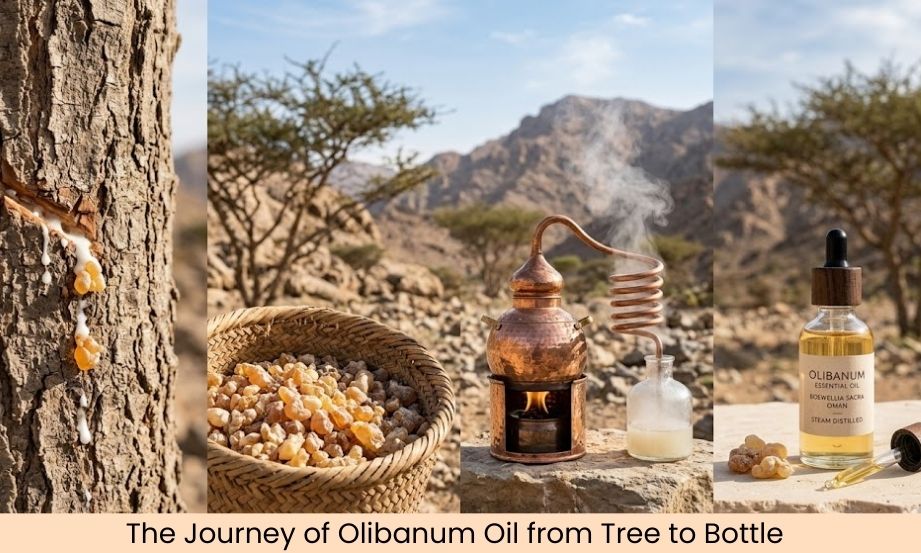
Few aromatic raw materials carry the weight of history as quietly and powerfully as Olibanum Oil. Derived from the resin of Boswellia trees native to the arid highlands of Somalia, Ethiopia, Oman, and India, this oil has moved through ancient trade routes, sacred rituals, and artisan perfumery for millennia. Yet for all its cultural reach, the process by which resin becomes finished oil remains poorly understood outside of specialty fragrance and flavour circles. This explainer pulls back the curtain on every stage of that journey — from the first incision made in a Boswellia trunk to the final condensation of steam-distilled aromatic compounds.
Olibanum Oil Begins with the Right Tree Species
The genus Boswellia encompasses roughly twenty species, but not all produce resin of equivalent aromatic or commercial value. Boswellia sacra (native to Oman and Yemen), Boswellia carterii (primarily from Somalia and Kenya), and Boswellia serrata (cultivated across India) are the three species most commonly tapped for commercial production. Each yields resin with a subtly different chemical profile, which in turn affects the character of the finished oil.
Boswellia sacra resin is generally considered the most prized, known for producing oil with a cleaner, more citrus-forward top note. Boswellia carterii tends toward a deeper, slightly earthier character. Boswellia serrata, processed extensively in India, yields a resin that lends itself particularly well to the production of Resinoid Olibanum — a thick, semi-solid extract that serves a different function than distilled oil but shares the same source material.
The geographic environment shapes the resin significantly. Trees growing at higher elevations, in drier soils with greater seasonal temperature variation, tend to produce denser resin with more complex terpene compositions. This is why origin traceability is treated as a point of distinction among serious fragrance houses and flavour ingredient suppliers alike.
Natural Olibanum Harvesting: The Art of Tapping Without Harm
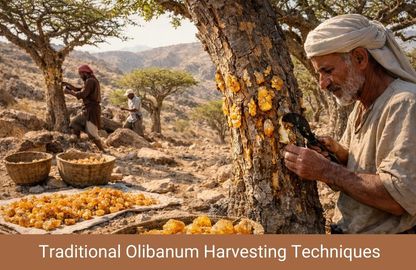
Harvesting begins with a practice called tapping or wounding, and it is as much a skill as it is a science. Collectors — often working the same family trees for generations — make shallow, deliberate incisions into the bark of the Boswellia trunk using a tool called a mingaf. The cut does not penetrate deeply; it only needs to breach the outer bark layer to access the oleoresin ducts beneath.
The tree responds to this wound by secreting resin as a natural defence mechanism. This initial flow is called the first tapping, and it is typically left to run and harden on the tree surface for a few weeks before being collected. Experienced tappers know not to rush this stage — the longer the resin is allowed to harden on the tree, the more volatile aromatic compounds become concentrated as moisture evaporates.
A single Boswellia tree can be tapped multiple times per season, with three to four tappings being common. The later tappings generally yield darker, more resinous material that is richer in heavier compounds. Natural Olibanum harvesters learn to stagger collections, allowing the tree adequate time between wounds to begin healing and prevent excessive depletion of its resin reserves. This discipline is not merely about preserving the tree for future seasons — it is the defining factor that separates quality-focused production from purely extractive practices.
Read Our Article
Olibanum Oil for Various Industries: A Comprehensive GuideOlibanum Gum: Sorting, Grading, and Cleaning the Raw Resin
Once collected, the hardened resin — commonly referred to as Olibanum Gum — arrives at sorting facilities in rough sacks or crates. At this stage, the material is far from homogeneous. It contains dust, bark fragments, sand, and sometimes insect matter picked up during field collection. Before any further processing, the raw Olibanum Gum must be cleaned and graded.
Sorting is conducted primarily by hand. Workers separate the tears — the individual hardened resin droplets — by size, colour, and opacity. The most highly valued tears are pale, milky-white, and relatively round in shape, indicating a clean first-tapping collection with minimal contamination. Darker, more amber-coloured pieces typically represent later tappings or have been exposed to greater heat and oxidation during collection.
Grading systems vary by region and buyer, but broadly, Olibanum Gum is separated into at least three or four commercial grades. Top-grade material is reserved for direct use in high-end incense formulation and steam distillation of fine-grade Olibanum Oil. Lower grades feed industrial applications, Olibanum Reconstitution blending, and solvent extraction for Olibanum Resinoid production.
Post-sorting, the resin is typically sieved to remove fine particulates, and in some facilities, lightly washed with water to remove surface dust before being spread in thin layers to dry in shaded, ventilated areas. The goal is to remove extraneous matter without driving off the lighter volatile fractions that carry the oil's characteristic brightness.
Olibanum Resinoid: The Solvent Extraction Route Explained
Not all commercially useful material from Boswellia resin is obtained through steam distillation. Olibanum Resinoid — sometimes written as Resinoid Olibanum — is produced by extracting the resin using a non-polar organic solvent, most commonly hexane or ethanol, though CO2 extraction is increasingly used in premium-grade production.
The process involves immersing the cleaned, broken resin pieces in the chosen solvent and allowing the aromatic compounds to dissolve over a controlled period. The resulting miscella (a solution of solvent and extracted compounds) is then filtered to remove undissolved plant matter. The solvent is subsequently evaporated under reduced pressure using rotary evaporation equipment, leaving behind a thick, viscous, dark-coloured mass.
Olibanum Resinoid retains a far broader spectrum of non-volatile and semi-volatile constituents than steam-distilled oil. This makes it particularly useful in fragrance formulation when a perfumer seeks the full body and warmth of frankincense without sacrificing fixative depth. It is also used as a base note anchor in incense, candle, and cosmetic applications where low-volatility aromatic richness is valued.
The production of Olibanum Resinoid is typically conducted in dedicated extraction facilities separate from distillation operations. Quality is judged by colour, consistency, odour profile, and the percentage of non-volatile residue — a figure that determines how much extractable aromatic matter was successfully captured during processing.
Our Other Product
Evernia PrunastriPure Olibanum Steam Distillation: The Core Production Method
Steam distillation is the method by which Pure Olibanum essential oil is produced, and it demands a level of precision that distinguishes serious producers from those simply moving volume. The process begins by loading cleaned, graded Boswellia resin — ideally in a consistent particle size — into a stainless steel distillation still. Particle size matters because it determines the rate of steam penetration and the efficiency of compound extraction.
Steam is introduced from below, either as direct steam (where water is added to the still and boiled in place) or indirect steam (where steam is generated in a separate boiler and piped into the still). Commercial operations producing Pure Olibanum at scale generally prefer indirect steam because it allows tighter control over temperature and pressure, reducing the risk of degrading lighter terpene fractions through overheating.
As the steam passes through the resin mass, it picks up volatile aromatic compounds — primarily monoterpenes like alpha-pinene, limonene, and alpha-thujene, along with sesquiterpenes and small amounts of diterpene derivatives. These compounds travel with the steam into a condensation coil immersed in cold water. The steam condenses back to liquid, and because aromatic compounds are largely immiscible with water, they separate naturally.
The resulting liquid in the collection vessel has two distinct layers: the essential oil (which floats due to lower density) and the aromatic hydrosol (distillation water). The oil is drawn off through a Florentine flask or separator funnel. This separated liquid is what the industry knows as Olibanum Oil — a clear to pale yellow fluid with a crisp, resinous, woody-citrus aroma and remarkable tenacity.
Olibanum Oil Distillation Variables That Define Final Quality
The duration of distillation is not a fixed parameter — it is a quality decision. Short distillation runs of two to four hours yield oil that is dominated by bright, volatile monoterpenes. The oil smells sharp, citrusy, and clean. Extended runs of six to ten hours begin pulling heavier, slower-moving sesquiterpene fractions, producing oil with greater depth, more resinous warmth, and stronger fixative behaviour in blends.
Temperature is equally critical. Excessively high steam temperatures can cause resinification of certain compounds within the still, reducing yield and degrading lighter-molecular-weight components. The optimal pressure and temperature range depends on the specific resin batch, its age, moisture content, and the particle size of the material.
Water quality for steam generation also plays a role. Hard water with high mineral content can interfere with the distillation process and leave trace mineral residues. Most quality-focused producers use filtered or softened water. Some facilities go further, using deionised water to ensure the final Olibanum Oil meets the strict purity standards required for pharmaceutical-grade or high-end flavour applications.
Yield from steam distillation is relatively modest compared to solvent extraction. Depending on resin quality and distillation parameters, Boswellia resin typically yields between three and ten percent by weight in essential oil. Premium first-tapping material with high volatile compound content sits at the higher end of that range.
Read Our Article
10 Proven Benefits of Olibanum Oil Backed by Scientific ResearchOlibanum Reconstitution: Blending Science Meets Aromatic Precision
Olibanum Reconstitution is a process that sits at the intersection of chemistry, perfumery knowledge, and material economics. A reconstituted Olibanum is crafted by combining several derived fractions — most commonly the steam-distilled essential oil, the Olibanum Resinoid, and in some formulations, specific isolated terpene components — to achieve an aromatic profile that replicates the full complexity of the original resin more closely than any single fraction could on its own.
The rationale for Olibanum Reconstitution is practical. Steam-distilled Olibanum Oil, while aromatic and potent, lacks the heavier, resinous bass notes that characterise the raw gum. Conversely, Olibanum Resinoid is too viscous and non-volatile for most direct applications. A well-formulated reconstitution captures the brightness of the distilled oil, the depth of the resinoid, and the overall naturalness of the source material in a single, workable ingredient.
Reconstitution is used extensively in fragrance creation when formulators need a frankincense accord with full-spectrum odour impact, ease of handling, and consistent batch-to-batch performance. High-end incense manufacturers, luxury candle producers, and flavour ingredient specialists each have their own preferred reconstitution ratios depending on the end application's performance requirements.
Quality control in Olibanum Reconstitution relies on gas chromatography-mass spectrometry (GC-MS) analysis to verify that the final blend's chemical profile falls within accepted parameters. Reference standards established from authenticated natural material allow producers to measure each batch against a defined fingerprint, ensuring that the reconstitution retains its natural character and meets specification.
Our Other Product
Amyris OilNatural Olibanum: Quality Assessment and Analytical Standards
Once distillation or extraction is complete, the finished material undergoes a series of quality assessments before it can be designated as Natural Olibanum suitable for commercial distribution. These tests span physical, chemical, and sensory dimensions.
Physical assessment covers specific gravity, refractive index, and optical rotation — three parameters that, taken together, provide a rapid first-pass indication of whether the oil's composition falls within expected ranges. Deviations can indicate adulteration, batch inconsistency, or process faults during distillation.
GC-MS analysis provides the definitive chemical fingerprint. For Olibanum Oil, the expected dominant compounds include alpha-pinene (typically twenty to sixty percent depending on origin), limonene, alpha-thujene, and incensole acetate among sesquiterpene constituents. Any detection of synthetic extenders — common adulterants including added pinene fractions or turpentine derivatives — registers clearly against a reference chromatogram.
Organoleptic assessment by trained evaluators rounds out the analytical process. A skilled assessor can detect off-notes that instrumentation alone may miss — particularly the subtle olfactory cues that indicate oxidation, microbial contamination during storage, or incorrect distillation conditions. For premium-grade Natural Olibanum bound for fine fragrance or flavour application, this human sensory review is considered non-negotiable.
 Call Us Now!
Olibanum Oil Storage, Stabilisation, and Shelf Life
Olibanum Oil is predominantly composed of monoterpenes, which are known for their relative susceptibility to oxidation and polymerisation over time. Exposure to heat, light, and oxygen degrades these compounds, shifting the oil's aroma profile toward a sharper, more camphoraceous character and reducing its performance in formulation.
Correct storage requires amber or opaque glass containers, ideally flushed with nitrogen before sealing to displace oxygen. Temperature should be kept consistently cool — between five and fifteen degrees Celsius — and away from direct light sources. Under these conditions, high-quality Olibanum Oil retains peak aromatic integrity for two to three years from distillation date.
Olibanum Resinoid and reconstituted materials have somewhat greater inherent stability due to their lower content of light volatile fractions, but they are equally sensitive to heat — which can cause phase separation or irreversible viscosity changes. Drum storage for larger volumes should include insulated packaging and climate-controlled warehousing.
Batch dating and lot traceability are standard practice among reputable Olibanum Oil suppliers. Each batch should be accompanied by a certificate of analysis (CoA) documenting GC-MS results, physical parameters, country of origin, botanical source species, extraction method, and distillation date. This documentation chain is essential for compliance in regulated end markets including flavour, cosmetic, and pharmaceutical applications.
Conclusion
The journey from Boswellia tree to finished Olibanum Oil is neither simple nor short — it involves botanical knowledge, skilled harvesting, meticulous resin grading, and precision distillation across facilities and geographies. Each stage, from the deliberate tapping of the bark to the controlled condensation of aromatic steam, contributes to the character and quality of the final material. Whether the end product is a steam-distilled Pure Olibanum, a solvent-derived Olibanum Resinoid, or a precisely calibrated Olibanum Reconstitution, the integrity of the finished ingredient is ultimately determined by the discipline applied at every step of its production chain.
Frequently Asked Questions
Olibanum Oil is the steam-distilled essential oil obtained from the hardened resin of Boswellia trees. It differs from Olibanum Resinoid, which is produced through solvent extraction and retains heavier, non-volatile compounds. While Pure Olibanum oil is clear to pale yellow and highly volatile with bright terpene-forward character, Resinoid Olibanum is a thick, viscous extract suited for fixative and base-note applications in perfumery and incense.
Boswellia sacra, native to Oman and Yemen, is widely regarded as producing the most prized resin for distillation, yielding oil with a clean, citrus-forward aromatic profile. Boswellia carterii from Somalia offers a deeper, earthier character, while Boswellia serrata from India is particularly valued for Resinoid Olibanum production. The quality of the final oil is also shaped significantly by growing elevation, soil type and seasonal climate conditions.
A single Boswellia tree can typically be tapped three to four times per season under responsible harvesting practice. Each tapping involves making a fresh shallow incision near a previous wound and allowing the secreted resin to harden on the tree surface before collection. Experienced collectors space out each tapping cycle carefully to allow the tree to begin healing between wounds, which helps maintain resin quality and prevents long-term depletion of the tree's output capacity.
Top-grade Olibanum Gum is characterised by pale, milky-white tears that are relatively uniform in size and shape, indicating clean first-tapping collection with minimal bark or dust contamination. Lower grades tend to be darker in colour - ranging from amber to brown - and contain more debris from later tappings or greater field exposure. Grade directly determines end use: premium tears go toward fine fragrance distillation, while lower grades feed industrial blending, Olibanum Reconstitution and Olibanum Resinoid production.
Olibanum Resinoid is most commonly produced using hexane or ethanol as the extraction solvent, with supercritical CO2 extraction increasingly adopted for premium-grade material. The solvent choice matters because it determines which molecular-weight compounds are captured. Hexane selects predominantly non-polar compounds; ethanol captures a broader spectrum including some polar constituents; CO2 extraction allows precise tuning of pressure and temperature to selectively target desired fractions. The resulting resinoid is then evaluated for colour, consistency, odour depth and non-volatile residue percentage.
The primary volatile compounds extracted during steam distillation of Pure Olibanum include monoterpenes such as alpha-pinene, limonene and alpha-thujene, which collectively give the oil its characteristic bright, resinous and slightly citrus aroma. Sesquiterpene compounds, including incensole acetate, contribute deeper, warmer and more balsamic dimensions. The ratio of these fractions in the finished oil depends on distillation duration, steam temperature, resin origin and tapping grade - all variables that producers manage to achieve a target aromatic profile.
Distillation run time has a direct and measurable impact on the aromatic composition of the finished oil. Short runs of two to four hours yield oil dominated by light monoterpenes - bright, crisp and highly volatile. Extended runs of six to ten hours progressively extract heavier sesquiterpene fractions, producing an oil with more resinous warmth, greater odour tenacity and stronger fixative performance in fragrance blends. Producers select run time deliberately based on the intended application of the finished Olibanum Oil.
Olibanum Reconstitution is formulated to overcome the inherent limitations of individual fractions. Steam-distilled Olibanum Oil lacks the heavy resinous depth of the raw gum; Olibanum Resinoid is too viscous for direct application in most finished products. A reconstituted material combines the distilled oil's brightness with the resinoid's depth and fixative character, producing a full-spectrum ingredient with consistent batch-to-batch performance. It is widely used in fine fragrance, luxury incense and cosmetic formulation where both aromatic complexity and handling ease are required.
Verification of Natural Olibanum quality relies on a combination of physical measurements and chemical analysis. Physical parameters assessed include specific gravity, refractive index and optical rotation - all of which provide rapid first-pass screening. Gas chromatography-mass spectrometry (GC-MS) delivers the definitive chemical fingerprint, confirming the presence and ratio of expected compounds and flagging adulterants such as added synthetic terpene fractions or turpentine derivatives. A trained organoleptic evaluation by a skilled assessor complements the instrumental analysis, detecting oxidation, off-notes or process anomalies that instruments alone may not flag.
Olibanum Oil should be stored in amber or opaque glass containers flushed with nitrogen before sealing, kept at a consistent temperature between five and fifteen degrees Celsius and shielded from direct light. Under these conditions, high-quality oil retains peak aromatic character for two to three years from its distillation date. The oil's high monoterpene content makes it susceptible to oxidation and polymerisation if storage conditions are not maintained - degradation presents as a sharper, camphoraceous shift in odour profile. Each commercial batch should be accompanied by a full certificate of analysis documenting distillation date origin, botanical species and GC-MS results.
Recent Posts
- Indian Oud Reconstitution vs. Natural Oud: Cost Effectiveness, Performance, and Quality Comparison for Bulk Buyers
- Floral Green Fragrance Bases: Formulating With Narcissus Absolute Alternatives in Modern Perfumery
- Reconstituted Oud Blending Guide: Dihydroambrettolide, Benzyl Acetone, and Ester Based Components for Professional Fragrance Formulation
- Geranium Oil Varieties Egyptian Reunion and Madagascar Geranium Compared
- Frankincense Serrata in Premium Incense Manufacturing
- Balsam Tolu vs Balsam Peru
- Vetiver Oil in Fresh Green and Woody Fragrances
Copyright @ 2026 | BMV Fragrances Private Limited | All Rights Reserved
Website Design & Digital Marketing by webmasterindia.
Website Updated On: