





Listen to the Audio Version
Prologue: The Material That Memory Is Made From
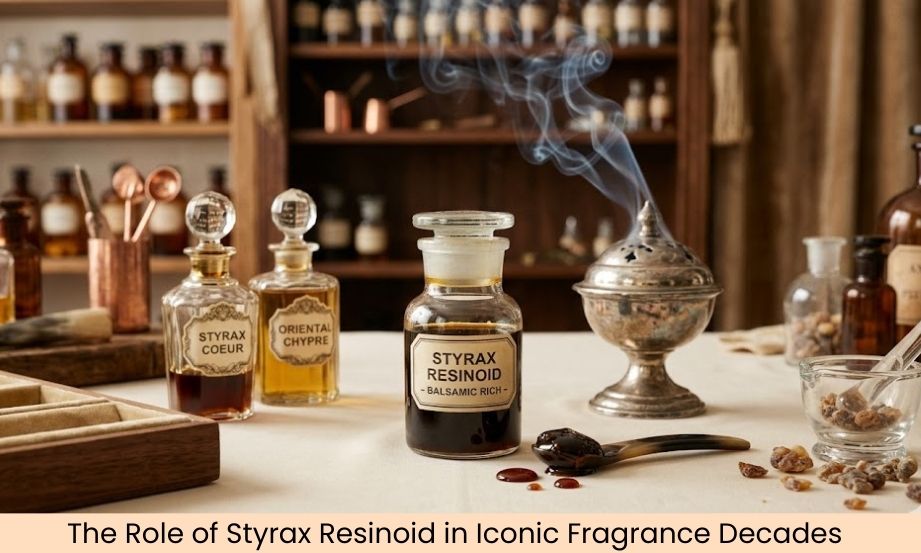
There is a smell that older perfumers will recognise the instant it drifts across the room — a smell that conjures old department stores, velvet-draped counters, and the particular quality of luxury as it was understood when the twentieth century was young. It is warm. It is balsamic. It is faintly smoky, faintly sweet, with a depth that suggests incense and amber and something older still. It is the smell of styrax.
Styrax resinoid — the solvent extract of the pathological resin produced by wounded Liquidambar trees in the highlands of Turkey and the Americas — has been used in perfumery for centuries. Ancient Egyptians burned it in temple rites. Medieval apothecaries prized it for its medicinal and aromatic properties. But it was the master perfumers of the twentieth century who elevated it from raw material to architectural element, deploying it with increasing sophistication in some of the most celebrated fragrances ever created.
This is the story of those perfumers and those fragrances. It is also the story of an ingredient that survived the synthetic revolution, weathered regulatory scrutiny, and emerged in the twenty-first century as a bridge between fragrance’s grand classical tradition and a new generation of perfumers who want depth, authenticity, and the unmistakable quality that only a genuinely complex natural material can provide.
The Chemistry Behind the Legend
To understand why master perfumers reached for styrax resinoid generation after generation, it is necessary to understand something of what the material actually is — not merely what it smells like, but why it behaves in the ways that made it indispensable.
Styrax resinoid is not a simple compound. It is a complex, variable mixture of cinnamic acid esters — principally cinnamyl cinnamate and cinnamyl benzoate — alongside free cinnamic acid, cinnamyl alcohol, styrene polymers, triterpenoid compounds, and dozens of minor aromatic constituents. This complexity is precisely what made it so useful. Unlike a single aroma chemical, which does one thing and does it consistently, styrax resinoid does many things simultaneously: it fixes volatile top notes by reducing their evaporation rate, it rounds harsh edges in floral and spicy materials, it contributes its own warm balsamic-smoky character as a base note, and its high-boiling constituents leave a tenacious skin-close impression that outlasts almost every other natural material in a composition.
The cinnamic esters are the key. Cinnamyl cinnamate in particular has an extraordinarily low volatility — it barely moves at room temperature — and a sweet, balsamic, slightly floral character that cushions and extends the more volatile compounds sitting above it in a fragrance pyramid. This is not a metaphor. The chemistry of fixation is a real physical phenomenon: the high-boiling components of styrax resinoid reduce the partial pressure of the volatile materials dissolved in them, slowing their evaporation and extending their presence on skin.
The Fixative Principle
When volatile aroma chemicals are dissolved in or co-precipitated with a low-volatility material like styrax resinoid, their effective vapour pressure decreases. This slows their evaporation from skin and fabric, extending the perceivable longevity of the top and heart notes above them. The best fixatives are those whose own odour character integrates harmoniously with the accord they are fixing — and this is precisely what styrax does.
 Call Us Now!
The 1920s: The Age of Architectural Perfumery
The 1920s
Opulence, orientalism, and the birth of the modern fragrance structure
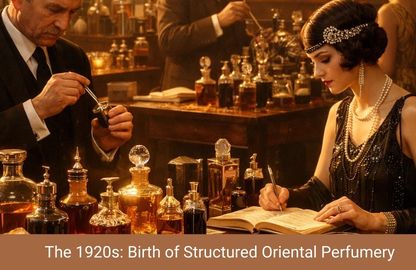
The nineteen-twenties changed perfumery forever. The decade that gave the world the Charleston, the Bauhaus, and the poetry of Eliot and Pound also produced a revolution in fragrance composition that would define what fine perfume meant for the next fifty years. At the centre of this revolution was a set of design principles borrowed from architecture and music: the idea that a perfume should have structure, that its character should evolve through defined phases, and that the depth of a composition depended on the quality of its foundations.
The oriental accords that dominated high-end perfumery in this period — rich, warm, resinous constructions built over balsamic and animalic bases — were impossible to realise without materials of exceptional fixative quality. Chief among these was styrax resinoid.
The Oriental Accord and Styrax’s Founding Role
The great oriental fragrances of the 1920s shared a structural DNA that their creators understood intuitively even if they could not always articulate it analytically. The base of a successful oriental was not merely a collection of heavy materials — it was a carefully balanced accord of balsamic, animalic, and resinous notes that created what the French perfumers of the period called fond, the deep background against which the whole composition played out.
Styrax resinoid was indispensable to this fond. Its balsamic warmth softened the harsh aspects of costus and civet. Its smoky, slightly phenolic quality deepened labdanum and oakmoss bases. And its extraordinary staying power ensured that the oriental accord’s character was still perceptible on warm skin twelve, sixteen, even twenty-four hours after application.
Read Our Article
Styrax Resinoid: Viscosity, Solubility, and Handling Properties| Perfumer | Jacques Guerlain |
|---|---|
| Styrax Role | Anchors the oriental base accord alongside labdanum and benzoin; the smoky balsamic character of styrax resinoid provides the warm cushion on which the rose, iris, and bergamot notes rest. It is the ingredient that makes the dry-down sing rather than merely persist. |
| Legacy | One of the best-selling fragrances of the 20th century. Its base accord, built substantially on balsamic resins including styrax, defined what 'oriental depth' meant for generations of perfumers who followed. |
Jacques Guerlain’s genius lay not in the innovation of individual notes but in proportion and architecture. He understood that the aldehydic top of Shalimar would last only minutes — its role was to announce and enchant. The citrus heart would persist longer. But the oriental base, with its labdanum and benzoin and the quiet depth of styrax underneath, was what would remain on the wearer’s skin as memory. That memory, he understood, was what created fragrance loyalty.
Ernest Beaux and the Russian School
While Guerlain was perfecting the oriental in Paris, the Russian emigre tradition — represented by perfumers like Ernest Beaux, who had trained in the Imperial Russian court perfumery tradition before the revolution brought him to Grasse — brought its own relationship with balsamic and resinous materials to French perfumery.
The Russian tradition had long used styrax and related balsams in both religious and secular fragrance contexts. For Beaux, these materials were not merely functional fixatives — they were emotionally charged ingredients that connected fragrance to memory, warmth, and a particular quality of depth that he considered essential to any composition worth wearing. His influence on the generation of perfumers who came after him helped cement styrax’s position not merely as a technical ingredient but as an emotionally significant one.
The Russian Balsamic Tradition
Russian Orthodox church incense traditionally incorporated levant styrax (the same botanical source as modern styrax resinoid) alongside frankincense, myrrh, and mastic. Russian perfumers trained in this context brought an instinctive understanding of styrax’s emotional resonance to French commercial perfumery — treating it not as a mere fixative but as a primary contributor to a fragrance’s character and memory-making power.
Our Other Product
Pure Ylang YlangThe 1930s–40s: Austerity, Glamour, and Structural Mastery
The 1930s – 1940s
Depression, wartime austerity, and the golden age of Hollywood glamour
The world of the nineteen-thirties and forties was defined by profound contradictions. The Great Depression imposed austerity on millions, yet the fragrance industry — particularly in Paris and New York — responded with an intensification of luxury, as if the great houses understood that fragrance was one of the few affordable luxuries that connected ordinary people to the glamour that cinema and fashion magazines placed before them.
The fragrances of this period are, in retrospect, masterworks of structural engineering. Constrained by expense and ingredient availability to create maximum impact from minimum complexity, the great perfumers of the era became extraordinarily skilled at using every material they worked with to its fullest potential. Styrax resinoid was among the most versatile tools at their disposal.
Florals with Depth: The Chypre-Balsamic Family
The chypre family — built on the classical accord of bergamot, labdanum, and oakmoss — was the other great structural achievement of early twentieth-century perfumery alongside the oriental. Where the oriental was unabashedly warm and heavy, the chypre was more complex: austere and mossy on one side, warmly balsamic on the other, with a green-citrus sparkle at the top that gave it an elegance the oriental sometimes lacked.
Styrax resinoid’s role in the chypre family was more subtle than in the oriental. Rather than anchoring a heavy base accord, it served as a bridge — softening the rough, angular quality of oakmoss, warming the coldness that labdanum could sometimes exhibit in isolation, and providing a balsamic continuity that held the accord together as it evolved from the bright bergamot opening to the deep mossy dry-down.
| Perfumer | Jacques Guerlain |
|---|---|
| Styrax Role | Used in the chypre base to warm and round the oakmoss-labdanum accord; the peach aldehyde heart rests on a foundation where styrax resinoid provides balsamic continuity and prevents the mossy base from becoming too cold or angular. It is the warmth behind the mystery. |
| Legacy | Considered by many perfumers to be the most technically perfect fragrance ever created. Perfumer Luca Turin described its dry-down as “the greatest chord in perfumery.” That chord owes its warmth, in significant part, to the balsamic base that styrax anchors. |
Wartime Adaptation and the Substitution Question
The Second World War created severe disruption to the supply of aromatic raw materials. Many ingredients sourced from occupied territories became unavailable. The laboratories of Grasse, New York, and London faced the challenge of maintaining the characters of established fragrances — or creating new ones — with significantly constrained palettes.
Styrax resinoid, sourced primarily from Turkey (a non-belligerent power) and increasingly from the Americas, was among the few natural balsamic materials that remained relatively accessible during the war years. Perfumers who had previously used it as one among several balsamic fixatives found themselves depending on it more heavily as labdanum, benzoin, and other resinous materials became scarce.
This forced intimacy produced a generation of perfumers with extraordinary knowledge of styrax’s capabilities — its range of application, its compatibility with other materials, and the variety of accords it could anchor. The wartime constraint became, paradoxically, a school of advanced styrax mastery that shaped the compositions of the late 1940s and 1950s.
The 1950s–60s: Post-War Luxury and the Synthetic Revolution
The 1950s – 1960s
Reconstruction, confidence, and the emergence of synthetic aroma chemistry
The post-war decades brought affluence, optimism, and — for the fragrance industry — a technological revolution that would fundamentally alter the relationship between natural and synthetic materials. The rapid development of synthetic aroma chemicals created an extraordinary palette of new materials: musks of unprecedented cleanliness and persistence, aldehydes of radical transparency, and woody base notes of a consistency that natural materials could rarely match.
In this context, styrax resinoid faced its first serious challenge. Why use a complex, variable, expensive natural resinoid when a synthetic could deliver a defined subset of its properties with perfect consistency? The perfumers of this era answered that question through their work: because the complexity, the variability, and the interactivity of a genuine natural material was precisely what gave a great perfume its humanity.
The New Aldehyic-Balsamic Accord
The meeting of synthetic aldehydes with natural balsamic resins produced some of the most celebrated fragrances in history. Aldehydes — particularly the C-10, C-11, and C-12 series — created a characteristic shimmering, waxy, almost metallic luminosity in the top of a fragrance that was entirely new in the 1920s and remained fashionable through the 1950s. But the aldehydes, brilliant as they were, needed anchoring: left without a substantial base, their top note effect dissipated too quickly and left nothing of value behind.
Styrax resinoid was the perfect anchor. Its warmth complemented the cool metallicity of the aldehydes. Its balsamic depth gave the composition a foundation from which the aldehyde brightness could spring. And its extraordinary persistence meant that the wearer, hours after the top notes had vanished, was left with a warm, skin-close balsamic impression that functioned almost as a signature — the scent of the skin itself, transformed.
| Perfumer | Josephine Catapano (Estée Lauder Creative Team) |
|---|---|
| Styrax Role | Central to the rich oriental-balsamic base that distinguished Youth Dew from the lighter European florals of its era; styrax resinoid contributes the warm, smoky-balsamic depth that made the fragrance’s skin-close dry-down so memorable and commercially distinctive. |
| Legacy | Youth Dew became Estée Lauder’s flagship for decades and introduced American women to the concept of wearing fragrance as a personal statement rather than a light finishing touch. Its balsamic boldness, rooted in materials like styrax, was a deliberate break from prevailing convention. |
Robert Ricci, Edmond Roudnitska, and the New Naturalism
Not all perfumers of the 1950s and 1960s embraced the synthetic revolution with equal enthusiasm. Edmond Roudnitska, who created some of the most influential fragrances of the mid-twentieth century and whose theoretical writings on the aesthetics of perfumery remain essential reading, was deeply committed to what he called the transparency and truthfulness of natural materials.
For Roudnitska, the value of natural materials like styrax resinoid lay not in any specific constituent compound but in the totality of their character — the way their dozens of components interacted with each other and with other ingredients in ways that no synthetic could reproduce. A single synthetic cinnamic ester might smell broadly similar to a component of styrax. But the context in which that compound appeared in the natural resinoid — surrounded by dozens of supporting compounds that modified, extended, and humanised it — was inimitable.
The 1970s–80s: Power, Excess, and the Triumph of the Bold
The 1970s – 1980s
Power dressing, fragrance as statement, and the era of olfactory ambition
The nineteen-seventies and eighties produced fragrances of a scale and ambition that has never been equalled before or since. The perfumes of this era were not designed to be subtle: they were designed to arrive before you did and to linger long after you had left. They were weapons, declarations, signatures. And the materials that gave them their power — their reach, their persistence, their almost physical presence — were the great natural balsamic resins, used in quantities that would astonish a modern formulator working within current IFRA guidelines.
Styrax resinoid was at the heart of this moment. In an era when fragrance houses competed to create the most powerful, most persistent, most immediately recognisable scents in the world, the one material that combined genuine olfactory character with extraordinary fixation power was indispensable.
The Oriental Renaissance
The 1970s saw a major revival of interest in the oriental family, driven in part by growing Western fascination with Middle Eastern and Asian cultures, and in part by the simple commercial observation that heavy, balsamic fragrances sold extremely well to the growing luxury markets of the Arab world and the newly affluent consumers of the Pacific Rim.
The perfumers who built this oriental renaissance — a generation that included Yves Rocher’s house perfumers, the teams at IFF and Givaudan who were creating the great commercial orientals of the period, and independent artists like Jean-Paul Guerlain working within his family’s tradition — used styrax resinoid with a freedom and generosity that expressed both their confidence in the material and the commercial permissiveness of an era before IFRA restrictions had significantly constrained balsamic materials.
| Perfumer | Jean-Louis Sieuzac |
|---|---|
| Styrax Role | Used at the foundation of the oriental-spicy base accord, where its warm balsamic character supports and extends the frankincense, myrrh, and labdanum framework. In Opium, styrax resinoid functions as the connective tissue between the spicy top and the heavy animalic base — the element that makes the transition seamless and the whole composition unified. |
| Legacy | One of the most commercially successful fragrances ever created and a defining statement of 1970s olfactory ambition. Its unapologetic heaviness and extraordinary persistence were made possible by precisely the kind of generous use of natural balsamic materials that modern formulation increasingly constrains. |
The 1980s: Power Florals and the Balsamic Anchor
The 1980s power floral — typified by the massive tuberose-jasmine constructions that dominated the mid-decade — presented a different challenge for the perfumer. The white floral materials at the heart of these compositions were, by nature, bright, loud, and expansive. What they needed was not a heavy oriental base — which would drag the brightness down — but a warm, balsamic anchor that sustained the floral without overwhelming it.
Styrax resinoid, used with more restraint than in the oriental context, performed this function beautifully. Its warmth prevented the tuberose-jasmine accord from going clinical or cold. Its smoky balsamic undertone added a sophisticated complexity that separated the finest 1980s florals from their cheaper, sharper competitors. And its persistence on skin ensured that the fragrance’s impression lingered long into the dry-down rather than evaporating in its own initial brilliance.
| Perfumer | Bob Aliano |
|---|---|
| Styrax Role | Part of the warm balsamic-musky base that gives the composition its remarkable longevity and differentiates it from lighter floral constructions of the same era. The styrax contribution is felt in the warm, slightly smoky quality of the extended dry-down, long after the brilliant tuberose-rose heart has given way. |
| Legacy | Became notorious for its projection and sillage — so potent that some restaurants banned it. That projection was made possible by the combination of high fragrance concentration and a balsamic base structure anchored by materials including styrax resinoid. |
Our Other Product
CastoreumThe 1990s: The Clean Revolution and the Quiet Survivor
The 1990s
Minimalism, clean aesthetics, and styrax’s role in defying the trend
If the 1970s and 1980s were styrax’s era of maximum deployment, the 1990s represented its first serious existential challenge. The decade brought a reaction against the excess of the previous era that was both aesthetic and commercial. Consumers, exhausted by the heaviness of the power fragrance era, reached for cleaner, lighter, fresher compositions. The marketing language of the period — water, air, skin, transparency — was antithetical to everything that made styrax resinoid great.
The ozonic and aquatic accords that dominated the early 1990s, led by landmark fragrances that evoked sea air, fresh linen, and rain on warm stone, had no obvious place for a dark, thick, intensely balsamic resinoid. Many perfumers of the period effectively stopped using it except in deliberately retro or niche contexts. And yet styrax survived — not by riding the tide of the moment, but by doing what it had always done best: providing, in small, carefully placed quantities, the depth and warmth that even the most minimalist composition cannot entirely abandon without losing its soul.
Styrax in Minimalist Context: The Art of Restraint
The perfumers who continued to use styrax resinoid in the 1990s did so with a restraint that was, in its own way, as sophisticated as the generous orientalism of the previous decade. Used at 1–2% of a fragrance concentrate rather than the 8–15% that had been common in the 1970s oriental context, styrax became an almost invisible presence — a warm undertone that the nose perceived as the difference between a composition that felt complete and one that felt somehow unresolved.
This ‘invisible’ use of styrax is perhaps the most technically demanding of all its applications. At high concentrations, its character is unmistakable. At low concentrations, it must blend seamlessly into the composition’s background while still performing its fixative function and contributing its subliminal warmth. The perfumers who understood how to use it in this way were, in the view of many industry observers, the most technically accomplished of their generation.
The Subliminal Fixative
Used at 0.5–2% of a fragrance concentrate, styrax resinoid becomes perceptually invisible but structurally essential. The nose cannot identify it as a distinct note. But remove it, and the composition loses something — a warmth, a continuity, a sense of resolution in the dry-down. This is perhaps the most sophisticated use of a natural fixative in perfumery: not to contribute a note, but to make all the other notes better.
The 2000s–10s: Niche Perfumery and the Resinoid Renaissance
The 2000s – 2010s
The rise of niche perfumery, the artisan renaissance, and a new reverence for naturals
The first two decades of the twenty-first century brought the most significant structural transformation in the fragrance industry since the synthetic revolution of the 1950s. The rise of niche perfumery — small, independent fragrance houses operating outside the mass-market commercial framework, targeting educated fragrance enthusiasts willing to pay premium prices for compositions of genuine complexity and artistic ambition — created a new market context in which natural materials, including styrax resinoid, were not merely permitted but actively celebrated.
The niche perfumers who built their reputations in this period — Serge Lutens, Christopher Brosius, Andy Tauer, Sarah McCartney, and dozens of others around the world — approached their craft with an intellectual seriousness that had been largely absent from mainstream commercial perfumery for decades. They wrote about their materials, educated their customers, and made the choice of ingredient itself part of the narrative of each composition. In this context, styrax resinoid was not a commodity input. It was a protagonist.
Serge Lutens and the Return to Orientalism
No single perfumer did more to rehabilitate the rich, resinous oriental tradition in the post-1990s period than Serge Lutens, working initially with master perfumer Christopher Sheldrake and later with a series of collaborators. Lutens’ fragrances, released through his Palais Royal boutique in Paris and gradually introduced to a wider audience through his Shiseido collaboration, were uncompromising explorations of olfactory depth, complexity, and what Lutens himself described as the ‘architecture of darkness.’
Styrax resinoid featured centrally in several of the most acclaimed Lutens compositions — not as a background fixative but as a named, acknowledged protagonist. Lutens was among the first mainstream-adjacent perfumers to discuss his use of specific natural materials in public, and his willingness to speak about the role of balsamic resins in his work helped to educate a new generation of fragrance enthusiasts about what these materials were and what they contributed.
| Perfumer | Christopher Sheldrake |
|---|---|
| Styrax Role | Uses labdanum, cistus, and dark balsamic resins including styrax as foundational elements of an exploration of the aromatic legacy of the 19th-century Borneo spice trade. The styrax contribution is central to the smoky-balsamic quality that makes this fragrance feel genuinely archaic — as if transported from a trading post in another century. |
| Legacy | Critically acclaimed as one of the most successful reinterpretations of the historical oriental accord in contemporary niche perfumery. Demonstrates that the balsamic-resinoid vocabulary can speak to twenty-first-century audiences as compellingly as it did to those of the 1920s. |
The Arabian Market and the Oud-Balsamic Tradition
The explosive growth of the Middle Eastern luxury fragrance market in the 2000s created a powerful new demand for compositions built on dark, resinous, animalic foundations that European commercial perfumery had largely abandoned. Arabian fragrance tradition — rooted in oud, rose, musk, and balsamic resins — demanded precisely the materials that the niche revival was simultaneously reintroducing to Western audiences.
Styrax resinoid occupied a particularly important position in this context. In traditional Arabic mukhallat (blended) fragrance compositions, balsamic materials including levant styrax had long been used alongside oud and rose to create the warm, enveloping base character that Arabic fragrance culture prized. The reconnection of modern global perfumery with this tradition — through brands like Amouage, Memo, and numerous independent Arabian houses — created a significant new market for high-quality styrax resinoid and reinforced its position as an ingredient of enduring cross-cultural significance.
BMV Fragrances
BMV Fragrances supplies Styrax Resinoid to fragrance houses serving both European niche markets and the Middle Eastern luxury fragrance sector. Our material is consistently produced to support both the delicate, precision-dosed applications of European artisan perfumery and the generous, characterful applications of Arabic fragrance tradition. We understand that different perfumery cultures use this material differently — and we supply a resinoid that performs beautifully across all of them.
Read Our Article
MandarineThe 2020s: Naturals, Nostalgia, and the Living Archive
The 2020s
Sustainability, nostalgia, and the new generation’s rediscovery of classical materials
The fragrance world of the 2020s is navigating a set of tensions that would have been familiar to perfumers at any point in the past century: the tension between natural and synthetic, between restriction and freedom, between commercial accessibility and artistic integrity. What is new in this decade is the intensity and sophistication with which these tensions are being publicly discussed — by perfumers, by critics, by an increasingly educated consumer audience that understands more about fragrance ingredients than any previous generation of fragrance buyers.
In this context, styrax resinoid has acquired a new significance that goes beyond its functional properties. It has become a living archive: a material that connects the contemporary perfumer to a century of olfactory tradition, that embodies the balsamic-resinous vocabulary that produced the greatest fragrances of the twentieth century, and that offers a kind of depth and authenticity that no synthetic alternative has yet convincingly replicated.
The Sustainability Question
The twenty-first-century perfumer works under a scrutiny that their predecessors never faced: scrutiny of ingredient sourcing, of environmental impact, of the conditions under which raw materials are produced. Styrax resinoid, sourced from Liquidambar trees in Turkey and the Americas, presents a relatively favourable profile in this context.
The resin is harvested through controlled wounding of living trees, which continue to produce resin for years or decades after the initial wounding. No tree felling is required. The trees that produce levant styrax grow in regions where they represent an important economic resource for local communities, creating incentives for their conservation rather than their destruction. Responsible sourcing programs that ensure fair payment to harvesters and sustainable harvesting practices are increasingly part of the supply chain for quality styrax resinoid — and are central to the sourcing philosophy of suppliers like BMV Fragrances.
IFRA Restrictions and the Formulator’s Response
The major practical challenge facing the contemporary perfumer who wishes to use styrax resinoid is the IFRA restriction framework. Styrax resinoid is a restricted ingredient under the current IFRA amendment, with use levels capped by product category due to the sensitisation potential of its cinnamic acid derivatives. These restrictions are real, meaningful, and demand respect — a perfumer who ignores them places both their customers and their commercial relationships at risk.
But restriction does not mean prohibition. The most skilled contemporary perfumers have responded to IFRA constraints not by abandoning styrax but by developing more sophisticated techniques for its use — using it more precisely, at lower concentrations, in contexts where its fixative and character contributions are maximised per unit of material used. The result, paradoxically, is a generation of perfumers who understand styrax more deeply than many of their predecessors, precisely because constraint has forced them to be more thoughtful about its deployment.
IFRA and Responsible Use
The current IFRA amendment restricts styrax resinoid use levels by product category. Any perfumer or formulator incorporating styrax resinoid in finished products must verify compliance with current IFRA guidelines before releasing the product. BMV Fragrances provides IFRA compliance documentation with every shipment of our styrax resinoid, and our team can advise on compliance requirements for specific application categories.
The New Natural Perfumers
Perhaps the most encouraging development of the 2020s for styrax resinoid is the emergence of a new generation of natural and botanical perfumers for whom materials like styrax are not historical relics but living creative tools. Working entirely or predominantly with natural materials, these perfumers have developed an intimacy with the full palette of balsamic, resinous, and animalic naturals that commercial perfumery largely abandoned after the 1980s.
For these perfumers, styrax resinoid represents something particularly valuable: a material of genuine complexity and proven emotional resonance whose full potential has not yet been exhausted. A century of great perfumers have explored it, built great things with it, and still left corners of its character unexplored. The combination of historical depth and creative possibility is, for the new generation of natural perfumers, precisely what makes it compelling.
Read Our Article
How to Use Benzoin Incense to Cleanse Your Home of Negative Energy?A Century of Techniques: How Master Perfumers Used Styrax
The following table summarises the principal technical roles that master perfumers have assigned to styrax resinoid across the decades, providing a reference framework for contemporary formulators who wish to draw on this century of accumulated knowledge.
| Technique | Era Associated | How It Works | Contemporary Application |
|---|---|---|---|
| Oriental base anchor | 1920s–1980s | Used at 5–15% of concentrate alongside labdanum, benzoin, and animalics to create a warm, heavy balsamic foundation for oriental accords. | Still relevant for oriental, amber, and oud-dominant compositions; observe current IFRA limits. |
| Aldehyde cushion | 1950s–1970s | Positioned beneath bright aldehyic top notes to provide warmth and persistence; prevents the cold metallic quality of aldehydes from dominating the dry-down. | Effective in modern interpretations of classic aldehyic-floral structures. |
| Chypre bridge | 1920s–1960s | Used at moderate levels to soften the angular quality of oakmoss and warm the coldness of labdanum in classical chypre structures. | Valuable in neo-chypre compositions using modern mossy alternatives. |
| Invisible base note | 1990s–present | Used at 0.5–2% to provide subliminal warmth and fixation without contributing a perceptible balsamic note; the hand that holds the composition together. | Highly relevant for contemporary minimalist and clean fragrance structures that need depth without heaviness. |
| Power floral anchor | 1980s | Used beneath heavy white floral accords (tuberose, jasmine) to prevent the composition from going cold or clinical in the dry-down. | Applicable to modern floralcy constructions and intense white floral perfumes. |
| Spice integrator | 1970s–2000s | The warm balsamic quality of styrax smooths and rounds spice notes (cinnamon, clove, black pepper), preventing them from becoming harsh or dominant. | Particularly effective in contemporary spicy-woody oriental constructions. |
| Oud complement | 2000s–present | Used alongside oud materials to add balsamic warmth and cinnamic complexity to the oud accord; historically used in Middle Eastern mukhallat traditions. | Central to premium oud-balsamic compositions for both Western and Middle Eastern markets. |
| Smoke controller | All eras | The smoky, slightly phenolic quality of styrax can be used to suggest incense, smoke, or ancient resins; or used at low levels to add subliminal smokiness to other accords. | Effective in contemporary incense, smoky wood, and meditative fragrance categories. |
Our Other Product
Balsam Peru OilSourcing the Tradition: BMV Fragrances and Styrax Resinoid
The hundred-year history of styrax resinoid in master perfumery is the history of a material that rewards quality. Every use case described in this article — from Guerlain’s foundational oriental accord to the contemporary niche perfumer’s precision dosing — depends on a resinoid of authentic character, consistent composition, and genuine depth. A poor-quality or adulterated resinoid can produce none of these effects. Quality is not optional for a material with this level of olfactory ambition.
BMV Fragrances is a leading manufacturer, exporter, and wholesale supplier of Styrax Resinoid in India, supplying the global fragrance community with a material that is worthy of the tradition it represents. We manufacture under controlled conditions, provide complete batch documentation, and take the quality of our resinoid seriously because we understand that the perfumers who use it are building on a century of accumulated mastery.
| What the Tradition Demands | What BMV Fragrances Delivers |
|---|---|
| Authentic balsamic character with genuine depth | Properly processed resinoid with characteristic cinnamic ester profile and full smoky-balsamic complexity |
| Consistent composition across batches | Controlled manufacturing; batch-specific CoA and GC/MS documentation; specification-bound production |
| Full regulatory documentation | IFRA compliance letter (current amendment), SDS, CoA, origin declaration — every shipment |
| Traceability of origin | Declared origin; manufacturer documentation confirming production in India |
| Flexibility for studio to production scale | Sample quantities through bulk orders; same quality and documentation standards at every scale |
| Supplier the perfumery tradition can rely on | Established manufacturer and exporter; experienced in serving global fragrance customers; responsive commercial team |
BMV Fragrances
Whether you are recreating the architecture of a classic oriental, exploring the subliminal fixative technique of the 1990s minimalists, or building the oud-balsamic compositions of contemporary Middle Eastern-inspired perfumery, BMV Fragrances’ Styrax Resinoid is the material that connects your work to a century of mastery. Contact us to request a sample or discuss your supply requirements.
Frequently Asked Questions
Short answers to the most common questions asked by fragrance enthusiasts and professional perfumers about styrax resinoid’s history, character, and contemporary use.
Styrax resinoid is a solvent extract of the balsamic resin of Liquidambar trees. Classical perfumers valued it for three reasons simultaneously: its warm, smoky-balsamic odour character, which contributed a distinctive depth to base accords; its extraordinary fixative power, which extended the longevity of the more volatile materials above it; and its complexity, which meant it interacted differently with every other ingredient in a composition, making each use unique.
Styrax resinoid has been identified as a significant component in the base accords of numerous celebrated fragrances, including iconic orientals from Guerlain such as Shalimar and the closely related oriental family that Shalimar inspired. It appears in classical chypres, in the great oriental constructions of the 1970s and 1980s, and in many niche fragrances of the 2000s and 2010s that deliberately revisit classical balsamic-resinous vocabulary. Its presence is often described in terms of the warm, smoky-balsamic quality of a fragrance’s dry-down rather than attributed by name.
Styrax essential oil is produced by steam distillation and contains primarily the lighter, more volatile components of the raw resin — principally cinnamyl acetate and related esters. Styrax resinoid, produced by solvent extraction, retains both the volatile and non-volatile components of the resin, including the high-boiling cinnamic esters and polymeric compounds that give it its fixative power and balsamic depth. The resinoid is darker, thicker, more intense in character, and more valuable as a fixative than the essential oil.
Styrax use declined in the 1990s primarily because of the market shift toward light, clean, aquatic fragrances in which heavy balsamic resins had no natural place. The recovery came in two waves: first through the niche perfumery movement of the 2000s, which celebrated the classical oriental vocabulary; and second through the growth of Middle Eastern luxury fragrance markets, where balsamic and resinous materials are central to indigenous fragrance tradition. Styrax resinoid is today firmly re-established as a serious ingredient in both niche and mainstream luxury perfumery.
Yes, with care. Used at low concentrations (0.5–2% of the fragrance concentrate) within current IFRA limits, styrax resinoid can add subliminal warmth and fixative function to clean and minimalist fragrances without contributing a perceptible balsamic character. The technique requires skill — it is easy to use too much and destroy the lightness of the composition — but when done well, it produces a warmth and depth that no synthetic can fully replicate.
In isolation on a blotter, styrax resinoid opens with a warm, slightly smoky, faintly phenolic quality — reminiscent of incense or an old apothecary. Over 30–60 minutes it develops a richer, more balsamic-sweet character, somewhat reminiscent of labdanum but with a distinctive cinnamic warmth. The dry-down, hours later, is intensely skin-close, warm, and subtly sweet-spicy. In a fragrance composition, its character is almost always felt rather than specifically identified — it is the warmth in the base, the continuity in the dry-down, the quality that makes the skin note linger.
Styrax resinoid is a regulated ingredient due to its content of cinnamic acid derivatives, which are contact sensitisers in susceptible individuals. It is subject to IFRA concentration restrictions by product category and requires allergen declaration under EU Cosmetics Regulation (certain compounds must be listed when present above threshold concentrations in finished products). Used within current IFRA limits and with appropriate labelling, it is safe for cosmetic and fragrance use. BMV Fragrances provides IFRA compliance documentation with every shipment.
Levant styrax resinoid, from Liquidambar orientalis growing in Turkey, is considered the benchmark quality: warmer, sweeter, and richer in the cinnamic ester profile that gives the finest resinoids their character. American styrax resinoid, from Liquidambar styraciflua growing in the Americas, tends to be lighter in colour, slightly greener in character, and often lower in cinnamic ester content. Both are used commercially; levant styrax commands a premium and is preferred for fine fragrance applications. BMV Fragrances can advise on origin options for your specific application.
Classical house perfumers worked within commercial frameworks that rewarded consistency, volume, and predictability. Contemporary niche perfumers typically treat styrax resinoid as a creative protagonist — they write about it, name it in their ingredient lists, and build compositions specifically designed to showcase its character. They also tend to be more technically knowledgeable about its composition and more precise in their dosing, partly from necessity (IFRA restrictions require precision) and partly from an intellectual engagement with the material that commercial perfumery rarely encouraged.
BMV Fragrances is a leading manufacturer, exporter, and wholesale supplier of Styrax Resinoid in India, supplying perfumers, cosmetic manufacturers, and fragrance ingredient buyers across the globe. We provide batch-specific documentation (CoA, GC/MS, IFRA compliance letter, SDS) as standard and supply from sample quantities to bulk orders. Contact us to request a sample and experience the quality of styrax resinoid that is worthy of the tradition described in this article.
Recent Posts
- Indian Oud Reconstitution vs. Natural Oud: Cost Effectiveness, Performance, and Quality Comparison for Bulk Buyers
- Floral Green Fragrance Bases: Formulating With Narcissus Absolute Alternatives in Modern Perfumery
- Reconstituted Oud Blending Guide: Dihydroambrettolide, Benzyl Acetone, and Ester Based Components for Professional Fragrance Formulation
- Geranium Oil Varieties Egyptian Reunion and Madagascar Geranium Compared
- Frankincense Serrata in Premium Incense Manufacturing
- Balsam Tolu vs Balsam Peru
- Vetiver Oil in Fresh Green and Woody Fragrances
Copyright @ 2026 | BMV Fragrances Private Limited | All Rights Reserved
Website Design & Digital Marketing by webmasterindia.
Website Updated On: