
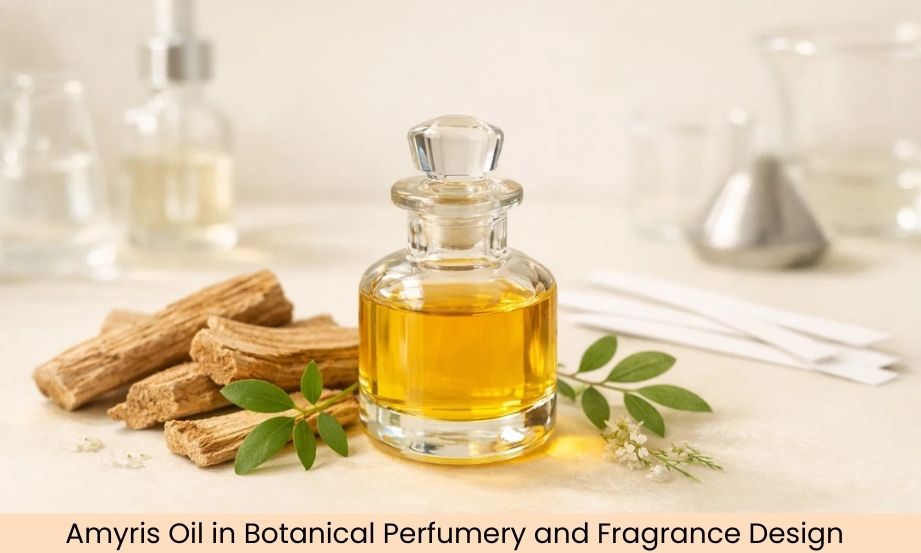





Listen to the Audio Version
Amyris Oil - Base Notes, Fixative Properties, and Fragrance Blending
Among the many botanical materials available to the natural perfumer, amyris oil occupies a deceptively humble but indispensable place. Distilled from the wood of Amyris balsamifera — a small, flowering tree native to Haiti and the wider Caribbean — amyris oil is sometimes dismissed as a cheap sandalwood substitute. This reputation does the material a serious disservice. Used knowledgeably, amyris oil is a versatile, sustainably sourced, and olfactorily complex base note that brings warmth, depth, and lasting power to an enormous range of fragrance compositions.
This article explores amyris oil from the perspective of the working perfumer: its olfactory character, its chemistry and fixative action, its interactions with other naturals, and practical guidance for incorporating it into blends across a variety of fragrance families.
Botanical and Production Overview
Amyris balsamifera is a member of the Rutaceae (citrus) family, though it bears little olfactory resemblance to its citrus relatives. The tree is sometimes called West Indian Rosewood or candlewood — the latter name referring to the fact that its resinous wood burns so readily it was historically used as torchwood by Caribbean communities.
The essential oil is produced by steam distillation of the dried wood chips and sawdust, typically yielding between 2% and 4% oil by weight. Haiti is the primary production country, though cultivation also occurs in parts of Central America. The oil is considered one of the more affordable naturals in the perfumer's palette, partly because the tree grows abundantly and the distillation process is well-established, and partly because the raw material is largely a by-product of the timber industry.
Sustainability Note
Unlike true sandalwood (Santalum album), which faces significant deforestation pressure and takes decades to mature, amyris grows relatively quickly and is not currently listed as a threatened species. For natural perfumers concerned with sustainability, amyris represents a genuinely responsible choice as a woody base note.
Olfactory Profile: What Amyris Actually Smells Like
The first task for any perfumer working with a new material is to understand its smell — not in isolation, but in motion: how it opens, how it evolves over time, and what it leaves behind on skin and fabric.
On the Blotter
Fresh from the vial on a blotter strip, amyris oil presents as warm, woody, and slightly milky, with a creamy, soft drydown that some describe as faintly reminiscent of sandalwood. It lacks the sharp, lactonic richness of genuine Mysore sandalwood, but shares its smoothness and its absence of harsh edges. There is a quiet balsamic sweetness underneath — not the caramelised sweetness of benzoin or vanilla, but something drier and more resinous.
Experienced noses will detect subtle smoky and slightly earthy facets, particularly in the opening. These resolve quickly into a more composed, rounded woody character as the oil settles.
On Skin
Amyris performs noticeably better on skin than on a blotter, which is characteristic of many base note materials. The warmth of skin temperature amplifies the creamier, softer aspects and softens any residual earthiness. After several hours, it leaves a clean, warm wood impression that reads as comforting and intimate without being heavy.
This skin-friendliness makes amyris an excellent base for skin-scent compositions — perfumes designed to smell like an enhanced version of clean, warm skin rather than a distinct, projected fragrance.
Comparison with Sandalwood
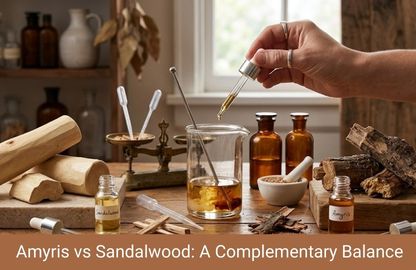
The comparison with sandalwood is inevitable, so it is worth addressing directly. The two materials share a soft, creamy woodiness and good longevity on skin. However, true sandalwood (particularly Santalum album) is richer, more rounded, more lactonic, and more complex, with an almost buttery smoothness that amyris does not fully replicate.
A useful frame: amyris is not a replacement for sandalwood, but a complement to it. It can extend and support sandalwood in a blend, add woody depth in compositions where true sandalwood is cost-prohibitive, and stand on its own in structures where a lighter, less dominant wood note is desirable.
Amyris Oil Chemistry and Fixative Properties
Chemical Composition
Amyris oil is composed primarily of sesquiterpene alcohols, with valerianol typically present at 30–50% and a range of supporting sesquiterpenes including elemol, gamma-eudesmol, and beta-eudesmol. This sesquiterpene alcohol-heavy profile is directly responsible for both the oil's olfactory character and its fixative properties.
Why Amyris Acts as a Fixative
In perfumery, a fixative is any material that slows the evaporation of more volatile fragrance components, extending the longevity of a blend overall. Fixatives do not simply 'hold' a fragrance in place; they interact with other molecules in the blend, modifying the volatility of surrounding materials and creating a more unified, lasting olfactory impression.
Amyris achieves its fixative effect through several mechanisms:
- High boiling point sesquiterpene alcohols evaporate slowly, creating a sustained base that anchors the overall structure of the blend.
- The oil has strong skin-substantivity — it bonds effectively with skin proteins and fabric fibres, increasing wear time on the body.
- Its molecular weight and polarity allow it to interact with both polar and non-polar fragrance molecules, helping to integrate materials that might otherwise separate or clash.
- It acts as a natural diluent for high-impact base materials like vetiver, labdanum, and costus, smoothing their projection without eliminating their character.
Practical Implication
When blending with amyris, expect a measurable improvement in longevity in the base of your composition. In testing with 10% amyris additions to otherwise identical bases, wear time on skin typically extends by 20–40%, depending on the other materials present.
Comparison with Other Fixatives
Amyris sits in a distinct category among common natural fixatives. Unlike animal-derived fixatives (musk, castoreum, civet) that are now largely restricted or replaced by synthetics, amyris is plant-derived and freely available. Unlike resinous fixatives such as benzoin, labdanum, and oakmoss, amyris does not add significant sweetness or green-animalic character — it contributes fixation with relatively neutral, woody modesty. This makes it particularly useful in compositions where the perfumer wants longevity without additional olfactory complication.
Our Other Product
Essential Oil FixativesFragrance Blending: How to Use Amyris
Usage Rates
Amyris is generally well-tolerated at a wide range of concentrations. In functional fragrance blending (perfumes, colognes, body oils), the following guidelines provide a useful starting point:
- As a minor base note and fixative support: 3–8% of the total formula
- As a primary wood note: 10–20% of the total formula
- In unscented or lightly scented carrier bases (body oils, hair oils): up to 50%, often blended with jojoba or fractionated coconut
There is no known IFRA restriction on amyris oil as of the current guidelines, and it has a good safety profile with low reported sensitisation rates. As with any undiluted essential oil, skin testing at intended use concentration is advisable.
Fragrance Families and Applications
Woody and Aromatic Orientals
This is the most natural home for amyris. The oil blends seamlessly with frankincense, myrrh, labdanum, benzoin, and resins to create warm, deep, contemplative base structures. It harmonises particularly well with Indian sandalwood, Australian sandalwood (Santalum spicatum), and cedarwood (both Virginian and Atlas varieties), creating layered woody accords that feel more complex and expensive than the cost of their components.
Floral Orientals and Chypres
In floral oriental compositions, amyris serves as a smoothing, warm foundation that lifts floral hearts without competing with them. Rose and amyris share a warm, slightly rosy-woody facet that makes them particularly harmonious. Jasmine absolute over an amyris-cedar-benzoin base creates a classic, skin-close oriental warmth.
In chypre structures built around oakmoss, labdanum, and bergamot, amyris helps to soften the animalic or mossy sharpness of the base without eliminating the character that defines the family.
Citrus Colognes and Lighter Compositions
One of the most underused applications of amyris is in citrus-forward colognes, where it provides a warm, lasting dry-down for compositions that would otherwise fade quickly. At 5–8%, amyris under a citrus and herb accord creates the impression of warmth and complexity while maintaining the bright, clean character of the top.
Gourmand and Vanilla-Forward Blends
The dry, woody nature of amyris is a useful counterweight to the sweetness of gourmand materials. Placed under vanilla, benzoin, tonka bean, and coumarin-rich botanicals, it prevents the composition from becoming cloying, adding a grounding woody dryness that keeps sweet blends wearable.
Read Our Article
Amyris Oil for Stress Relief: Benefits in AromatherapyA Sample Blend: Amyris in Practice
The following illustrative formula demonstrates amyris used as the primary fixative and base wood note in a simple oriental woody composition. All percentages refer to weight in the final concentrate before alcohol or carrier dilution.
| Note | Ingredient | % in Blend | Role |
|---|---|---|---|
| Top | Bergamot (FCF) | 12% | Brightness, freshness |
| Top | Pink pepper CO2 | 3% | Spice, lift |
| Heart | Rose absolute (Moroccan) | 10% | Floral depth, warmth |
| Heart | Frankincense (Boswellia carterii) | 8% | Resinous complexity |
| Heart | Labdanum absolute | 5% | Animalic warmth, richness |
| Base | Amyris oil | 18% | Primary wood, fixative |
| Base | Virginia cedarwood | 12% | Supporting wood |
| Base | Benzoin resinoid | 8% | Sweetness, fixation |
| Base | Patchouli (light) | 6% | Earthiness, depth |
| Base | Vetiver (Haiti) | 4% | Smoke, tenacity |
| Carrier | Jojoba golden | 14% | Dilution, skin feel |
Blender's Notes
The amyris in this formula does three things simultaneously: it extends the longevity of the rose and frankincense heart, it softens the animalic edge of the labdanum, and it acts as a woody bridge between the resinous elements (benzoin, labdanum) and the drier elements (cedarwood, vetiver). Without it, or with a direct replacement by a harsher wood such as undiluted vetiver or aged patchouli, the blend would feel less cohesive and more abrupt in its base transition.
Our Other Product
Zdravetz OilAmyris Oil and the Accord-Building Approach
For perfumers who work by constructing modular accords before assembling a full composition, amyris functions as what might be called a neutral wood matrix — a material that can be pre-blended with other base notes to create a unified woody-resinous accord that is then inserted into a formula as a single building block.
A Versatile Woody Base Accord
Consider the following pre-built accord, mixed as a stock blend:
- Amyris oil: 50 parts
- Virginia cedarwood: 25 parts
- Australian sandalwood: 15 parts
- Vetiver (Haitian or Javanese): 10 parts
This accord, used at 15–25% of a finished formula, provides a rounded, long-lasting woody base that works under almost any fragrance family. The amyris softens the dryness of the cedar, extends the sandalwood, and smooths the smokiness of the vetiver. It becomes a reliable building block that saves reformulation time and ensures consistency.
Common Mistakes and How to Avoid Them
Using Amyris as a Direct Sandalwood Replacement
This is the most common misuse of the material. While amyris shares some surface-level character with sandalwood, treating it as a drop-in replacement leads to disappointing results. Formulas that were built around the lactonic, buttery richness of true sandalwood will feel thinner and less coherent if amyris is substituted 1:1. The correct approach is to blend amyris with a small amount of sandalwood, or to redesign the formula around the character amyris actually offers.
Overuse in Lighter Compositions
At high concentrations in airy, aquatic, or green compositions, amyris can read as heavy or intrusive, pulling the fragrance toward a weightiness it was never meant to have. In these compositions, 3–6% is usually the upper limit before the character shifts uncomfortably.
Neglecting the Skin Test
Despite its good safety profile, any concentrated material applied to skin should be tested at use concentration before widespread application. Some individuals report a slightly medicinal or musty perception of amyris, particularly in combination with certain musks or animalic materials. Testing early avoids reformulation late.
Amyris Oil Sourcing and Quality Considerations
Amyris oil quality varies more than many perfumers expect, given its reputation as a commodity material. Key quality indicators include:
- Colour: Should be pale yellow to light amber. Unusually dark oil may indicate adulteration or poor distillation.
- Viscosity: Amyris is moderately viscous — thicker than most citrus oils but considerably thinner than labdanum or benzoin resinoid. Oils that are excessively thin may be adulterated or over-diluted.
- Odour profile: Should be clean, warm, and woody on opening, with no harsh chemical top notes that would suggest the presence of synthetic extenders.
- GC/MS reports: Reputable suppliers will provide gas chromatography/mass spectrometry analysis confirming the sesquiterpene alcohol profile. Valerianol at 30–50% is the benchmark for quality Haitian amyris.
As with all natural materials, building a relationship with a trusted supplier who provides batch-specific documentation is more valuable than relying on specification sheets alone.
 Call Now!
Conclusion
Amyris oil rewards the perfumer who takes the time to understand it on its own terms. It is not sandalwood, and it should not be asked to be. It is a warm, creamy, quietly complex base material with genuinely excellent fixative properties, a strong sustainability profile, and remarkable versatility across fragrance families. In a well-constructed accord it is invisible in the best possible sense — present as warmth, depth, and duration rather than as a specific named note.
Whether used as the primary wood note in an oriental composition, as a soft fixative in a citrus cologne, or as part of a modular base accord applied across a range of projects, amyris oil is one of the most useful and underappreciated tools in the natural perfumer's arsenal. The bottle at the back of the shelf deserves a place at the front of the bench.
Quick Reference: Amyris Oil at a Glance
| Parameter | Details |
|---|---|
| Botanical source | Amyris balsamifera (Rutaceae family) |
| Origin | Haiti, Central America |
| Extraction method | Steam distillation of dried wood |
| Odour character | Warm, creamy, woody, balsamic, slightly smoky |
| Note classification | Base note |
| Typical use rate | 3–20% depending on application |
| Key constituents | Valerianol (30–50%), elemol, eudesmol sesquiterpenes |
| Blends well with | Sandalwood, cedarwood, vetiver, labdanum, benzoin, rose, frankincense |
| Fragrance families | Orientals, woody orientals, chypres, floral orientals, gourmands |
| Sustainability | Non-threatened species; sustainable production |
| IFRA status | No current restriction |
Recent Posts
- Indian Oud Reconstitution vs. Natural Oud: Cost Effectiveness, Performance, and Quality Comparison for Bulk Buyers
- Floral Green Fragrance Bases: Formulating With Narcissus Absolute Alternatives in Modern Perfumery
- Reconstituted Oud Blending Guide: Dihydroambrettolide, Benzyl Acetone, and Ester Based Components for Professional Fragrance Formulation
- Geranium Oil Varieties Egyptian Reunion and Madagascar Geranium Compared
- Frankincense Serrata in Premium Incense Manufacturing
- Balsam Tolu vs Balsam Peru
- Vetiver Oil in Fresh Green and Woody Fragrances
Copyright @ 2026 | BMV Fragrances Private Limited | All Rights Reserved
Website Design & Digital Marketing by webmasterindia.
Website Updated On: