






Listen to the Audio Version
Geranium Oil: The Global Market for Trends, Origins & Trade Dynamics
Geranium oil has steadily earned its position as one of the most traded botanical extracts in the global essential oil market. Sourced primarily from the Pelargonium graveolens plant, this oil moves through complex international supply chains before reaching end users in fragrance, cosmetic, and personal care industries. Understanding where it comes from, how trade flows work, and what drives demand is key for importers, formulators, and procurement teams alike.
 Call Now!
Geranium Oil Origins: Understanding the Core Production Regions
The global supply of geranium oil is concentrated in a few key geographies, each contributing a distinct quality profile to the market. Egypt, China, and Reunion Island (Bourbon) form the backbone of global production, while emerging cultivation in South Africa, Madagascar, and Morocco continues to expand the sourcing map.
Egypt remains the dominant force, particularly from the El-Fayoum, Menofia, and Beheira governorates, where large-scale commercial cultivation supports a consistent export volume. Egyptian-grown geranium is valued for its high citronellol and geraniol content, making it a preferred choice for cosmetic and fragrance applications globally.
China, primarily from Yunnan Province and Guizhou, has grown into a significant low-cost supplier. The country's scale of cultivation and distillation infrastructure enables it to serve price-sensitive market segments in Asia and parts of Europe. However, quality standardization remains a discussion point for buyers sourcing Chinese-origin oil in bulk.
Reunion Island, historically known as the Bourbon origin, produces a premium-grade geranium oil prized for its refined aromatic character. Though production volumes are limited compared to Egypt or China, Bourbon geranium commands attention in high-end fragrance formulations and luxury personal care products manufactured in France, Switzerland, and Germany.
Geranium Egyptian Oil: Why Egypt Leads Global Supply Chains
The reputation of Geranium Egyptian oil in international trade is well established. Egypt's favorable agro-climatic conditions, combined with decades of cultivation expertise, allow farmers and distillers in the Nile Delta region to produce oil with a consistent quality profile year after year.
Egyptian geranium exports reach destinations across Europe, North America, and the Gulf region. Key importing countries include France, the United States, the United Kingdom, Germany, and the UAE. European fragrance houses in Grasse, historically the perfume capital of the world, have long relied on Egyptian-origin geranium as a core ingredient in their supply chains.
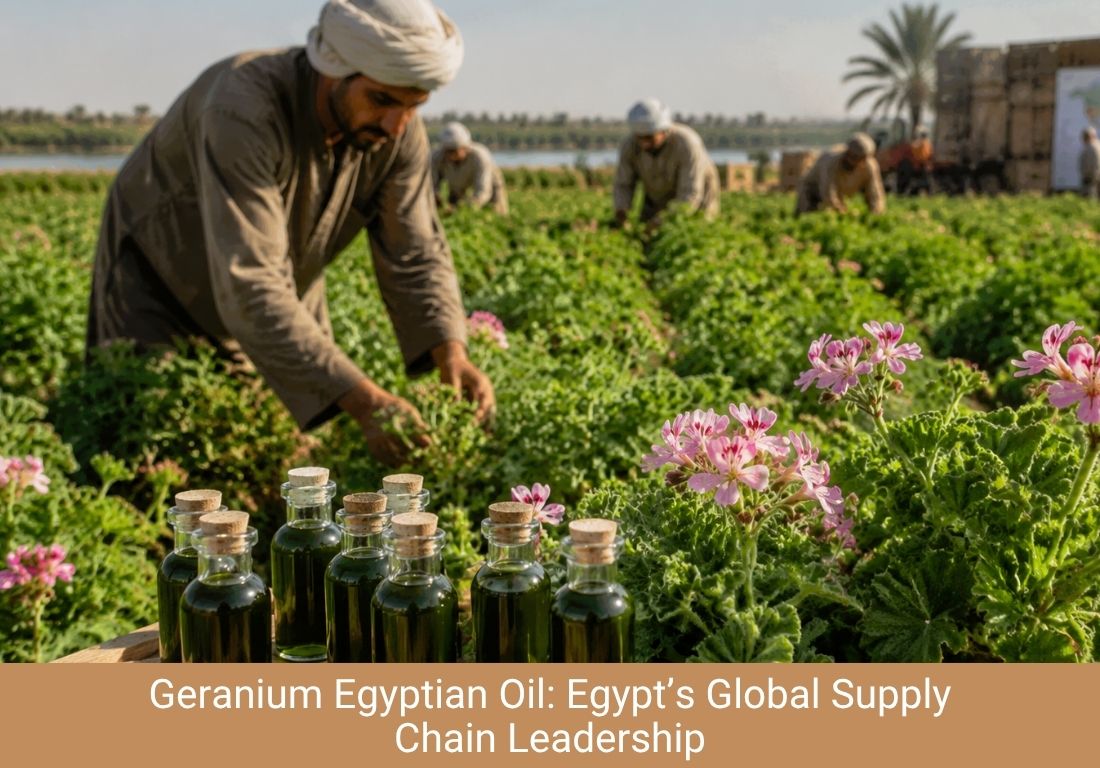
The bulk of Egyptian production is traded through Cairo-based export merchants and large distillation operators who consolidate supply from smallholder farmers. This structured supply chain supports reliable delivery timelines, which is critical for global buyers placing bulk orders.
Geranium Oil Manufacturers and Distillation Infrastructure across Key Markets
The distillation and processing landscape for this essential oil varies considerably by origin. In Egypt, medium-to-large distillation units are positioned close to farming clusters, enabling rapid processing after harvest to preserve aromatic quality. In China, industrial-scale operations in Yunnan allow continuous processing throughout the harvest season.
In India, particularly in states like Uttarakhand, Himachal Pradesh, and parts of the Northeast, geranium cultivation has gained momentum over the past decade, supported by state agricultural programs and private investment from essential oil trading companies.
BMV Fragrances Private Limited, one of India's well-regarded names in the essential oil and aroma chemical sector, plays an active role in sourcing, processing, and supplying geranium oil to domestic and international clients. The company works across multiple origin grades - Egyptian, Chinese, and Bourbon - to meet diverse buyer specifications across fragrance, personal care, and aromatherapy segments.
Geranium Oil in India: Cultivation Growth and Trade Positioning
India's emergence as both a producer and significant importer of geranium oil reflects the country's growing role in the global essential oil supply chain. Domestic cultivation, primarily in hilly terrain regions of the North and Northeast, has expanded steadily, driven by rising demand from Indian fragrance houses, cosmetic manufacturers, and Ayurvedic product brands.
At the same time, India imports substantial volumes of geranium oil from Egypt and China to meet demand that domestic production cannot yet fulfill. Mumbai, Chennai, and Delhi serve as the primary import and distribution hubs, while major fragrance manufacturing clusters in Kannauj, Pune, and Bengaluru are active consumers of the oil.
Geranium oil suppliers in India serve a dual role - sourcing internationally and distributing domestically - while also re-exporting processed or blended variants to markets in the Middle East and Southeast Asia. This positions India as a significant value-added node in the global geranium oil trade network.
Geranium Synthetic Oil: Its Role in Market Pricing and Formulation Strategy
An important dimension of geranium oil trade dynamics is the parallel market for geranium synthetic oil. As natural geranium prices fluctuate based on harvest conditions, currency movements, and freight costs, formulators in personal care, household fragrance, and soap manufacturing increasingly turn to synthetic geraniol and citronellol-based reconstructions.
Geranium synthetic oil offers a cost-effective alternative for applications where the precise botanical origin of the fragrance note is less critical to the end product. It is widely used in budget-tier cosmetics, cleaning products, and mass-market personal care items manufactured in China, India, and parts of Southeast Asia.
However, in premium markets - particularly Europe and North America - the preference for pure geranium and natural-origin oils remains strong, driven by clean beauty trends and consumer demand for transparency in ingredient sourcing. This creates a clear market segmentation where pure geranium commands a price premium over synthetic reconstructions.
Geranium Oil Suppliers and the Role of Global Trade Networks
The trade infrastructure connecting geranium oil producers to end users spans multiple tiers. At the origin level, distillers and farmer cooperatives in Egypt, China, and Reunion Island sell to export merchants. These merchants then supply to international distributors, brokers, and essential oil companies in Europe, North America, and Asia.
Key trading hubs include Rotterdam (Europe's main chemical and essential oil port), New York and New Jersey for North American distribution, Dubai for Gulf region supply, and Mumbai and Chennai for South and Southeast Asia. The involvement of third-party testing laboratories and quality certification bodies - such as ISO-certified testing facilities in France and Germany - adds a compliance layer that global buyers increasingly require.
Geranium oil producers and exporters who can provide GC/MS analysis, country-of-origin documentation, and sustainability certificates are better positioned to secure long-term contracts with multinational buyers in the fragrance and cosmetics sectors.
Essential Oils Geranium: Demand Drivers across End-Use Sectors
Demand for geranium oil across end-use industries has seen consistent growth driven by its broad applicability. The fragrance sector - which includes fine perfumery, personal care, and household products - accounts for the largest share of global consumption. Cosmetic manufacturers in South Korea, Japan, France, and the United States use geranium oil extensively in skin care formulations.
The aromatherapy and wellness sector, expanding rapidly across Europe, Australia, and India, has added a newer demand stream. Geranium oil benefits recognized within wellness communities - related to its aromatic profile and traditional use history - have contributed to the growth of retail essential oil sales through e-commerce platforms and specialty wellness stores.
Industrial applications in soaps, detergents, and air care products represent another significant demand segment, particularly in emerging markets where rising disposable incomes are driving growth in personal care consumption.
Conclusion
The global geranium oil market operates through well-defined trade corridors connecting production regions in Egypt, China, and Reunion Island to consuming markets across Europe, North America, and Asia. India's dual role as a cultivator and importer adds further complexity and opportunity to the supply chain. As demand for pure geranium continues to grow across fragrance, cosmetics, and wellness sectors, industry participants - including established suppliers like BMV Fragrances Private Limited - are well positioned to serve a market that values both quality consistency and reliable sourcing transparency.
FAQs
Egypt is currently the largest exporter of geranium oil globally, with production concentrated in the Nile Delta region and consistent supply reaching markets in Europe, North America, and the Gulf.
Pure geranium oil is a natural botanical extract used in premium fragrance and cosmetic formulations, while geranium synthetic oil is a cost-effective reconstruction used in mass-market personal care and household products.
Bourbon geranium from Reunion Island is a premium, limited-volume oil valued for its refined aromatic character, while Egyptian geranium offers higher volume consistency and is widely used across both fragrance and cosmetic applications.
India functions both as a growing domestic producer - primarily in Uttarakhand and Himachal Pradesh - and as a significant importer and re-exporter of geranium oil, connecting Egyptian and Chinese supply to South Asian and Middle Eastern markets.
International buyers commonly require GC/MS analysis reports, country-of-origin certificates, ISO quality compliance documentation, and increasingly, sustainability or ethical sourcing declarations from geranium oil suppliers.
Recent Posts
- The Global Market for Geranium Oil: Production Trends, Key Origins & Trade Dynamics
- Natural vs. Synthetic Oudh Oil: A Buyer's Guide for Formulators
- Oudh Oil in Western Perfumery: How Global Fragrance Houses are Embracing Oudh
- Top Agarwood Producing Countries: A Comparative Guide to Vietnamese, Indonesian, Indian & Cambodian Oudh
- Amyris Oil in Bakhoor & Middle Eastern Fragrance Traditions
- Amyris Oil vs. Sandalwood Oil: A Perfumer's Honest Comparison
- Geranium Oil in Luxury Perfumery: From Rose Accords to Chypre Compositions
Copyright @ 2026 | BMV Fragrances Private Limited | All Rights Reserved
Website Design & Digital Marketing by webmasterindia.
Website Updated On: