





Listen to the Audio Version
Why Amyris Oil Procurement Demands Vigilance
Amyris oil occupies a paradoxical position in the natural ingredients market. It is one of the most affordable of the premium woody base materials, widely available from dozens of suppliers across multiple countries, and used in enormous volumes across cosmetics, personal care, aromatherapy, and fine fragrance. Yet precisely because it is affordable and high-demand, it is also among the most frequently adulterated essential oils in commercial trade.
For procurement managers, cosmetic formulators, and natural product buyers making volume purchases, the consequence of sourcing adulterated amyris is not merely disappointing fragrance performance. It can mean formula instability, regulatory non-compliance, failed finished-product testing, batch recalls, and reputational damage with retail partners and consumers. A single compromised consignment of amyris oil can create problems that cost orders of magnitude more than the purchase price to resolve.
This guide is written for procurement professionals who need to go beyond price comparison and supplier promises. It provides a systematic framework for supplier evaluation, a practical understanding of GC/MS analysis for amyris verification, a catalogue of the most common adulteration practices and how to detect them, and a complete specification template that buyers can adapt for their own sourcing contracts.
The Adulteration Problem: What You Need to Know
Why Amyris Is a High-Risk Category for Adulteration
The economics of amyris oil adulteration are straightforward and, from a bad-actor supplier's perspective, attractive. Authentic amyris oil trades depending on grade and certification. Common adulterants — cedarwood fractions, synthetic sesquiterpenes, diluent vegetable oils, and rectified terpene fractions — cost a fraction of this. Blending 30–50% adulterant into amyris oil while retaining a superficially similar odour and appearance creates significant margin for the unscrupulous supplier, at the buyer's expense.
The challenge for buyers is that many adulterants used in amyris are not obvious on visual or even basic sensory inspection. A well-blended adulterated sample can smell broadly similar to authentic amyris on a cold blotter. It is only under more rigorous evaluation — extended wear, in-formula testing, and crucially, GC/MS analysis — that the substitution becomes apparent.
Critical Risk Warning
Adulteration is not just a quality issue — it is a regulatory compliance issue. Cosmetic products sold in the EU, US, UK, and most regulated markets must be formulated with ingredients that match their declared INCI names and compositions. A product labelled as containing 'Amyris balsamifera bark oil' that actually contains cedarwood fractions or synthetic diluents may constitute mislabelling under applicable cosmetics regulations.
The Most Common Amyris AdulterantsAppearance and Colour
Buyers should be aware of the following adulterant categories, which represent the most frequently encountered problems in commercial amyris supply:
| Adulterant | How It Enters the Supply | Sensory Clue | GC/MS Signature |
|---|---|---|---|
| Cedarwood fractions (Virginian, Texas, Atlas) | Direct blending at origin or by broker | Slightly sharper, drier opening | Cedrol, thujopsene, alpha-cedrene peaks appear; low valerianol |
| Synthetic sesquiterpenes (e.g. synthetic valerianol) | Added to boost marker compound readings | Cleaner, flatter odour profile | Unusually high valerianol (>60%) with minimal supporting compounds |
| Diluent vegetable oils (fractionated coconut, jojoba) | Added to stretch volume; very common | Fatty/greasy residue on evaporation | Low GC response overall; non-volatile residue present |
| Rectified or stripped amyris | Valuable fractions removed before sale | Thin, flat, lacking warmth or depth | Depleted supporting sesquiterpenes; abnormal eudesmol ratios |
| Other wood distillates (ho wood, rosewood) | Odour-compatible blending adulterant | Camphoraceous or rosy off-note | Linalool or camphor peaks present; not native to amyris |
| Mineral oil / paraffin | Cheap volume extender | Very greasy residue; odour suppression | No GC peaks in expected range; non-volatile residue >5% |
Adulteration at Different Points in the Supply Chain
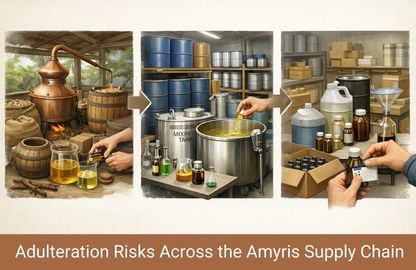
Understanding where adulteration is most likely to occur helps buyers direct their scrutiny appropriately. The amyris supply chain has several vulnerability points:
- At the distillery level: Small, under-resourced distilleries may stretch production by adding cedarwood or diluent oils to their raw output before sale to exporters. This is the hardest adulteration to detect because it occurs before any documentation is generated.
- At the exporter/aggregator level: Exporters who blend batches from multiple distilleries may knowingly or unknowingly include compromised material. Batch blending also makes single-distillery traceability impossible without explicit segregation.
- At the broker/distributor level: Commodity brokers who repackage and relabel may add adulterants to improve margin. This tier presents the highest intentional adulteration risk for buyers who do not conduct incoming goods testing.
- At the retailer/repackager level: Small-scale repackagers who sell to indie brands and formulators may dilute with carrier oils specifically because buyers at this tier are less likely to conduct GC/MS testing.
Our Other Product
Balsam ToluEvaluating Amyris Oil Suppliers: A Step-by-Step Framework
The Five Tiers of Supplier Assessment
A robust supplier evaluation framework for amyris oil moves through five progressive tiers, each designed to filter out unsuitable suppliers before commercial commitment. BMV Fragrances has been designed from the ground up to meet the standards described at each tier — and we welcome buyers who apply this level of rigour to their sourcing decisions.
Tier 1: Initial Qualification Screen
Before requesting samples or initiating commercial discussion, conduct a basic qualification screen. This is a desk exercise that should filter out clearly unsuitable suppliers immediately:
- Is the supplier willing to provide a Certificate of Analysis (CoA) and GC/MS report for a current commercial batch before a purchase order is placed? Suppliers who refuse or delay this request at the enquiry stage are a red flag.
- Does the supplier have a verifiable business address, registration, and operational history of at least 3 years in the essential oils trade?
- Is the supplier able to name their source country and, ideally, their distillery or exporter of origin? Vague answers ('we source from multiple origins') at this stage should prompt further investigation.
- Does the supplier have a current Safety Data Sheet (SDS) prepared to GHS/REACH standards? An absent or outdated SDS suggests inadequate regulatory awareness.
- Is the supplier listed or referenced in known industry directories or trade associations?
BMV Fragrances
BMV Fragrances passes every Tier 1 criterion. We provide CoA and GC/MS documentation on request before any purchase commitment, maintain full traceability to our manufacturing operations in India, and hold current SDS and IFRA compliance documentation for all products. We have been operating as a manufacturer, exporter, and wholesale supplier of Amyris Oil for years, serving global customers with full transparency.
Tier 2: Documentation Review
On receiving documentation, conduct a systematic review before ordering a sample:
- Verify the CoA contains: appearance, specific gravity, refractive index, optical rotation, and odour description. Generic CoAs without physical constants are inadequate.
- Verify the GC/MS report is batch-specific (the batch number should match the CoA). Generic or undated GC/MS reports may not reflect the actual batch being offered.
- Check that valerianol appears as the dominant peak at 30–50%. Check for the presence of elemol and eudesmol fractions. Note any unusual peaks.
- Check the IFRA compliance letter is current — ideally dated within the last 12 months — and references the current amendment number.
- Verify the INCI name declared is Amyris balsamifera bark oil, not a generic 'wood oil' or ambiguous designation.
Tier 3: Sample Evaluation
A sample should be evaluated on four dimensions before any volume commitment:
- Physical evaluation: check colour (pale yellow to light amber), clarity (should be clear, no haze), and viscosity (moderately fluid — thicker than water, much thinner than a resin or fixed oil). Any oiliness, greasiness, or residue after evaporation on a blotter is a red flag for vegetable oil adulteration.
- Odour evaluation: assess on blotter at 0, 30, and 120 minutes against your house reference standard. The opening should be warm, slightly smoky-woody; the heart should be creamy and balsamic; the dry-down should be clean, soft, and persistent. Harshness, sharpness, camphoraceous notes, or a greasy, fatty character on dry-down are all warning signs.
- In-formula evaluation: incorporate the sample at your standard use rate into a representative base. Compare performance — longevity, blending behaviour, and character — against your reference standard. Adulterated material often shows weaker fixation and longevity in formula even when it smells broadly similar neat.
- Analytical evaluation: run your own GC/MS on the sample. Do not rely solely on the supplier's documentation. Independent verification is the only way to confirm composition.
Supplier-provided GC/MS reports are not independent verification. A fraudulent supplier can provide a fabricated or copied report from a genuine batch. The only way to verify the composition of the specific material in your possession is to run your own GC/MS or to commission an independent laboratory to do so.
Tier 4: Commercial and Compliance Audit
- Confirm export documentation capability: can the supplier provide phytosanitary certificates, country-of-origin certificates, and all documents required for import clearance in your market?
- Confirm regulatory compliance for your target markets: EU Cosmetics Regulation, US FDA (if applicable), Japan MHLW, GCC requirements, COSMOS certification (if required for natural product lines).
- Discuss and agree minimum batch size, lead time, packaging format, and storage and handling standards during transit.
- Obtain and review the supplier's quality management documentation. ISO 9001 certification is a positive indicator; absence is not automatically disqualifying but should prompt further due diligence.
Tier 5: Ongoing Supplier Management
- Test every incoming batch, not just the first. Adulteration risk does not disappear once a supplier is qualified — it must be managed continuously.
- Conduct periodic review of supplier documentation, especially IFRA letters and SDS, which must be updated when IFRA amendments are released.
- Maintain a physical reference standard — a sealed, documented sample of your approved amyris oil — against which all future batches are evaluated.
- Schedule a formal supplier review at least annually, including review of any batch failures, quality deviations, or delivery issues.
 Call Us Now!
Verifying GC/MS Purity: A Practical Buyer's Guide
What GC/MS Analysis Does and Doesn't Tell You
Gas chromatography/mass spectrometry is the gold standard analytical method for essential oil verification. It separates the individual chemical components of an oil and identifies each one by its mass spectrum, allowing a detailed composition profile to be constructed. For buyers who are not analytical chemists, it is important to understand both the power and the limits of this technique.
GC/MS tells you: the identity of volatile compounds present in the oil and their relative proportions. It can confirm the presence of compounds characteristic of authentic amyris, flag the presence of adulterants with distinctive markers, and quantify key constituents against published standards.
GC/MS does not tell you: the absolute absence of all possible adulterants (some adulterants are specifically chosen because they are difficult to detect by GC/MS alone), the physical properties of the oil (which require separate measurement), or the microbiological quality of the oil.
Reading an Amyris GC/MS Report: Key Markers
The following table summarises the key GC/MS markers for authentic Haitian amyris oil and how to interpret them. Buyers should request that supplier GC/MS reports explicitly state the concentration of each of these compounds:
| Compound | Expected Range / Interpretation |
|---|---|
| Valerianol (10-epi-γ-eudesmol) | 30–50% — Primary quality marker; must be the dominant peak. Below 25% signals dilution or adulteration. Above 60% may signal synthetic valerianol addition. |
| Elemol | 5–15% — Important supporting sesquiterpene. Its absence is unusual and warrants investigation. |
| γ-Eudesmol | 5–12% — Supporting sesquiterpene; contributes to rounded character. Should be present. |
| β-Eudesmol | 3–10% — Supporting sesquiterpene. Low or absent levels are abnormal. |
| α-Eudesmol | 2–8% — Minor supporting sesquiterpene. Part of the characteristic amyris profile. |
| Total sesquiterpene alcohols | Minimum 60% — Authentic amyris is rich in sesquiterpene alcohols. Low total signals dilution. |
| Cedrol (from Virginia cedarwood) | Should be absent or trace (<1%) — Its presence is a clear adulterant indicator. |
| Thujopsene / alpha-cedrene | Should be absent or trace (<0.5%) — Cedar adulterant markers. |
| Linalool | Should be absent — Its presence indicates addition of ho wood, rosewood, or linalool terpene fractions. |
| Non-volatile residue | Less than 1% — Higher residue indicates fixed oil diluent addition (vegetable or mineral oil). |
Reference Standard
Reliable published references for amyris oil composition include the ISO standard ISO/DIS 3526, the Essential Oil Association (EOA) specification, and the AFNOR standard NF T75-259. Buyers commissioning independent GC/MS analysis should request that the laboratory compare results against one of these published standards and flag deviations.
How to Commission Independent GC/MS Testing
Buyers who cannot run GC/MS in-house should commission testing from an accredited independent laboratory. Key considerations:
- Use a laboratory accredited to ISO/IEC 17025 for essential oil analysis. Accreditation ensures the laboratory's methods are validated and results are traceable.
- Specify that you require identification and quantification of all major peaks, not just a targeted analysis for selected compounds. A full-scan analysis is more likely to flag unexpected adulterants.
- Request that the laboratory compare results against a published amyris oil standard and provide a pass/fail opinion against the standard.
- Retain a sealed portion of the tested sample in case results need to be disputed or re-tested.
- For high-value or high-volume purchases, consider testing from the same drum using samples taken from both the top and bottom of the container. Some fraudulent material is layered rather than homogeneously blended.
BMV Fragrances
BMV Fragrances conducts GC/MS analysis on every batch of Amyris Oil we manufacture and ship. Our batch-specific GC/MS reports are available to customers as standard documentation and consistently show valerianol at 30–50%, full sesquiterpene alcohol profiles characteristic of authentic amyris, and the absence of cedar adulterant markers. We welcome independent verification and will cooperate fully with any customer wishing to commission third-party testing of our material.
Writing a Defensible Amyris Oil Specification
Why Your Specification Matters
A purchase order that says 'amyris oil, food grade, 25 kg' offers the buyer almost no protection against substandard or adulterated material. A well-written specification, incorporated by reference into the purchase contract, is a legally enforceable standard that the supplier is contractually obligated to meet. It is the foundation of defensible incoming goods rejection and the mechanism by which you hold suppliers accountable.
The specification should define not just what you want, but how conformance will be verified and what happens when material does not conform. BMV Fragrances welcomes customer specifications and actively supports our customers in developing them — because a clear specification protects both parties and establishes the terms of a professional trading relationship.
Recommended Amyris Oil Specification
| Specification Parameter | Acceptance Criteria |
|---|---|
| INCI Name | Amyris balsamifera bark oil |
| Botanical name | Amyris balsamifera L. (family Rutaceae) |
| Plant part | Wood (dried chips and sawdust) |
| Extraction method | Steam distillation only — no solvent extraction |
| Declared origin | Haiti (primary); Honduras or Guatemala (secondary, must be declared) |
| Appearance | Clear to pale yellow liquid; no visible haze, turbidity, or particulate matter |
| Odour character | Warm, creamy-woody, softly balsamic; clean sandalwood-like dry-down; no harsh, fatty, camphoraceous, or chemical off-notes |
| Specific gravity at 20°C | 0.940 – 0.965 g/cm³ |
| Refractive index at 20°C | 1.503 – 1.513 |
| Optical rotation | −4° to +4° |
| Valerianol (GC/MS) | Minimum 30% of total composition |
| Total sesquiterpene alcohols (GC/MS) | Minimum 60% of total composition |
| Cedrol (GC/MS) | Maximum 1.0% — higher indicates cedar adulteration |
| Thujopsene / alpha-cedrene (GC/MS) | Maximum 0.5% — indicates cedar adulteration |
| Linalool (GC/MS) | Not detected (< 0.1%) — indicates wood oil adulteration |
| Non-volatile residue | Maximum 1.0% — higher indicates fixed oil diluent |
| Peroxide value | Maximum 10 meq/kg — monitors oxidative degradation |
| Heavy metals | Lead ≤ 10 ppm; Arsenic, Cadmium, Mercury ≤ 1 ppm each |
| Pesticide residues | In compliance with current EU MRL or buyer-specified standard |
| Microbial limits | Total aerobic count ≤ 100 CFU/mL; Pathogens absent |
| IFRA compliance | Compliant with current IFRA amendment; written compliance letter per batch |
| Required documentation per batch | Certificate of Analysis, GC/MS report, SDS (current), IFRA compliance letter, origin declaration/bill of lading |
| Packaging | Aluminium or HDPE drums; nitrogen-purged headspace; tamper-evident seals |
| Shelf life | Minimum 24 months from date of manufacture under specified storage conditions |
| Storage conditions | Cool (< 20°C), dark, away from heat sources and oxidising agents |
Contract Clause Recommendation
Consider adding the following clause to your purchase contract: 'Supplier warrants that each batch of material delivered under this agreement meets the specification attached hereto. Any batch failing to meet specification on incoming goods testing shall be rejected and returned at supplier's cost. Supplier shall provide replacement material meeting specification within [agreed lead time] at no additional cost to buyer.'
Our Other Product
Ambrette SeedSensory Evaluation Protocols
Building Your In-House Reference Standard
Every organisation sourcing amyris oil for volume use should maintain a physical reference standard: a sealed, accurately documented sample of verified, specification-compliant amyris oil stored under appropriate conditions. Without a reference standard, every sensory evaluation is subjective and relative — a reference standard makes evaluation comparative and consistent.
To establish a reference standard: source a quantity of amyris oil from a verified, fully documented batch; run your own GC/MS to confirm compliance; seal individual aliquots of approximately 50 mL in amber glass vials under nitrogen; label with batch number, date of testing, and specification version; and store in a cool, dark environment. Replace the reference standard annually or whenever it shows signs of oxidation.
Blotter and Skin Evaluation Protocol
The following protocol provides a consistent sensory evaluation framework for incoming amyris batches:
| Evaluation Stage | Method | What to Note | Pass / Fail Criterion |
|---|---|---|---|
| Initial blotter | Dip blotter, evaluate immediately | Opening character: woody, smoky, warm? Or sharp, camphoraceous, fatty? | No off-notes; character broadly consistent with reference |
| 30-minute blotter | Evaluate same blotter at 30 min | Heart character: creamy, balsamic? Or flat, thin, chemical? | Warm, creamy-woody character developing; no deterioration |
| 2-hour blotter | Evaluate at 2 hours | Dry-down: clean, soft, persistent? | Clean, warm wood dry-down; no harsh residue or greasy film |
| Skin evaluation (1 hour) | Apply 1 drop to inner wrist; evaluate at 1 hr | Warmth, depth, skin-friendliness | Warm, creamy, skin-close character; no irritation or off-note |
| Formula evaluation | Incorporate at standard use rate in base | Integration, longevity, character | Performance equivalent to reference standard in formula |
| Comparative panel | Blind assessment against reference (min. 3 evaluators) | Deviation score vs reference | Panel consensus: no significant deviation from reference |
Read Our Article
Amyris Oil for Stress Relief: Benefits in AromatherapyRegulatory Compliance for Volume Buyers
Key Regulatory Frameworks
| Market | Relevant Framework | Amyris Oil Status | Key Buyer Action |
|---|---|---|---|
| European Union | EU Cosmetics Regulation 1223/2009 | Not restricted; no mandatory allergen declaration at standard use rates | COSMOS certification available; confirm INCI declaration; check allergen review updates |
| United States | FDA 21 CFR; RIFM safety standards | GRAS status; no current restriction | Confirm RIFM safety file currency with supplier |
| United Kingdom (post-Brexit) | UK Cosmetics Regulation (retained EU law) | Aligned with EU; no restriction | Maintain UK-specific regulatory documentation post-divergence |
| Japan | MHLW Cosmetics Standards | Permitted; no restriction | Confirm current listing with supplier for each product type |
| GCC / Middle East | GSO standards; halal requirements | Compatible; no restriction | Obtain halal certification from accredited body if required |
| COSMOS / NATRUE | Organic/natural certification standards | Approved natural ingredient | Supplier must hold relevant certification; confirm per-batch |
| IFRA | 49th Amendment (current) | No category restriction | Current IFRA compliance letter required per batch |
Documentation Checklist for Regulated Markets
For buyers selling into regulated cosmetic markets, the following documentation should be on file for every batch of amyris oil received:
- Certificate of Analysis (batch-specific; signed by responsible party at supplier)
- GC/MS report (batch-specific; dated; laboratory identified)
- Safety Data Sheet (current to GHS/CLP standards; version-dated)
- IFRA compliance letter (current amendment; batch-specific or valid for all batches from named origin)
- Origin declaration or bill of lading confirming country of manufacture/distillation
- Allergen declaration (confirming absence or presence of regulated contact allergens)
- COSMOS or organic certification (if required for product label claims)
- Halal or other religious compliance certification (if required for target markets)
Our Other Product
ArmoiseStorage, Handling, and Shelf-Life Management
Why Storage Conditions Matter for Amyris
Amyris oil is more oxidation-stable than many citrus or terpene-heavy essential oils, but its sesquiterpene alcohol profile is not immune to degradation over time. Improper storage — particularly exposure to heat, light, and oxygen — can cause gradual oxidation, resulting in odour drift, colour darkening, and increased peroxide values. For cosmetic manufacturers, using degraded amyris oil can create stability problems in finished products and increase the sensitisation risk profile of the formulation.
| Storage Factor | Recommended Condition | Risk if Not Controlled |
|---|---|---|
| Temperature | Store at or below 20°C | Accelerated oxidation; colour darkening; odour drift toward musty/stale character |
| Light exposure | Dark storage; amber or opaque containers | Photo-oxidation; formation of uncharacteristic compounds |
| Oxygen exposure | Nitrogen-purged headspace; reseal immediately after use | Peroxide formation; rancidity; sensitisation risk increase |
| Container material | Aluminium drums or HDPE; avoid PVC or rubber seals | Leaching of plasticisers into oil; container degradation |
| Humidity | Dry environment; no condensation | Water contamination; microbial growth risk in contaminated oil |
| Shelf life | Use within 24 months of manufacture date | Increasing peroxide values; degraded odour; reduced fixative performance |
Incoming Goods Inspection
Every amyris delivery should be subject to a formal incoming goods inspection before the material is accepted into inventory. Minimum inspection steps:
- Check that drum seals are intact and tamper-evident. Broken seals may indicate the drum has been opened and adulterated after the original fill.
- Check that drum labelling matches purchase order, CoA batch number, and country of origin declaration.
- Inspect colour and clarity through a sample drawn from the drum — not just the bung area, which may not be representative.
- Conduct a rapid sensory evaluation against your reference standard.
- Verify specific gravity using a hydrometer or pycnometer and compare against specification.
- Submit sample for full GC/MS analysis as per your testing protocol.
- Do not release material to production inventory until all tests are completed and passed.
Why Source Amyris Oil from BMV Fragrances?
BMV Fragrances is a leading manufacturer, exporter, and wholesale supplier of Amyris Oil in India, supplying cosmetic manufacturers, aromatherapy brands, natural product companies, and fragrance houses across the globe. We have built our reputation on the exact quality principles and documentation standards described in this guide.
| What You Need | What BMV Fragrances Provides |
|---|---|
| Verified GC/MS documentation per batch | Batch-specific GC/MS reports showing full composition profile; valerianol 30–50%; cedar adulterant markers absent |
| Authentic, unadulterated amyris oil | Manufactured in-house in India under controlled conditions; not a commodity broker blend |
| Full regulatory documentation | CoA, SDS, IFRA compliance letter, origin declaration — all current, batch-specific, supplied as standard |
| Flexible order volumes | Sample quantities through to bulk drums and IBCs for high-volume accounts; same quality standards at every order size |
| Reliable global export capability | Experienced export team; full documentation support for EU, US, GCC, Southeast Asia, Africa, and beyond |
| Competitive wholesale pricing | Direct-from-manufacturer pricing; no intermediary margin; transparent, negotiable for volume contracts |
| Natural and COSMOS-compatible supply | 100% natural amyris oil from sustainable sources; suitable for natural beauty and organic certified product lines |
| Responsive commercial partnership | Direct communication with our quality and export teams; rapid response to documentation requests and quality queries |
BMV Fragrances
Whether you are conducting your first supplier qualification assessment or reviewing your current amyris supply chain, BMV Fragrances invites you to apply every standard in this guide to our material and our documentation. We are confident that BMV Fragrances will meet your criteria — and we welcome the opportunity to demonstrate that through samples, GC/MS data, and direct engagement with your procurement and quality teams.
Frequently Asked Questions
The following questions are among those most commonly asked by procurement managers, quality teams, and formulators when sourcing amyris oil for the first time or reviewing existing supply arrangements.
Preliminary signs include greasy residue after evaporation (vegetable oil dilution), a sharp pencil-like opening (possible cedarwood), or a camphoraceous note (possible ho wood). Very thin oil or unusually low pricing may also indicate dilution. However, only GC/MS can confirm authenticity.
A minimum of 30% valerianol by GC/MS is the standard quality benchmark. For premium fragrance or cosmetic applications, buyers may specify 35–50%. Extremely high values may indicate synthetic valerianol addition.
Haiti is the primary production origin and offers the most consistent composition and warm woody profile. Material from Honduras or Guatemala may differ slightly but can still be suitable for many applications.
Yes. Amyris oil is compatible with COSMOS and NATRUE standards when sourced from a certified supplier able to provide proper certification documents.
Typical evaluation volumes range from 1–5 kg for small brands to 25–50 kg for larger manufacturers, allowing testing, analysis, and stability assessment.
Amyris oil currently has no specific IFRA usage restrictions and can be used across fragrance and cosmetic categories, subject to standard formulation practices.
Evaporation residue above 1%, greasy blotter marks, abnormal density or refractive index, and unusual GC/MS fatty ester peaks can indicate dilution with vegetable oils.
Suppliers should provide a Certificate of Analysis, GC/MS report, Safety Data Sheet, IFRA compliance letter, and origin declaration. Additional certifications may be required for regulated markets.
No. Amyris oil and sandalwood oil come from different botanical sources. Amyris has a lighter woody profile, while sandalwood is richer and more complex.
BMV Fragrances manufactures and exports high-quality amyris oil with full traceability, GC/MS testing, and complete documentation, ensuring reliable supply for global wholesale buyers.
Contact BMV Fragrances
BMV Fragrances is a leading manufacturer, exporter, and wholesale supplier of Amyris Oil in India, supplying fragrance houses, cosmetic manufacturers, aromatherapy brands, and ingredient buyers across the globe. If you are looking to source high-quality, fully documented, specification-compliant amyris oil from a trusted manufacturing partner, we welcome your enquiry.
Recent Posts
- Balsamic Depth and Woody Elegance of Resinoid Guggul
- Resinoid Tolu Pourable: Composition, Aroma, Uses and Stability
- Olibanum Crystals: A Timeless Essence in Components, Fragrance and Emerging Trends
- Resinoid Styrax: A Comprehensive Guide to Its Origins, Composition, Safety and Market Trends
- Resinoid Olibanum Super: Aroma, Composition, Applications and Global Impact
- Agarbatti Perfume: The Cultural Significance in Religious and Spiritual Practices
- Indian Oud Reconstitution vs. Natural Oud: Cost Effectiveness, Performance, and Quality Comparison for Bulk Buyers
Copyright @ 2026 | BMV Fragrances Private Limited | All Rights Reserved
Website Design & Digital Marketing by webmasterindia.
Website Updated On: