





Listen to the Audio Version
AI Summary – Labdanum Resinoid for Fragrance Industry
Labdanum resinoid stands as one of the most strategically important natural fragrance ingredients in global perfumery — an irreplaceable architectural base material underpinning chypre, oriental, amber, and leather fragrance families across both fine fragrance and functional fragrance applications. As the global fragrance market expands toward USD 74.76 billion by 2030, and as the clean beauty and natural fragrance movements accelerate demand for authentic botanical ingredients, labdanum resinoid is experiencing a significant resurgence in procurement interest from fragrance houses, niche perfume brands, and cosmetic manufacturers worldwide. This report provides procurement teams, ingredient buyers, and supply chain strategists with a comprehensive market intelligence overview — including market sizing, key demand drivers, regional growth analysis, sourcing challenges, and a detailed profile of BMV Fragrances Pvt Ltd, India's leading labdanum resinoid manufacturer and global exporter.
The Global Fragrance Market: The Commercial Backdrop for Labdanum Resinoid
To understand the commercial significance of labdanum resinoid, procurement professionals must first appreciate the extraordinary scale and momentum of the global fragrance industry that drives demand for it.
The global fragrance market was valued at approximately USD 56.60 billion in 2024 and is projected to reach USD 74.76 billion by 2030, growing at a compound annual growth rate of 4.9% — representing one of the most robust sustained growth trajectories in the broader personal care and cosmetic ingredients sector. North America leads global fragrance consumption with a 33.3% market share, followed by Europe, where France, Germany, Italy, and the United Kingdom have historically anchored the world's finest fragrance traditions. The Asia Pacific region, however, is emerging as the fastest-growing fragrance market, expanding at a 5.1% CAGR driven by rising disposable incomes, urbanization, and a rapidly maturing consumer appreciation for premium and niche fragrance products across China, South Korea, Japan, India, and Southeast Asia.
Within this expanding market, two critical structural trends are directly reshaping demand for premium natural ingredients like labdanum resinoid: the explosive growth of niche and artisan perfumery, and the broad consumer shift toward natural, sustainably sourced fragrance ingredients.
Global Fragrance Market Overview (2024–2030)
| Metric | Data Point | Source |
|---|---|---|
| Global Fragrance Market Value (2024) | USD 56.60 Billion | Grand View Research |
| Projected Market Value (2030) | USD 74.76 Billion | Grand View Research |
| Market CAGR (2025–2030) | 4.9% | Grand View Research |
| Largest Regional Market | North America (33.3% share) | Grand View Research |
| Fastest-Growing Region | Asia Pacific (5.1% CAGR) | Congruence Market Insights |
| Labdanum Oil Market Value (2024) | USD 350 Million | Verified Market Reports |
| Labdanum Oil Projected Value (2033) | USD 500 Million | Verified Market Reports |
| Labdanum Market CAGR (2026–2033) | 4.5% | Verified Market Reports |
Source: Compiled from published industry market research reports, 2024–2025.
Understanding Labdanum Resinoid: The Ingredient That Holds Fragrances Together
Before examining market dynamics, it is essential for procurement professionals to understand precisely what labdanum resinoid is and why it occupies such a structurally irreplaceable position in global fragrance formulation.
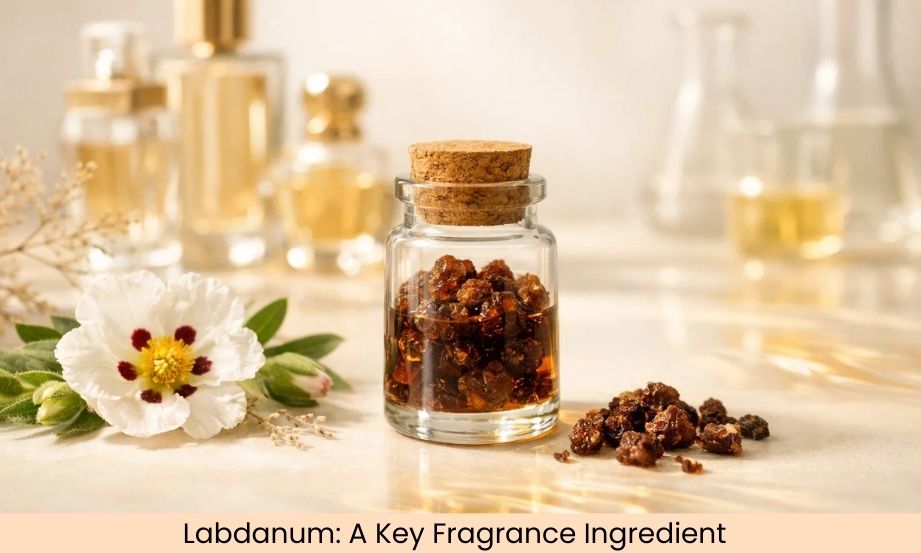
Labdanum resinoid is a solvent-extracted aromatic concentrate derived from the crude resin of Cistus ladanifer — the rock rose shrub native to the Mediterranean basin, cultivated primarily in Spain, Portugal, and Morocco. The extraction process involves harvesting the sticky oleoresin secreted naturally by the shrub's leaves and twigs, followed by solvent extraction (typically with hydrocarbon solvents), filtration, and solvent removal to yield a viscous, dark amber-to-brown resinoid with an extraordinarily complex olfactory profile: warm, balsamic, amber-leathery, slightly animalic, with nuances of tobacco, dried fruit, sun-warmed herbs, and a deep resinous sweetness.
In practical fragrance formulation terms, labdanum resinoid performs three critical and largely irreplaceable functions that make it foundational to modern perfumery:
- Fixative Function: Labdanum resinoid's complex mixture of labdane-type diterpenes, benzoic acid esters, and high-boiling aromatic compounds creates exceptional tenacity. It slows the evaporation rate of more volatile fragrance materials, extending the longevity of entire compositions.
- Structural Base Function: In chypre, oriental, and amber accord construction, labdanum provides the resinous structural mass — the 'architecture' — upon which other fragrance materials are layered. Without a well-built labdanum base, compositions lack the dimensional depth and warmth that define fine fragrance quality.
- Ambergris Substitute Function: With growing restrictions and ethical concerns around animal-derived fragrance materials, labdanum resinoid is widely used to replicate the animalic, skin-like warmth historically contributed by natural ambergris — making it commercially indispensable in contemporary formulation.
This trifecta of functionality explains why labdanum resinoid commands premium pricing and sustained demand across fragrance houses of all scales — from global corporations like Givaudan, Firmenich, Symrise, and IFF to boutique artisan perfumers and niche fragrance startups.
Our Other Product
Pure Ylang YlangKey Demand Drivers: Why Labdanum Resinoid Procurement Is Growing
The Niche and Artisan Perfumery Revolution
The single most powerful demand driver for labdanum resinoid in the current market cycle is the sustained global expansion of niche and artisan perfumery. Major fragrance industry analysts consistently identify niche perfumery as the fastest-growing segment within the broader fine fragrance category, with consumers actively seeking complex, naturally-derived compositions with authentic ingredient stories and olfactory depth that mass-market fragrances cannot replicate.
Labdanum resinoid is foundational to this niche perfumery movement. Its ability to create the warm, enveloping amber-balsamic base that defines luxury olfactory experiences makes it among the most sought-after materials in the ingredient portfolios of leading niche fragrance houses. Procurement teams at fragrance houses report increasing specification requests for labdanum resinoid in oriental, amber, chypre, and leather-focused compositions — exactly the fragrance families driving the most significant growth in niche perfumery globally.
Clean Beauty and Natural Ingredient Substitution
The global clean beauty movement is creating sustained structural demand growth for natural resinoid ingredients. As consumers and regulatory bodies in the EU, North America, and increasingly Asia scrutinize synthetic fragrance materials and question the safety credentials of certain aromatic chemicals, natural materials with long historical use and recognized safety profiles — including labdanum resinoid — are being specified more frequently by cosmetic and personal care brands rebuilding their fragrance programs around natural ingredient sourcing.
For procurement professionals, this represents a meaningful demand signal: natural fragrance ingredient sourcing is no longer an artisan niche but is increasingly a mainstream brand positioning requirement across skincare, personal care, home fragrance, and fine fragrance categories.
Restriction of Oakmoss and Synthetic Ambergris Alternatives
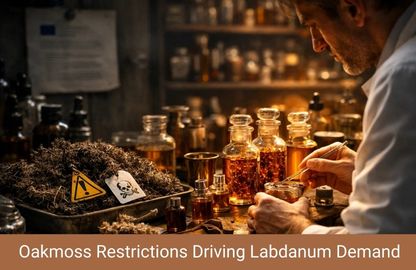
IFRA and EU regulatory restrictions on oakmoss (Evernia prunastri) — the traditional co-pillar of classic chypre compositions alongside labdanum — have been progressively tightened over the past two decades due to sensitization concerns. Far from reducing demand for labdanum, these restrictions have actually increased its commercial importance: with oakmoss severely usage-restricted, perfumers building chypre-inspired compositions now rely more heavily on labdanum resinoid to carry the balsamic-resinous structural weight that oakmoss once provided.
Asia Pacific Market Growth
The rapid development of fragrance culture across Asia — particularly in China, South Korea, and the emerging markets of Southeast Asia — is generating significant new demand for premium natural fragrance ingredients. Asian consumers' demonstrated preference for warm, resinous, amber-based fragrance families aligns directly with labdanum resinoid's olfactory profile, creating a structural demand tailwind that ingredient procurement teams at global fragrance houses and regional distributors must actively plan for.
| Demand Driver | Commercial Impact | Timeline |
|---|---|---|
| Niche & artisan perfumery growth | High — direct specification increase | Ongoing, accelerating |
| Clean beauty / natural ingredient shift | High — replacing synthetic alternatives | 2022–2030 |
| IFRA oakmoss restrictions | Medium-High — labdanum fills structural gap | Ongoing since 2000s |
| Asia Pacific fragrance market growth | High — new regional demand base | 2024–2032 |
| Luxury fragrance market expansion | Medium-High — premium ingredient pull | Ongoing |
| Ambergris ethical sourcing restrictions | Medium — labdanum as substitute | Ongoing |
Assessment: Based on published industry analysis and fragrance ingredient sourcing trends, 2024–2025.
Regional Market Analysis: Where Labdanum Resinoid Demand Is Concentrating
Europe: The Historic Anchor Market
Europe — led by France, Germany, the United Kingdom, and Italy — remains the world's most sophisticated and highest-volume market for premium natural fragrance ingredients including labdanum resinoid. The concentration of global fragrance houses in Grasse, Paris, and Switzerland ensures that European procurement teams represent the largest single block of professional demand for verified, high-quality labdanum resinoid. EU regulations and IFRA compliance standards drive stringent quality requirements, making supplier credibility, GC/MS documentation, and consistent batch quality critical procurement criteria in this market.
North America: The Premium Growth Market
North America accounts for the largest single regional share of global fragrance market revenue at 33.3% and represents a high-growth opportunity for premium natural ingredient suppliers. The US market's embrace of niche perfumery, natural personal care, and clean beauty positions labdanum resinoid as a high-demand ingredient across fragrance houses, independent perfumers, and natural cosmetic manufacturers. American procurement professionals increasingly prioritize supply chain transparency, ethical sourcing credentials, and multi-format product availability — attributes that well-positioned global suppliers must be prepared to demonstrate.
Asia Pacific: The Emerging Demand Frontier
The Asia Pacific region represents the most significant growth opportunity in the global labdanum resinoid market over the 2024–2032 forecast period. Rising middle-class consumer spending on premium fragrance products, the rapid development of local niche perfume brands, and the expansion of natural cosmetic manufacturing across China, South Korea, and India are all creating new and growing procurement demand for authentic labdanum resinoid. India, in particular, occupies a dual role — as both a growing domestic fragrance consumption market and an increasingly important global manufacturing and export hub for natural fragrance ingredients.
Middle East: The Heritage Fragrance Market
The Middle East represents a culturally significant and commercially substantial market for labdanum resinoid given the region's deeply rooted oud, amber, and balsamic fragrance traditions. Gulf consumers' strong preference for warm, resinous, long-lasting fragrance compositions creates natural alignment with labdanum resinoid's olfactory profile. Regional fragrance houses and luxury perfume brands across the UAE, Saudi Arabia, and Kuwait represent important procurement relationships for labdanum resinoid suppliers with the quality credentials and logistical capacity to service this demanding market reliably.
Read Our Article
Labdanum Resinoid: A Comprehensive GuideSupply Chain Landscape: Sourcing Challenges and Procurement Considerations
Raw Material Geography and Supply Concentration
Labdanum resinoid production is geographically concentrated around the Mediterranean basin, with Spain and Portugal supplying the majority of high-quality Cistus ladanifer gum used as the primary raw material. Morocco supplies additional volumes of Cistus-derived resin with a slightly different chemical profile. This geographic concentration creates inherent supply chain risk for procurement teams — seasonal harvest variability, regional climate conditions, political and logistical factors, and the labor-intensive nature of resin collection all contribute to pricing volatility and availability fluctuation that procurement professionals must actively manage.
Quality Variability and Adulteration Risk
Labdanum resinoid commands significant pricing premiums in global fragrance ingredient markets, creating economic incentive for adulteration and misrepresentation across the supply chain. Procurement teams sourcing labdanum resinoid must rigorously verify product authenticity through GC/MS analysis, optical rotation testing, refractive index measurement, and organoleptic evaluation. Supplier certificates of analysis must be requested and cross-referenced for every shipment. Working with manufacturers who perform in-house quality verification and maintain documented batch traceability is essential for procurement risk management.
 Call Us Now!
India's Strategic Role in Global Labdanum Resinoid Supply
India has emerged as a critically important node in the global labdanum resinoid supply chain — not as a raw material source (Cistus ladanifer does not grow commercially in India), but as a sophisticated processing, reconstitution, and export hub that transforms imported Mediterranean labdanum raw materials into finished resinoid products of consistent, internationally standardized quality. Indian fragrance ingredient manufacturers with deep technical processing expertise, rigorous quality control infrastructure, and well-established global logistics networks are uniquely positioned to serve international procurement needs with the consistency, scale, and competitive pricing that European and Mediterranean primary producers often struggle to match.
BMV Fragrances Pvt Ltd: India's Premier Labdanum Resinoid Manufacturer and Global Supplier
For fragrance house procurement teams, flavor and fragrance ingredient buyers, and natural ingredient distributors seeking a reliable, technically sophisticated, and globally capable labdanum resinoid supplier, BMV Fragrances Pvt Ltd stands in a category of its own among Indian manufacturers.
Company Overview
BMV Fragrances Pvt Ltd is India's leading manufacturer, exporter, and wholesale supplier of labdanum resinoid, supplying fragrance houses, cosmetic manufacturers, and natural ingredient distributors across the globe. With deep technical expertise in resinoid processing and a comprehensive product portfolio specifically engineered to meet the diverse formulation needs of the international fragrance industry, BMV Fragrances occupies a unique and strategically valuable position in the global labdanum resinoid supply landscape.
Quality Standards and Formulation Excellence
BMV Fragrances' labdanum resinoid products are manufactured to meet international fragrance ingredient quality standards and are documented with comprehensive certificates of analysis. The company's in-house quality control processes cover organoleptic evaluation, physical parameter verification, and chromatographic profiling — delivering the documentation transparency that procurement teams at regulated fragrance houses and certified natural brands require. All BMV Fragrances labdanum resinoid variants carry a verified shelf life of 24 months under recommended storage conditions (tightly sealed, cool, dry, away from light and heat).
Formulation Performance: Why Industry Professionals Choose BMV Fragrances
BMV Fragrances' labdanum resinoid products consistently deliver the technical performance attributes most valued by professional fragrance formulators: exceptional fixative strength anchoring volatile top notes across long wear periods; deep, authentic amber-balsamic character that provides structural warmth and dimensional depth to chypre, oriental, and amber compositions; seamless compatibility with patchouli, sandalwood, vetiver, benzoin, rose, jasmine, lavender, and citrus materials; and the characteristic animalic-leathery nuance that gives masculine, unisex, and oriental compositions their distinctive luxury signature.
Global Supply Capability
BMV Fragrances' established export infrastructure enables reliable supply to fragrance houses, ingredient distributors, and cosmetic manufacturers across Europe, North America, the Middle East, Asia Pacific, and beyond. For procurement professionals managing global supply chains, BMV Fragrances offers the combination of Indian manufacturing cost efficiency, technically sophisticated product quality, multi-variant product breadth, and export reliability that positions them as a preferred strategic sourcing partner for labdanum resinoid procurement.
Market Outlook: The Road to 2030 and Beyond
The market intelligence presented in this report points to a clear and positive trajectory for global labdanum resinoid demand through 2030 and into the following decade. The convergence of global fragrance market growth, niche perfumery expansion, natural ingredient substitution trends, and Asia Pacific market development creates a structural demand environment that rewards well-positioned, quality-focused labdanum resinoid suppliers with global reach and technical depth.
For procurement professionals, the strategic imperative is clear: build reliable, documented, multi-source supply relationships for labdanum resinoid now, before demand intensification creates the supply tightness and pricing volatility that reactive procurement strategies will struggle to manage. The suppliers best positioned to serve procurement needs across this growth cycle are those combining raw material quality, technical processing sophistication, product portfolio breadth, and proven global export capability — the combination that defines BMV Fragrances Pvt Ltd's unique value proposition in the global labdanum resinoid market.
Recent Posts
- Indian Oud Reconstitution vs. Natural Oud: Cost Effectiveness, Performance, and Quality Comparison for Bulk Buyers
- Floral Green Fragrance Bases: Formulating With Narcissus Absolute Alternatives in Modern Perfumery
- Reconstituted Oud Blending Guide: Dihydroambrettolide, Benzyl Acetone, and Ester Based Components for Professional Fragrance Formulation
- Geranium Oil Varieties Egyptian Reunion and Madagascar Geranium Compared
- Frankincense Serrata in Premium Incense Manufacturing
- Balsam Tolu vs Balsam Peru
- Vetiver Oil in Fresh Green and Woody Fragrances
Copyright @ 2026 | BMV Fragrances Private Limited | All Rights Reserved
Website Design & Digital Marketing by webmasterindia.
Website Updated On: